

A guide to Metacheck, an R package providing a module based tool for checking scientific manuscripts and data repositories for best practices using text search, R code, and optional LLM queries.
Scimeto - Automated Manuscript Integrity Checker
Upload your academic manuscript and get instant analysis of citations, references, statistics, retractions, and more. 21 plugins, 9 citation styles, free for researchers.
Introducing COSIG: The Collection of Open Science Integrity Guides
Investigating the integrity of published scientific papers is key to the scientific process, but the necessary knowledge is in short supply. We present COSIG, an open collection of meta-scientific guides enabling anyone to perform forensic peer review.
Crossref: The sustainable source of community-owned scholarly metadata
This paper describes the scholarly metadata collected and made available by Crossref, as well as its importance in the scholarly research ecosystem. Containing over 106 million records and expanding at an average rate of 11% a year, Crossref’s metadata has become one of the major sources of scholarly data for publishers, authors, librarians, funders, and researchers. The metadata set consists of 13 content types, including not only traditional types, such as journals and conference papers, but also data sets, reports, preprints, peer reviews, and grants. The metadata is not limited to basic publication metadata, but can also include abstracts and links to full text, funding and license information, citation links, and the information about corrections, updates, retractions, etc. This scale and breadth make Crossref a valuable source for research in scientometrics, including measuring the growth and impact of science and understanding new trends in scholarly communications. The metadata is available through a number of APIs, including REST API and OAI-PMH. In this paper, we describe the kind of metadata that Crossref provides and how it is collected and curated. We also look at Crossref’s role in the research ecosystem and trends in metadata curation over the years, including the evolution of its citation data provision. We summarize the research used in Crossref’s metadata and describe plans that will improve metadata quality and retrieval in the future.
GitHub - metaocaml/metaocaml-bibliography: MetaML and MetaOCaml bibliography
MetaML and MetaOCaml bibliography. Contribute to metaocaml/metaocaml-bibliography development by creating an account on GitHub.
RegCheck: A tool for structured comparisons between study registrations and papers
Across the social and medical sciences, researchers recognize that specifying planned research activities (i.e., 'registration') prior to the commencement of research has benefits for both the transparency and rigour of science. Despite this, evidence suggests that study registrations frequently go unexamined, minimizing their effectiveness. In a way this is no surprise: manually checking registrations against papers is labour- and time-intensive, requiring careful reading across formats and expertise across domains. The advent of AI unlocks new possibilities in facilitating this activity. We present RegCheck, a modular LLM-assisted tool designed to help researchers, reviewers, and editors from across scientific disciplines compare study registrations with their corresponding papers. Importantly, RegCheck keeps human expertise and judgement in the loop by (i) ensuring that users are the ones who determine which features should be compared, and (ii) presenting the most relevant text associated with each feature to the user, facilitating (rather than replacing) human discrepancy judgements. RegCheck also generates shareable reports with unique RegCheck IDs, enabling them to be easily shared and verified by other users. RegCheck is designed to be adaptable across scientific domains, as well as registration and publication formats. In this paper we provide an overview of the motivation, workflow, and design principles of RegCheck, and we discuss its potential as an extensible infrastructure for reproducible science with an example use case.

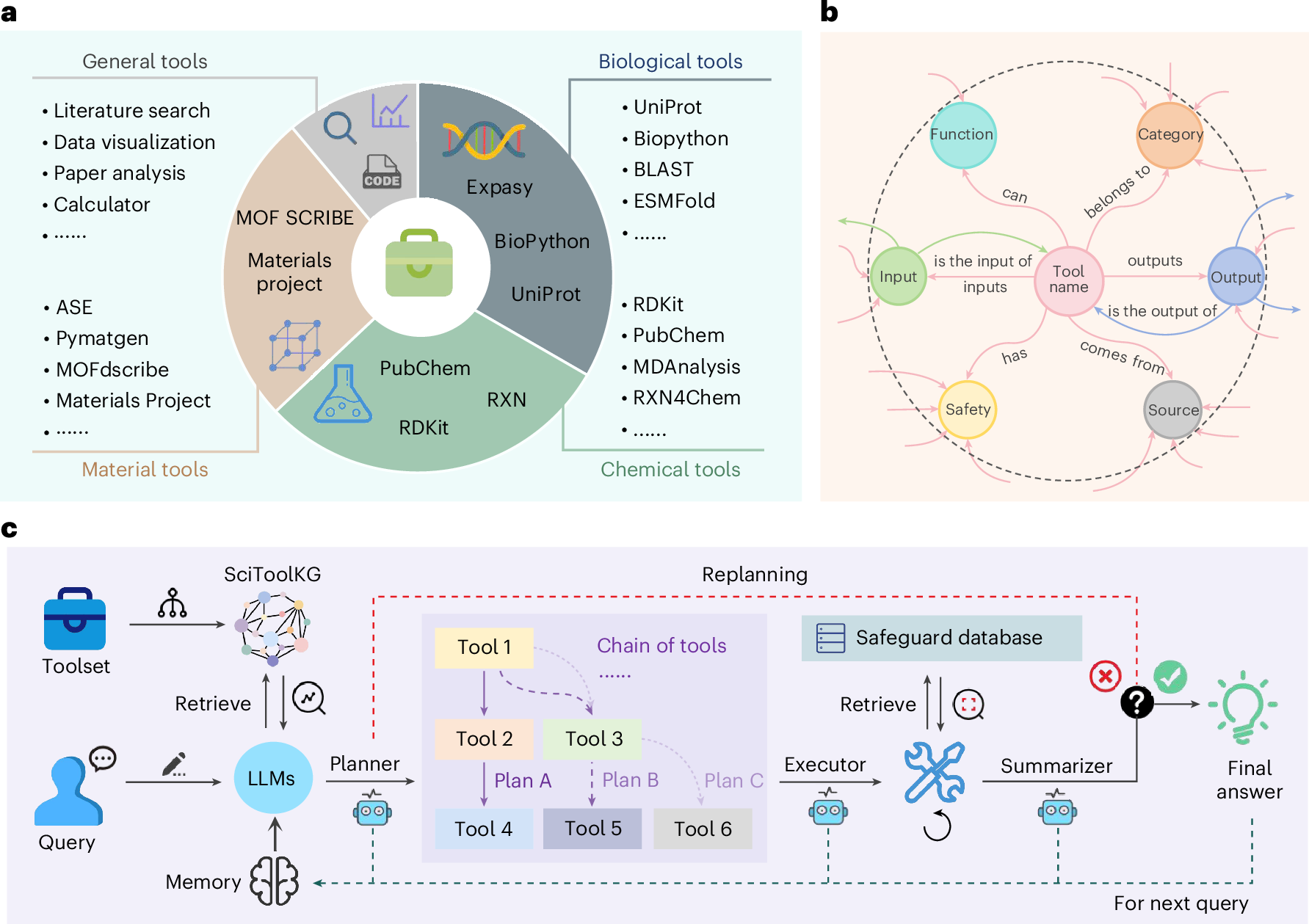
SciToolAgent: a knowledge-graph-driven scientific agent for multitool integration
Scientific research increasingly relies on specialized computational tools, yet effectively utilizing these tools requires substantial domain expertise. While large language models show promise in tool automation, they struggle to seamlessly integrate and orchestrate multiple tools for complex scientific workflows. Here we present SciToolAgent, a large language model-powered agent that automates hundreds of scientific tools across biology, chemistry and materials science. At its core, SciToolAgent leverages a scientific tool knowledge graph that enables intelligent tool selection and execution through graph-based retrieval-augmented generation. The agent also incorporates a comprehensive safety-checking module to ensure responsible and ethical tool usage. Extensive evaluations on a curated benchmark demonstrate that SciToolAgent outperforms existing approaches. Case studies in protein engineering, chemical reactivity prediction, chemical synthesis and metal–organic framework screening further demonstrate SciToolAgent’s capability to automate complex scientific workflows, making advanced research tools accessible to both experts and nonexperts.
Research Guides: List of APIs for Scholarly Resources: Scholarly Metadata API
A list of commonly used scholarly resources API
MetaOCaml
Introduction to BER MetaOCaml: how to use, how to install, the current status and the future development
Introducing the Open-Source Codex Security CLI
Codex Security helps security and engineering teams find, confirm, and fix vulnerabilities. Use its command-line interface (CLI) to scan repositories you own or have permission to assess, review findings over time, and check changes before they land. Quickstart Guide for an interactive scan Cloud set-up for connected GitHub repositories Link to the public repo: Codex Security This is an early release, and we’re listening to your feedback as we continue improving it. The Codex Security CLI ...

GitHub - denisidoro/navi: An interactive cheatsheet tool for the command-line
An interactive cheatsheet tool for the command-line - denisidoro/navi
AI agents are checking the scientific literature — and spotting decades-old errors
The technology is proving adept at finding faults in decades-old papers and reference databases.

OG Check - Free Open Graph Meta Tags Checker & Validator Tool
Free online Open Graph checker and validator. Analyze, preview and optimize your website's meta tags for better social media sharing on Facebook, Twitter, LinkedIn. Generate OG code instantly.
Scientific Content Management System | Curvenote
Create, manage, and publish interactive research with connected workflows, modular content, and built-in provenance. Book a demo
Today we launch the first stable release of RegCheck: v1.0.0. RegCheck makes it easier and quicker to compare study registrations to published papers for consistency - something we know is important in principle, but rarely done in practice. A 🧵 on what's new: regcheck.app

RegCheck
regcheck.appDid you know you can search for R packages by what they do, as opposed to just their names? Look! 👉🏼 rwarehouse.netlify.app @kylieainslie.bsky.social made The Warehouse for just this purpose. Send it to a new R programmer today ❤️ because it's the resource we all wish we'd had at some point #rstats

