The Web is critical not merely to the digital revolution but to our continued prosperity—and even our liberty. Like democracy itself, it needs defending
Society Desperately Needs An Alternative Web
In a world of rampant technology, and what will be the future of our planet, it is inflicting harms in the very fabric of society who depends on it. Is it too late to steer its path towards an internet intended to free information, preserve our privacy and be accountable to the needs of humanity?

The Internet is a Series of Webs
The fate of the open web is inextricable from the other ways our world is in crisis. What can we do about it?

My journey to the heart of the forgotten internet
Slowly but surely, huge swaths of the internet are vanishing. But the artefacts of the early web are still out there, and they have lessons for the future.

Opinion | How to Save the Web (Published 2018)
Governments, businesses and users around the world must commit to a set of fundamental principles for the web.

Welcome to the Post-Naive Internet Era
The grand idealism of the free and open internet might be over for now, but in its place falls a more practical mindset. Just like Silicon Valley’s entrepreneurs are entering their “Hard Tech” era, the people building web alternatives are also entering their Post-Naive Era. Here are the names to know.

Sustainable Web Manifesto
“If the Internet was a country, it would be the 13th largest polluter”
We’re in the middle of a perfect storm for rollback of the “open web” and burgeoning online surveillance
Looking at fallout of the KOSA hearings today — and subsequent commentary — I remain optimistic for the development of social technology & communication but I’m beginning to think the ope…

The Paradox of Open
Numerous organisations and initiatives have been launched with a belief in openness and free knowledge. Their proponents placed their bets on the combined power of networked information services and new governance models for the production and sharing of content and data. We – as members of this broad movement – were among those who believed it possible to leverage this combination of power and opportunity to build a more democratic society, unleashing the power of the internet to create universal access to knowledge and culture. For us, such openness meant not only freedom, but also presented a path to justice and equality.
Framing to Grow the Open Social Web and Serve Democratic Freedoms – Position Paper / Richard Reisman
Framing to Grow the Open Social Web and Serve Democratic Freedoms – Position Paper Richard Reisman (Discussion Draft 2/13/26) For FediForum Un-Workshop March 2, 2026 Growing the usage and functionality of the social web to meet the needs of humanity requires a broadened framing of the task and ...

The Missing Building Blocks of the Web
At a time when millions are losing trust in the the web’s biggest sites, it’s worth revisiting the idea that the web was supposed to be…

The Web We Have to Save
The rich, diverse, free web that I loved — and spent years in an Iranian jail for — is dying. Why is nobody stopping it?
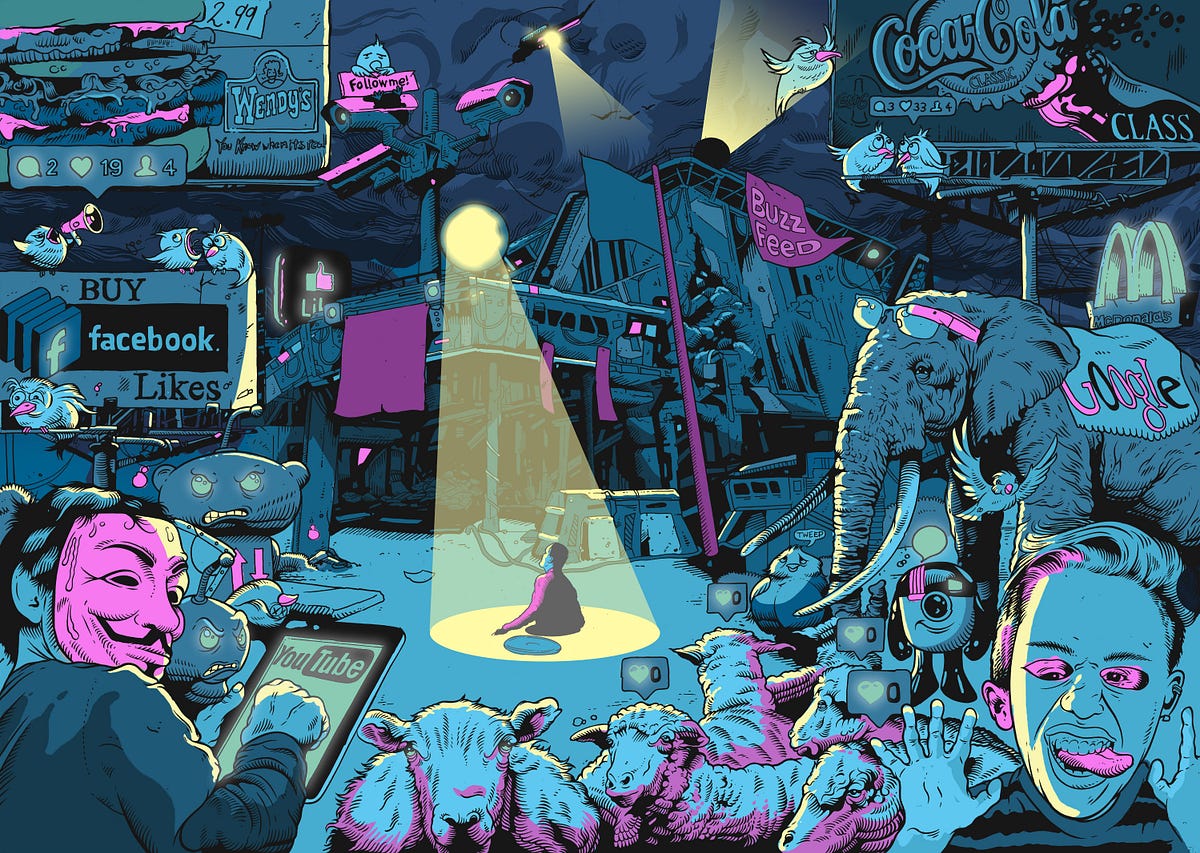
FR#166 – No Change
Many people in Europe see the open social web as a path to digital sovereignty. This week demonstrated a problem: the assumption that European governments actually want to be sovereign.

The web was always about redistribution of power. Let's bring that back.
It's time to rekindle the movement.

Internet for the People: The Fight for Our Digital Future
"For all the informational convenience the internet offers, it is deeply flawed. How can it be improved? Writer Ben Tarnoff proposes one possibility in this intriguing book, which urges the development of 'a public lane on the information superhighway.' It's worth checking out for yourself." – Seth MacFarlane Why is the internet so broken, and what could ever possibly fix it? In Internet for the People, leading tech writer Ben Tarnoff offers an answer. The internet is broken, he argues, because it is owned by private firms and run for profit. Google annihilates your privacy and Facebook amplifies right-wing propaganda because it is profitable to do so. But the internet wasn't always like this—it had to be remade for the purposes of profit maximization, through a years-long process of privatization that turned a small research network into a powerhouse of global capitalism. Tarnoff tells the story of the privatization that made the modern internet, and which set in motion the crises that consume it today. The solution to those crises is straightforward: deprivatize the internet. Deprivatization aims at creating an internet where people, and not profit, rule. It calls for shrinking the space of the market and diminishing the power of the profit motive. It calls for abolishing the walled gardens of Google, Facebook, and the other giants that dominate our digital lives and developing publicly and cooperatively owned alternatives that encode real democratic control. To build a better internet, we need to change how it is owned and organized. Not with an eye towards making markets work better, but towards making them less dominant. Not in order to create a more competitive or more rule-bound version of privatization, but to overturn it. Otherwise, a small number of executives and investors will continue to make choices on everyone’s behalf, and these choices will remain tightly bound by the demands of the market. It's time to demand an internet by, and for, the people now.
Internet for the People: The Fight for Our Digital Future
"For all the informational convenience the internet offers, it is deeply flawed. How can it be improved? Writer Ben Tarnoff proposes one possibility in this intriguing book, which urges the development of 'a public lane on the information superhighway.' It's worth checking out for yourself." – Seth MacFarlane Why is the internet so broken, and what could ever possibly fix it? In Internet for the People, leading tech writer Ben Tarnoff offers an answer. The internet is broken, he argues, because it is owned by private firms and run for profit. Google annihilates your privacy and Facebook amplifies right-wing propaganda because it is profitable to do so. But the internet wasn't always like this—it had to be remade for the purposes of profit maximization, through a years-long process of privatization that turned a small research network into a powerhouse of global capitalism. Tarnoff tells the story of the privatization that made the modern internet, and which set in motion the crises that consume it today. The solution to those crises is straightforward: deprivatize the internet. Deprivatization aims at creating an internet where people, and not profit, rule. It calls for shrinking the space of the market and diminishing the power of the profit motive. It calls for abolishing the walled gardens of Google, Facebook, and the other giants that dominate our digital lives and developing publicly and cooperatively owned alternatives that encode real democratic control. To build a better internet, we need to change how it is owned and organized. Not with an eye towards making markets work better, but towards making them less dominant. Not in order to create a more competitive or more rule-bound version of privatization, but to overturn it. Otherwise, a small number of executives and investors will continue to make choices on everyone’s behalf, and these choices will remain tightly bound by the demands of the market. It's time to demand an internet by, and for, the people now.
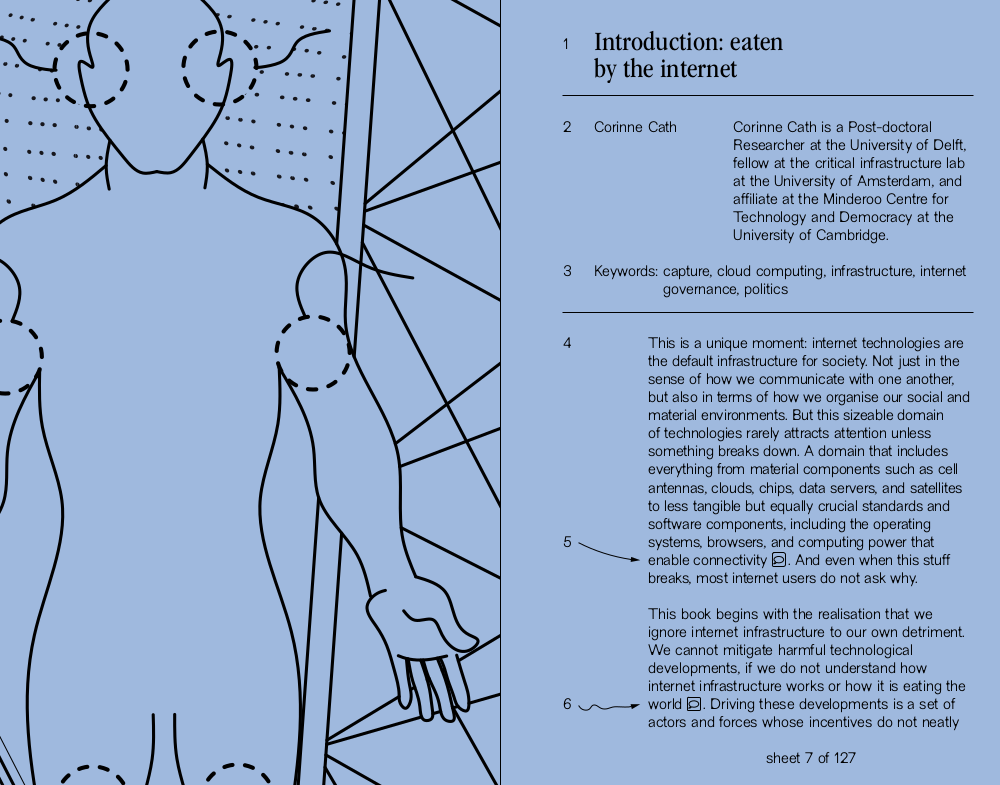
Eaten by the Internet
This book makes internet infrastructure visible as a force of political power, which is transforming the social world, from the bottom up—through fifteen chapters contributed by a global set of researchers, activists, and techies. We are living a unique moment: internet technologies are the default infrastructure for society, not just how we communicate but also how we organise our social life, politics, and economy, all the way down to our material environments, like cities. Our world is eaten by the internet. This means that those who control the internet control the bounds of public speech, economic production, social cohesion, and politics, making its infrastructure a core political terrain in the networked age. The book’s chapters cover a wide set of topics, spanning from the global politics of content moderation by internet infrastructure to the colonialism inherent in the race to plug the moon, from the harms wrought by blockchain companies in rural America to the particularities of online censorship across Asia. The chapters take on thorny topics, discussing power consolidation in the advertisement and cloud industry, the role of internet infrastructure in the war in Ukraine, and tech’s environmental impact—amongst others. In doing so, this book roots contemporary technology debates in the politics of internet infrastructure and urges us to ask how can we ensure our infrastructures sustain us, rather than consume us?