Earth’s seas are absorbing excess heat 40 percent faster than previous estimates
Global Warming Is Rapidly Accelerating, New Paper Finds
A new study found the first statistically significant evidence that global warming is ramping up at a horrifying rate.

A recent doubling of global warming rate signals a 1.5 °C breach by 2028
Timely and accurate projections of when global warming will exceed the Paris Agreement’s 1.5 °C threshold are essential for effective climate policy. Existing estimates place this exceedance in the early 2030 s but carry substantial uncertainty. Here we analyze the latest observational temperature records through 2025 and identify a statistically significant doubling of the global warming rate during 2011–2025 (0.40 °C per decade) compared to 1971–2025 (0.20 °C per decade). Extrapolating this accelerated rate projects a crossing of the 1.5 °C threshold by 2028, nearly a decade earlier than previous estimates. Regional analyses attribute this acceleration primarily to intensified warming over East Asia–the North Pacific, mid-latitude Eurasia, and the South Atlantic–Antarctic regions. The ensemble mean of 26 climate models fails to capture the observed doubling of the warming rate, simulating a rate of only 0.29 °C per decade. These findings suggest a narrower window remains to limit warming to 1.5 °C, underscoring the urgency for rapid and substantial reductions in greenhouse gas emissions.
It’s 90 degrees in the Arctic right now
The Arctic is heating faster than the rest of the planet. New data illustrate how dire that is

World’s seas have hit hottest temperature on record for July, say scientists
Average sea surface temperature outside polar regions was highest on record for July, beating previous high in 2023

Future warming events will outdo the extreme heat waves of the recent past, new study finds
The extreme heat waves we have seen over the last few years may only serve as a preview of what is to come as a result of climate change. A new study led by researcher Philipp Aglas-Leitner from Freie ...

Climate change
Present-day climate change includes both global warming—the ongoing increase in global average temperature—and its wider effects on Earth's climate system. Climate change in a broader sense also includes previous long-term changes to Earth's climate. The modern-day rise in global temperatures is driven by human activities, especially fossil fuel burning since the Industrial Revolution. Fossil fuel use, deforestation, and some agricultural and industrial practices release greenhouse gases. These gases absorb some of the heat that the Earth radiates after it warms from sunlight, warming the lower atmosphere. Earth's atmosphere now has roughly 50% more carbon dioxide, the main gas driving global warming, than it did at the end of the pre-industrial era, reaching levels not seen for millions of years.

What's Really Warming the World?
What's Really Warming the World? Climate deniers blame natural factors; NASA data proves otherwise

Climate Models Are Running Red Hot, and Scientists Don’t Know Why
The simulators used to forecast warming have suddenly started giving us less time.

This El Niño is set to be the largest on record by a ‘mind-blowing margin’
Forecasters predict that the monster climate pattern will combine with global warming to push global temperatures in 2027 to new heights.

One billion people will live in insufferable heat within 50 years – study
Human cost of climate crisis will hit harder and sooner than previously believed, research reveals
Majority of US voters link extreme weather to climate crisis, study finds
Top Democrat says findings show public ‘way ahead of the politicians’ as Trump dismisses global heating as ‘hoax’

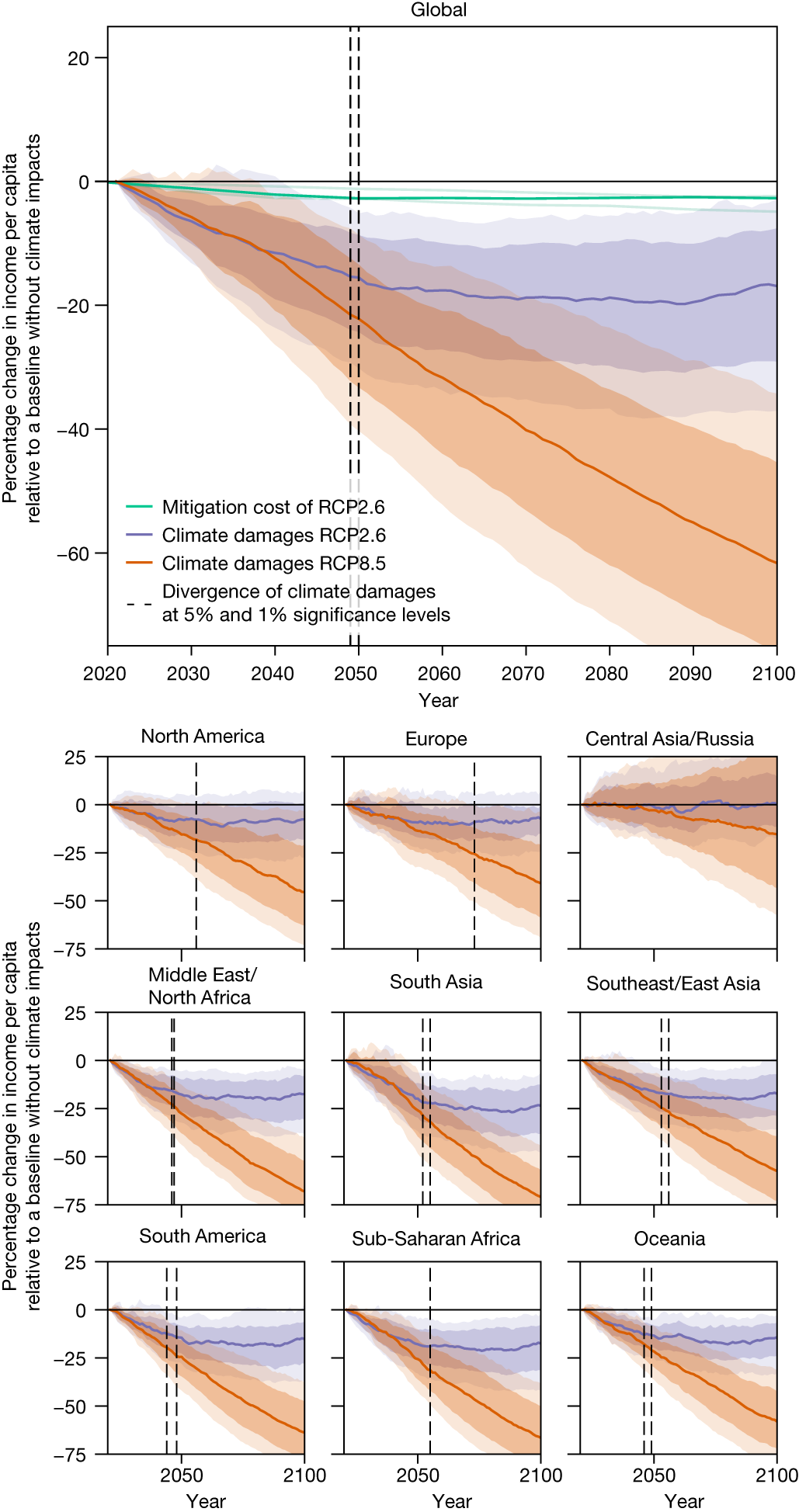
RETRACTED ARTICLE: The economic commitment of climate change
Global projections of macroeconomic climate-change damages typically consider impacts from average annual and national temperatures over long time horizons1–6. Here we use recent empirical findings from more than 1,600 regions worldwide over the past 40 years to project sub-national damages from temperature and precipitation, including daily variability and extremes7,8. Using an empirical approach that provides a robust lower bound on the persistence of impacts on economic growth, we find that the world economy is committed to an income reduction of 19% within the next 26 years independent of future emission choices (relative to a baseline without climate impacts, likely range of 11–29% accounting for physical climate and empirical uncertainty). These damages already outweigh the mitigation costs required to limit global warming to 2 °C by sixfold over this near-term time frame and thereafter diverge strongly dependent on emission choices. Committed damages arise predominantly through changes in average temperature, but accounting for further climatic components raises estimates by approximately 50% and leads to stronger regional heterogeneity. Committed losses are projected for all regions except those at very high latitudes, at which reductions in temperature variability bring benefits. The largest losses are committed at lower latitudes in regions with lower cumulative historical emissions and lower present-day income.
Climate change target of 2C is ‘dead’, says renowned climate scientist
Prof James Hansen says pace of global heating has been significantly underestimated, though other scientists disagree
Did the hot summer make more people worry about climate change? Here’s what the latest indications show
Around 65% of the British public are now concerned about climate change.

Wildlife destruction 'not a slippery slope but a series of cliff edges'
New study finds ocean ecosystems likely to collapse in 2020s and land species in 2040s unless global warming stemmed

'Hotter and hotter and hotter' - Europe's new climate in seven charts
Temperature records were smashed in June - and scientists warn this is a sign of things to come.