

<p>The mortality rate in the intensive care unit (ICU) is a key metric of hospital clinical quality. To enhance hospital performance, many methods have been proposed for the stratification of patients’ different risk categories, such as severity scoring systems and machine learning models. However, these methods make capturing time sequence information difficult, posing challenges to the continuous assessment of a patient’s severity during their hospital stay. Therefore, we built a predictive model that can make predictions throughout the patient’s stay and obtain the patient’s risk of death in real time. Our proposed model performed much better than other machine learning methods, including logistic regression, random forest, and XGBoost, in a full set of performance evaluation processes. Thus, the proposed model can support physicians’ decisions by allowing them to pay more attention to high-risk patients and anticipate potential complications to reduce ICU mortality.</p>
Distributionally Robust Data Valuation
Data valuation quantifies the contribution of each data point to the performance of a machine learning model. Existing works typically define the value of data by its improvement of the validation performance of the trained model. However, this approach can be impractical to apply in collaborative machine learning and data marketplace since it is difficult for the parties/buyers to agree on a common validation dataset or determine the exact validation distribution a priori. To address this, we propose a distributionally robust data valuation approach to perform data valuation without known/fixed validation distributions. Our approach defines the value of data by its improvement of the distributionally robust generalization error (DRGE), thus providing a worst-case performance guarantee without a known/fixed validation distribution. However, since computing DRGE directly is infeasible, we propose using model deviation as a proxy for the marginal improvement of DRGE (for kernel regression and neural networks) to compute data values. Furthermore, we identify a notion of uniqueness where low uniqueness characterizes low-value data. We empirically demonstrate that our approach outperforms existing data valuation approaches in data selection and data removal tasks on real-world datasets (e.g., housing price prediction, diabetes hospitalization prediction).
Google's AI ranks #1 for predicting flu hospitalizations.
Google’s science AI model was the best at forecasting flu-related hospital admissions, the Centers for Disease Control announced.

OpenDataVal: a Unified Benchmark for Data Valuation
Assessing the quality and impact of individual data points is critical for improving model performance and mitigating undesirable biases within the training dataset. Several data valuation algorithms have been proposed to quantify data quality, however, there lacks a systemic and standardized benchmarking system for data valuation. In this paper, we introduce OpenDataVal, an easy-to-use and unified benchmark framework that empowers researchers and practitioners to apply and compare various data valuation algorithms. OpenDataVal provides an integrated environment that includes (i) a diverse collection of image, natural language, and tabular datasets, (ii) implementations of eleven different state-of-the-art data valuation algorithms, and (iii) a prediction model API that can import any models in scikit-learn. Furthermore, we propose four downstream machine learning tasks for evaluating the quality of data values. We perform benchmarking analysis using OpenDataVal, quantifying and comparing the efficacy of state-of-the-art data valuation approaches. We find that no single algorithm performs uniformly best across all tasks, and an appropriate algorithm should be employed for a user's downstream task. OpenDataVal is publicly available at https://opendataval.github.io with comprehensive documentation. Furthermore, we provide a leaderboard where researchers can evaluate the effectiveness of their own data valuation algorithms.
A Life-Saving Checklist
If something so simple can transform intensive care, what else can it do?

Data Shapley: Equitable Valuation of Data for Machine Learning
As data becomes the fuel driving technological and economic growth, a fundamental challenge is how to quantify the value of data in algorithmic predictions and decisions. For example, in healthcare and consumer markets, it has been suggested that individuals should be compensated for the data that they generate, but it is not clear what is an equitable valuation for individual data. In this work, we develop a principled framework to address data valuation in the context of supervised machine learning. Given a learning algorithm trained on $n$ data points to produce a predictor, we propose data Shapley as a metric to quantify the value of each training datum to the predictor performance. Data Shapley uniquely satisfies several natural properties of equitable data valuation. We develop Monte Carlo and gradient-based methods to efficiently estimate data Shapley values in practical settings where complex learning algorithms, including neural networks, are trained on large datasets. In addition to being equitable, extensive experiments across biomedical, image and synthetic data demonstrate that data Shapley has several other benefits: 1) it is more powerful than the popular leave-one-out or leverage score in providing insight on what data is more valuable for a given learning task; 2) low Shapley value data effectively capture outliers and corruptions; 3) high Shapley value data inform what type of new data to acquire to improve the predictor.
General-purpose large language models outperform specialized clinical AI tools on medical benchmarks
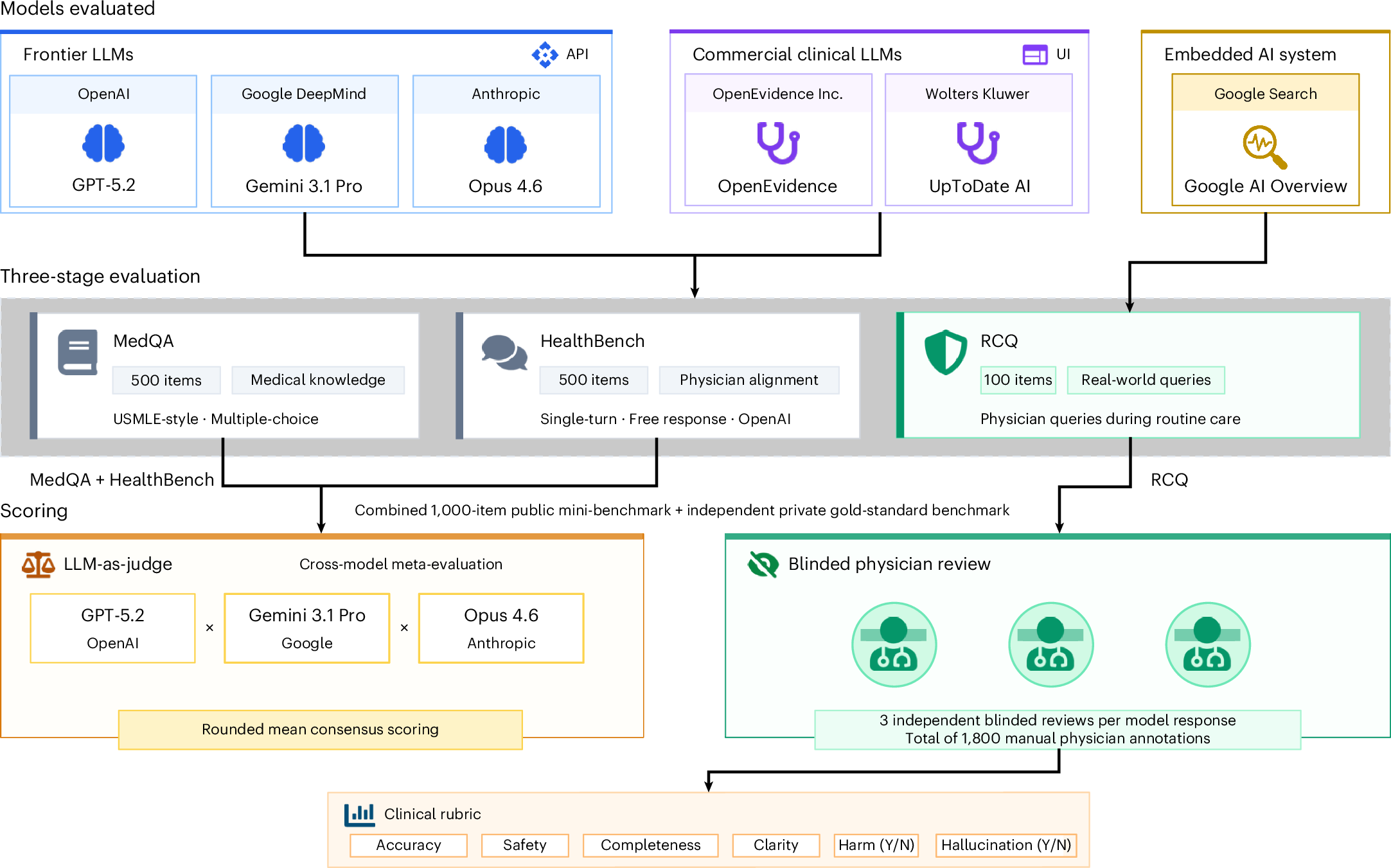
Specialized clinical artificial intelligence (AI) tools are entering medical practice despite scarce independent evaluation. We quantitatively evaluate two clinical AI tools, OpenEvidence and UpToDate Expert AI, built on large language models (LLMs) against three frontier LLMs: GPT-5.2, Gemini 3.1 Pro and Claude Opus 4.6. Our evaluation has three stages: (1) 500 MedQA questions testing medical knowledge, (2) 500 HealthBench items measuring alignment with clinicians and (3) the real clinical queries (RCQ) benchmark, built from 100 de-identified queries from physicians to a general-purpose language model in a live clinical environment. For the RCQ benchmark, 12 US clinicians performed randomized, blinded review of model outputs, producing 1,800 model–question annotations. Frontier LLMs outperformed clinical AI tools in all three evaluations. Clinical AI tools performed comparably to auto-enabled Google Search AI Overview on the RCQ. These findings highlight the need for independent, real-world evaluation of AI tools before they enter clinical settings.
GAN-Based Data Augmentation for Prediction Improvement Using Gene Expression Data in Cancer
Within the area of bioinformatics, Deep Learning (DL) models have shown exceptional results in applications in which histological images, scans and tomographies are used. However, when gene expression data is under analysis, the performance is often limited, further hampered by the complexity of these models that require several instances, in the order of thousands, to provide good results. Due to the difficulty and the costs involved in the collection of medical data, the application of Data Augmentation (DA) techniques to alleviate the lack of samples is a topic of great relevance. State-of-the-art models based on Conditional Generative Adversarial Networks (CGAN) and some introduced modifications are used in this work to investigate the effect of DA for prediction of the vital status of patients from RNA-Seq gene expression data. Experimental results on several real-world data sets demonstrate the effectiveness and efficiency of the proposed models. The application of DA methods significantly increase prediction accuracy, leading by 12% with respect to benchmark data sets and 3.15% with respect to data processed with feature selection. Results based on CGAN models outperform in most cases, alternative methods like the SMOTE or noise injection techniques.

Estimating Training Data Influence by Tracing Gradient Descent
We introduce a method called TracIn that computes the influence of a training example on a prediction made by the model. The idea is to trace how the loss on the test point changes during the training process whenever the training example of interest was utilized. We provide a scalable implementation of TracIn via: (a) a first-order gradient approximation to the exact computation, (b) saved checkpoints of standard training procedures, and (c) cherry-picking layers of a deep neural network. In contrast with previously proposed methods, TracIn is simple to implement; all it needs is the ability to work with gradients, checkpoints, and loss functions. The method is general. It applies to any machine learning model trained using stochastic gradient descent or a variant of it, agnostic of architecture, domain and task. We expect the method to be widely useful within processes that study and improve training data.

Deep Learning on a Data Diet: Finding Important Examples Early in Training
Recent success in deep learning has partially been driven by training increasingly overparametrized networks on ever larger datasets. It is therefore natural to ask: how much of the data is superfluous, which examples are important for generalization, and how do we find them? In this work, we make the striking observation that, in standard vision datasets, simple scores averaged over several weight initializations can be used to identify important examples very early in training. We propose two such scores—the Gradient Normed (GraNd) and the Error L2-Norm (EL2N) scores—and demonstrate their efficacy on a range of architectures and datasets by pruning significant fractions of training data without sacrificing test accuracy. In fact, using EL2N scores calculated a few epochs into training, we can prune half of the CIFAR10 training set while slightly improving test accuracy. Furthermore, for a given dataset, EL2N scores from one architecture or hyperparameter configuration generalize to other configurations. Compared to recent work that prunes data by discarding examples that are rarely forgotten over the course of training, our scores use only local information early in training. We also use our scores to detect noisy examples and study training dynamics through the lens of important examples—we investigate how the data distribution shapes the loss surface and identify subspaces of the model’s data representation that are relatively stable over training.
DAVINZ: Data Valuation using Deep Neural Networks at Initialization
Recent years have witnessed a surge of interest in developing trustworthy methods to evaluate the value of data in many real-world applications (e.g., collaborative machine learning, data marketplaces). Existing data valuation methods typically valuate data using the generalization performance of converged machine learning models after their long-term model training, hence making data valuation on large complex deep neural networks (DNNs) unaffordable. To this end, we theoretically derive a domain-aware generalization bound to estimate the generalization performance of DNNs without model training. We then exploit this theoretically derived generalization bound to develop a novel training-free data valuation method named data valuation at initialization (DAVINZ) on DNNs, which consistently achieves remarkable effectiveness and efficiency in practice. Moreover, our training-free DAVINZ, surprisingly, can even theoretically and empirically enjoy the desirable properties that training-based data valuation methods usually attain, thus making it more trustworthy in practice.
Data Valuation Without Training of a Model
Many recent works on understanding deep learning try to quantify how much individual data instances influence the optimization and generalization of a model. Such attempts reveal characteristics and importance of individual instances, which may provide useful information in diagnosing and improving deep learning. However, most of the existing works on data valuation require actual training of a model, which often demands high-computational cost. In this paper, we provide a training-free data valuation score, called complexity-gap score, which is a data-centric score to quantify the influence of individual instances in generalization of two-layer overparameterized neural networks. The proposed score can quantify irregularity of the instances and measure how much each data instance contributes in the total movement of the network parameters during training. We theoretically analyze and empirically demonstrate the effectiveness of the complexity-gap score in finding `irregular or mislabeled' data instances, and also provide applications of the score in analyzing datasets and diagnosing training dynamics. Our code is publicly available at https://github.com/JJchy/CG_score.
Learning to Reweight Examples for Robust Deep Learning
Deep neural networks have been shown to be very powerful modeling tools for many supervised learning tasks involving complex input patterns. However, they can also easily overfit to training set biases and label noises. In addition to various regularizers, example reweighting algorithms are popular solutions to these problems, but they require careful tuning of additional hyperparameters, such as example mining schedules and regularization hyperparameters. In contrast to past reweighting methods, which typically consist of functions of the cost value of each example, in this work we propose a novel meta-learning algorithm that learns to assign weights to training examples based on their gradient directions. To determine the example weights, our method performs a meta gradient descent step on the current mini-batch example weights (which are initialized from zero) to minimize the loss on a clean unbiased validation set. Our proposed method can be easily implemented on any type of deep network, does not require any additional hyperparameter tuning, and achieves impressive performance on class imbalance and corrupted label problems where only a small amount of clean validation data is available.
Data Minimization at Inference Time
In high-stakes domains such as legal, banking, hiring, and healthcare, learning models frequently rely on sensitive user information for inference, necessitating the complete set of features. This not only poses significant privacy risks for individuals but also demands substantial human effort from organizations to verify information accuracy. This study asks whether it is necessary to use all input features for accurate predictions at inference time. The paper demonstrates that, in a personalized setting, individuals may only need to disclose a small subset of features without compromising decision-making accuracy. The paper also provides an efficient sequential algorithm to determine the appropriate attributes for each individual to provide. Evaluations across various learning tasks show that individuals can potentially report as little as 10\% of their information while maintaining the same accuracy level as a model that employs the full set of user information.
Machine Unlearning
Once users have shared their data online, it is generally difficult for them to revoke access and ask for the data to be deleted. Machine learning (ML) exacerbates this problem because any model trained with said data may have memorized it, putting users at risk of a successful privacy attack exposing their information. Yet, having models unlearn is notoriously difficult. We introduce SISA training, a framework that expedites the unlearning process by strategically limiting the influence of a data point in the training procedure. While our framework is applicable to any learning algorithm, it is designed to achieve the largest improvements for stateful algorithms like stochastic gradient descent for deep neural networks. SISA training reduces the computational overhead associated with unlearning, even in the worst-case setting where unlearning requests are made uniformly across the training set. In some cases, the service provider may have a prior on the distribution of unlearning requests that will be issued by users. We may take this prior into account to partition and order data accordingly, and further decrease overhead from unlearning. Our evaluation spans several datasets from different domains, with corresponding motivations for unlearning. Under no distributional assumptions, for simple learning tasks, we observe that SISA training improves time to unlearn points from the Purchase dataset by 4.63x, and 2.45x for the SVHN dataset, over retraining from scratch. SISA training also provides a speed-up of 1.36x in retraining for complex learning tasks such as ImageNet classification; aided by transfer learning, this results in a small degradation in accuracy. Our work contributes to practical data governance in machine unlearning.
Benchmarking DeepSeek R1 Models using Lumigator: A Practical Evaluation for Zero-Shot Clinical Summarization
New state-of-the-art models emerge every few weeks, making it hard to keep up, especially when testing and integrating them. In reality, many available models may already meet our needs. The key question isn’t “Which model is the best?” but rather, “What’s the smallest model that gets the job done?”

TRAK: Attributing Model Behavior at Scale
The goal of data attribution is to trace model predictions back to training data. Despite a long line of work towards this goal, existing approaches to data attribution tend to force users to choose between computational tractability and efficacy. That is, computationally tractable methods can struggle with accurately attributing model predictions in non-convex settings (e.g., in the context of deep neural networks), while methods that are effective in such regimes require training thousands of models, which makes them impractical for large models or datasets. In this work, we introduce TRAK (Tracing with the Randomly-projected After Kernel), a data attribution method that is both effective and computationally tractable for large-scale, differentiable models. In particular, by leveraging only a handful of trained models, TRAK can match the performance of attribution methods that require training thousands of models. We demonstrate the utility of TRAK across various modalities and scales: image classifiers trained on ImageNet, vision-language models (CLIP), and language models (BERT and mT5). We provide code for using TRAK (and reproducing our work) at https://github.com/MadryLab/trak .