

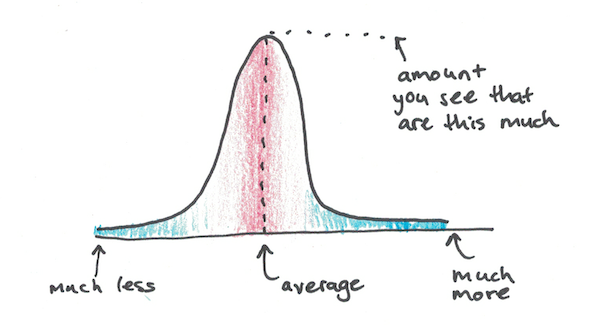
Some ideas are so powerful once you know them, you start to see them everywhere. Normal distributions are one of these ideas. Let's understand it!
Mental Models: The Best Way to Make Intelligent Decisions (~100 Models Explained)
The smartest people in the world use mental models to make intelligent decisions, avoid stupidity, and increase productivity. Let's take a look at how ...
Bayesian Thinking in Everyday Life
More than 200 years ago, Thomas Bayes came up with a brilliant idea that has helped shape the world today, called Bayes Theorem. This…

Noise in Cognition: Bug or Feature?
Noise in behavior is often considered a nuisance: Although the mind aims for the best possible action, it is let down by unreliability in the sensory and response systems. Researchers often represent noise as additive, Gaussian, and independent. Yet a careful look at behavioral noise reveals a rich structure that defies easy explanation. First, in both perceptual and preferential judgments sensory and response noise may potentially play only minor roles, with most noise arising in the cognitive computations. Second, the functional form of the noise is both non-Gaussian and nonindependent, with the distribution of noise being better characterized as heavy-tailed and as having substantial long-range autocorrelations. It is possible that this structure results from brains that are, for some reason, bedeviled by a fundamental design flaw, albeit one with intriguingly distinctive characteristics. Alternatively, noise might not be a bug but a feature. Specifically, we propose that the brain approximates probabilistic inference with a local sampling algorithm, one using randomness to drive its exploration of alternative hypotheses. Reframing cognition in this way explains the rich structure of noise and leads to the surprising conclusion that noise is not a symptom of cognitive malfunction but plays a central role in underpinning human intelligence.

The shape of a knowledge worker
In a recent post, I threw around the term 'cognitive exponent' a bunch. Today I'd like to talk about a thing that might help us frame our investigation of what puts someone on the right side of that exponential graph.
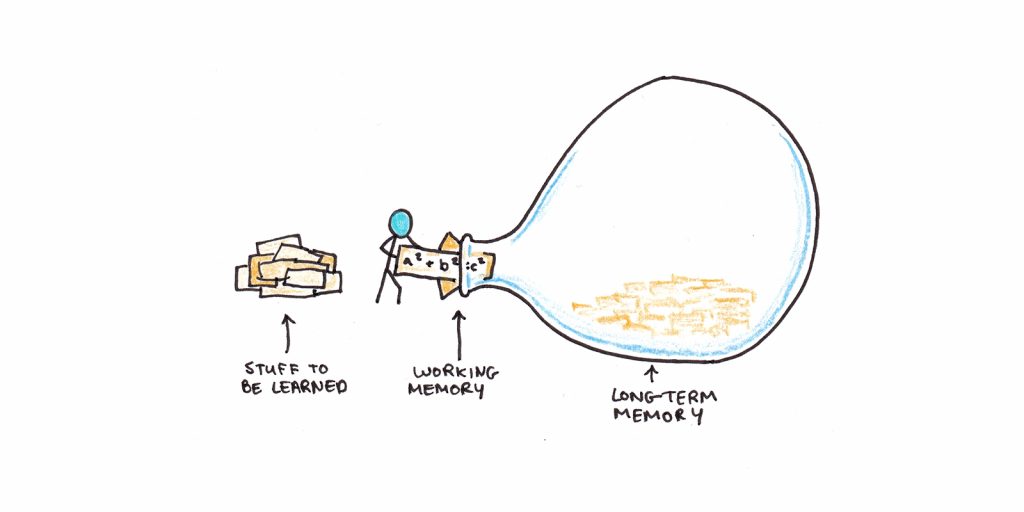
Cognitive Load Theory and its Applications for Learning - Scott H Young
What makes learning hard? How can we make it easier? Cognitive load theory explains how we learn and how to do it better.
Thinking Fast, Slow, Artificially: AI and Your Brain
AI can boost your decisions — or quietly undermine them. Wharton researchers introduce a new theory of cognition that every leader needs to understand.

People Who Can't Visualize Anything Are Challenging a 300-Year-Old Theory of Thought
Mental imagery might not be as central to complex human thought as we believed, philosophers say.

How We Pay Attention Changes the Very Shape of Our Brains
Imagine arriving at the airport just in time to catch a plane. Everything in your behavior betrays the heightened concentration of your attention. Your mind on alert, you look for the departures si…

To Make Sense of the Present, Brains May Predict the Future | Quanta Magazine
A controversial theory suggests that perception, motor control, memory and other brain functions all depend on comparisons between ongoing actual experiences and the brain’s modeled expectations.

Social Modeling as Architecture, Not Deficit:
Why Neurotypical Expectations Are an Inappropriate Ask

Normal science
Normal science, identified and elaborated on by Thomas Samuel Kuhn in The Structure of Scientific Revolutions,[1] is the regular work of scientists theorizing, observing, and experimenting within a settled paradigm or explanatory framework.[2] Regarding science as puzzle-solving,[3] Kuhn explained normal science as slowly accumulating detail in accord with established broad theory, without questioning or challenging the underlying assumptions of that theory.
The Great Mental Models
The Great Mental Models project is the clearest way to change the way you see the world, avoid problems before they happen, and make better decisions.

The Attention Economy and the Collapse of Cognitive Autonomy
Check out the first in a series on social media from Denny Center Student Fellow Rai Hasen Masoud (F'27) to learn more about the attention economy and it's impacts on our democracy.
This Is Your Brain on Podcasts (Published 2016)
Different people’s brains absorb a compelling story in the roughly the same complicated pattern, using many parts of the brain, researchers found.
