It's an iffy Amazon leadership principle but a great engineering metric
Don't Feed the Thought Leaders
In this article, the author shares their experience as an engineering manager and the challenges they faced when trying to reach alignment and prev...

Scaling Engineering Teams: Lessons from Google, Facebook, and Netflix
After spending over a decade in engineering leadership roles at some of the world’s most chaotic innovation factories—Google, Facebook, and Netflix—I’ve learned one universal truth: scaling e…

Why Amazon Has No Profits (And Why It Works) | Andreessen Horowitz
Amazon has a tendency to polarize people. On one hand, there is the ruthless, relentless, ferociously efficient company that’s building the Sears Roebuck of the 21st Century. But on the other, there is the fact that almost 20 years after it was launched, it has yet to report a meaningful profit. This chart captures the...

Lack of leadership in open source results in source-available licenses | TechCrunch
Cloud infrastructure providers -- such as Amazon -- continue to pose an existential threat to the future of open source.

Amazon CEO Andy Jassy says 'really good' A.I. models take 'billions of dollars' to train
Amazon isn't the first to market with a model that generate human-like text. But Amazon wants to stand out with low prices, easy of use and choice.

Engineering managers have a new job description
Why engineering managers are expected to be hands-on again and how AI tools are making it possible to stay technically sharp while still leading.

Jeff Bezos’ email to his employees shows Amazon’s leadership problems are only beginning
Just as The New York Times’ scathing indictment of Amazon and its workplace culture hit the internet earlier this month—before the print edition was even in many readers’ hands—Amazon’s CEO Jeff Bezos sent a memo to his employees in an effort to contain the impact. Perhaps admirably, he acknowledged the controversy and encouraged his employees “to give this . . . article a careful read.”


The golden mean of design and engineering - The Intercom Blog
For great products to be built, both design and engineering need to be in balance. If you have a super strong engineering team but a weak or underserved design team, you will struggle.

The Paradox of Perfection: When ‘Good Enough’ is Actually Better
Exploring the tension between engineering perfectionism and pragmatic delivery. Discover why striving for the perfect solution often prevents us from shipping valuable improvements and how to find the balance.
AWS Marketplace: Railway
Railway's mission is to build a world where developers ship without friction. We are a platform as a service bringing human-friendly design standards to internet infrastructure to help more great ideas materialize.
Earth on AWS
AWS is the world's most comprehensive cloud, enabling organizations to accelerate innovation, reduce costs, and scale more efficiently
Responsible AI
Discover how AWS is committing to developing AI responsibly – to built trust, promote the safe development of AI, and act as a force for good.
Measuring an engineering organization.
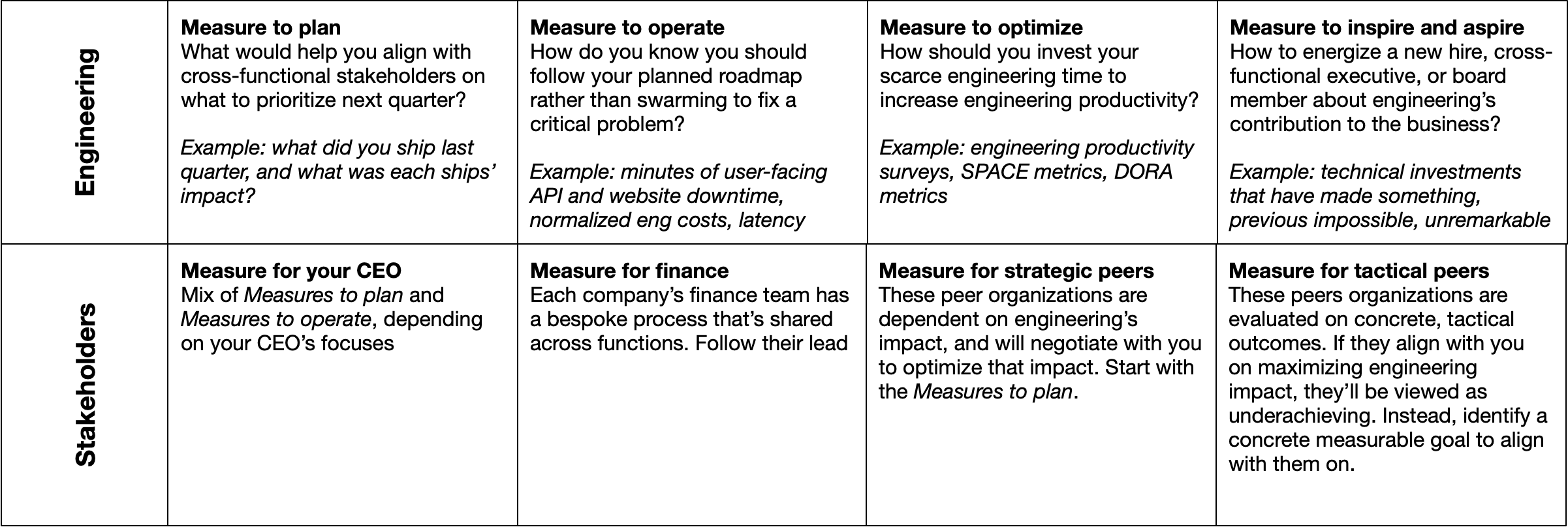
For the past several years, I’ve run a learning circle with engineering executives. The most frequent topic that comes up is career management–what should I do next? The second most frequent topic is measuring engineering teams and organizations–my CEO has asked me to report monthly engineering metrics, what should I actually include in the report? Any discussion about measuring engineering organizations quickly unearths strong opinions. Anything but sprint points! Just use SPACE! Track incident frequency! Wait, absolutely do not track incident frequency! Just make a pretty chart, they won’t look at it anyway! All of these answers, even the last one, have a grain of truth to them, but they skip past an important caveat: there are many reasons to measure engineering, many stakeholders asking for metrics, and addressing each requires a different approach.