


We analyzed 248,000 Reddit posts to uncover what makes certain threads appear in AI search results. Learn which post types, engagement levels, and formats drive visibility.
What Americans See About AI Online
One month of web browsing data shows most respondents visited a search page with an AI-generated summary, but visits to in-depth content about AI were much rarer.

I pulled ~90,000 Reddit posts about what makes writing "sound like AI" to determine the biggest AI-slop giveaways (Part 2)
674 votes, 228 comments. The majority of people can instantly tell when writing is generated by AI. For those who don't intend to get into the weeds…
It Is Trivially Easy to Use Reddit to Manipulate AI Search, Research Suggests
"We show that a tiny snippet—just 13 words—of retrieved text on a UGC website like Reddit, Wikipedia, Quora, or Facebook can change AI agents to output spam / scam content pretty consistently."

Exclusive: New York Times tests out AI-generated search summaries
In recent weeks, the paper has quietly rolled out a new AI-powered search page for a small subset of visitors.

Google Search's guidance about AI-generated content | Google Search Central Blog | Google for Developers
In this post, we'll share more about how AI-generated content fits into our long-standing approach to show helpful content to people on Search.

Elicit: AI for scientific research
Use AI to search, summarize, extract data from, and chat with over 125 million papers. Used by over 2 million researchers in academia and industry.

Elicit: AI for scientific research
Use AI to search, summarize, extract data from, and chat with over 125 million papers. Used by over 2 million researchers in academia and industry.
AI use in American newspapers is widespread, uneven, and rarely disclosed
AI is rapidly transforming journalism, but the extent of its use in published newspaper articles remains unclear. We address this gap by auditing a large-scale dataset of 186K articles from online editions of 1.5K American newspapers published in the summer of 2025. Using Pangram, a state-of-the-art AI detector, we discover that approximately 9% of newly-published articles are either partially or fully AI-generated. This AI use is unevenly distributed, appearing more frequently in smaller, local outlets, in specific topics such as weather and technology, and within certain ownership groups. We also analyze 45K opinion pieces from Washington Post, New York Times, and Wall Street Journal, finding that they are 6.4 times more likely to contain AI-generated content than news articles from the same publications, with many AI-flagged op-eds authored by prominent public figures. Despite this prevalence, we find that AI use is rarely disclosed: a manual audit of 100 AI-flagged articles found only five disclosures of AI use. Overall, our audit highlights the immediate need for greater transparency and updated editorial standards regarding the use of AI in journalism to maintain public trust.

AI use in American newspapers is widespread, uneven, and rarely disclosed
AI is rapidly transforming journalism, but the extent of its use in published newspaper articles remains unclear. We address this gap by auditing a large-scale dataset of 186K articles from online editions of 1.5K American newspapers published in the summer of 2025. Using Pangram, a state-of-the-art AI detector, we discover that approximately 9% of newly-published articles are either partially or fully AI-generated. This AI use is unevenly distributed, appearing more frequently in smaller, local outlets, in specific topics such as weather and technology, and within certain ownership groups. We also analyze 45K opinion pieces from Washington Post, New York Times, and Wall Street Journal, finding that they are 6.4 times more likely to contain AI-generated content than news articles from the same publications, with many AI-flagged op-eds authored by prominent public figures. Despite this prevalence, we find that AI use is rarely disclosed: a manual audit of 100 AI-flagged articles found only five disclosures of AI use. Overall, our audit highlights the immediate need for greater transparency and updated editorial standards regarding the use of AI in journalism to maintain public trust.
Zero-Click Readership: Are AI Overviews Changing the Way We Discover Research - The Scholarly Kitchen
Today's post asks: If research is increasingly accessed through AI-generated summaries rather than via primary sources, then what does it mean to “engage with research” at all?

AI Index | Stanford HAI
The mission of the AI Index is to provide unbiased, rigorously vetted, and globally sourced data for policymakers, researchers, journalists, executives, and the general public to develop a deeper understanding of the complex field of AI. To achieve this, we track, collate, distill, and visualize dat

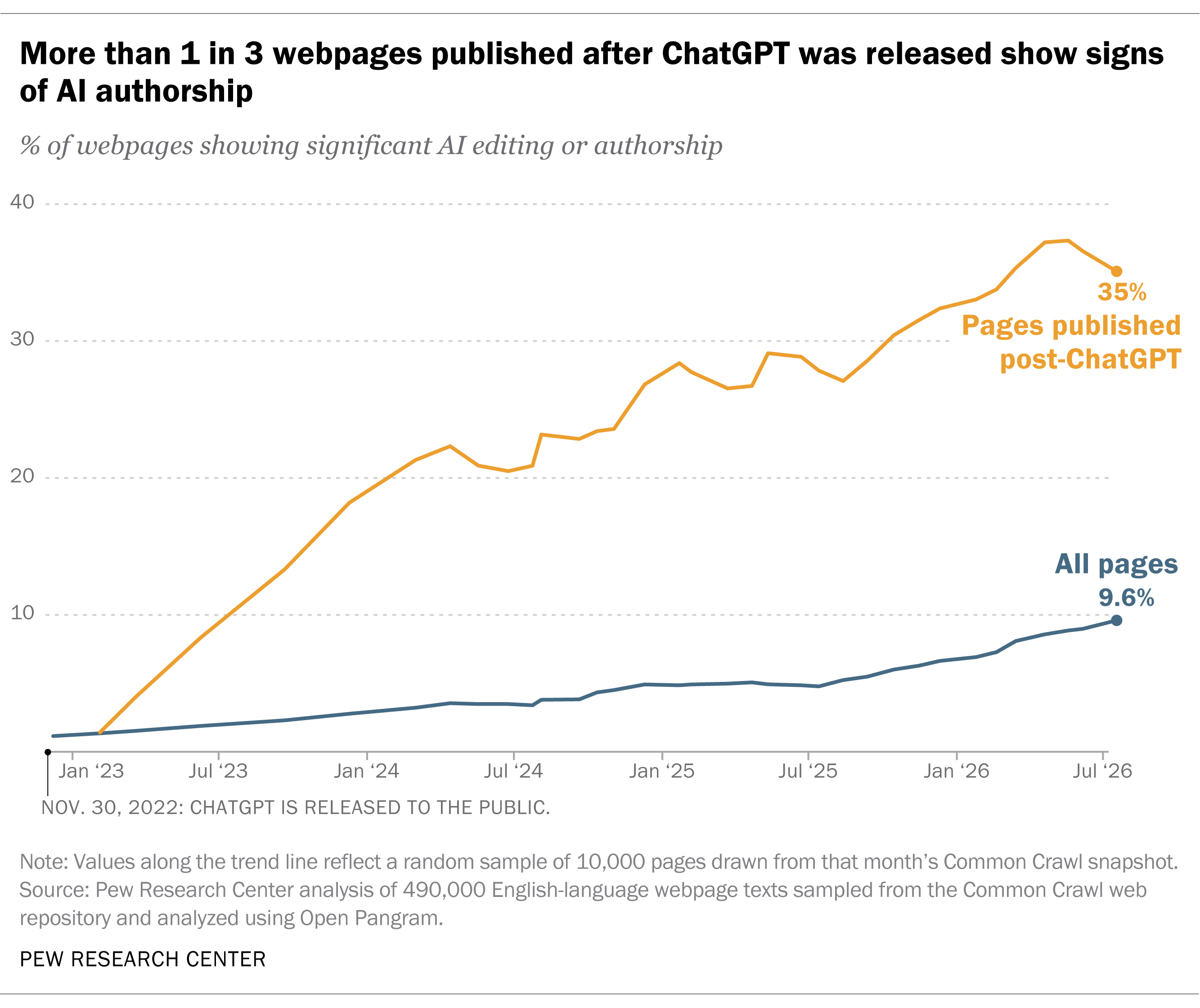
Study Finds A Third of New Websites are AI-Generated
Researchers found the internet is becoming aggressively positive as AI-generated text floods the web.

How Much of the Internet Is Written With AI?
In a random sample of 10,000 webpages collected in July 2026, one-in-ten show signs of being written or substantially edited by AI.
AI for Research | Scite
Scite searches 280M+ scholarly articles to give you citation-backed answers and show you how every claim is supported or disputed.
AI-generated responses are undermining crowdsourced research studies
Many answers to online research questions show signs of being generated by AI chatbots, raising doubts about the validity of behavioural data collected this way

The Impact of AI-Generated Text on the Internet
By mid-2025, roughly 35% of newly published websites were classified as AI-generated or AI-assisted.