


The Internet spaces I tend to inhabit have more polarisation than at many other recent times, and little explication of the worldviews that lead to different premises for discussion, that in turn...
Historical pragmatism and the internet
This article argues that the literature describing the internet revolution in the 1990s was characterized by the rhetoric of the technological sublime. This rhetoric suffered from three fatal flaws: (1) it was not sufficiently grounded in the historical development of technology; (2) it viewed the internet in isolation, failing to consider the wider technological context; and (3) it failed to examine the internet in view of the social, economic, religious and political circumstances of its users. Several examples from history are cited, demonstrating that changes in various systems for the production, dissemination and preservation of cultural information both border and deborder the world. The article suggests that if internet researchers take a pragmatic, historically grounded approach, they will discover that the introduction of internet technology can be seen to have similar consequences. While the technology overcomes many boundaries (of space and time, politics and economics), other social borders may be created at the same time. It is easier to see old boundaries coming down than to see new ones being erected. Rather than being swept by utopian or dystopian enthusiasms, the article insists that the really interesting discoveries are to be made in locating the subtle social shifts taking place, relatively unnoticed, as a consequence of technological change.

Rethink: Web - Open Space
When we struggle to explain the inherent qualities of a medium, we tend to defer to analogies and metaphors. This is especially true of the internet. Clouds, highways, streams, and real estate are just a few examples of the concepts employed to represent this intangible invention. Staring into a screen, it’s easy to imagine an […]

The rise of AI ‘civilizations’ and the fall of corporate responsibility
The internet fights over anthropomorphism around the Hugging Face hack.

Architecture and the Internet: Designing places in cyberspace
Cyberspace, as the information space is called, has become accessible in the past decade through the World Wide Web. And although it can only be experienced through the mediation of computers, it is quickly becoming an alternative stage for everyday economic, cultural, and other human activities. As such, there is a potential and a need to design it according to place–like principles. Making places for human inhabitation is, of course, what architects, landscape architects, and town planners have been doing in physical space for thousands of years. It is curious, therefore, that Cyberspace designers have not capitalized on the theories, experiences, and practices that have been guiding physical place–making. While most 3D environments closely mimic physical spaces, they are, by and large, devoid of the essential characteristics that differentiate a ‘place’ from mere ‘space.’ And only rarely are they sensitive to, and take advantage of, the peculiarities of Cyberspace. We believe that this state of affairs is temporary, characteristic of early adoption stages of new technologies. As the Web matures, and as it assumes more fully its role as a destination rather than as means of communication, there will be a growing need to design it according to place–making principles. By looking at physical architecture as a case study and metaphor for organizing space into meaningful places, this paper explores the possibility of organizing Cyberspace into spatial settings that not only afford social interaction, but, like physical places, also embody and express cultural values. At the same time, because Cyberspace lacks materiality, is free from physical constraints, and because it can only be ‘inhabited’ by proxy, these ‘places’ may not necessarily resemble their physical counterparts.
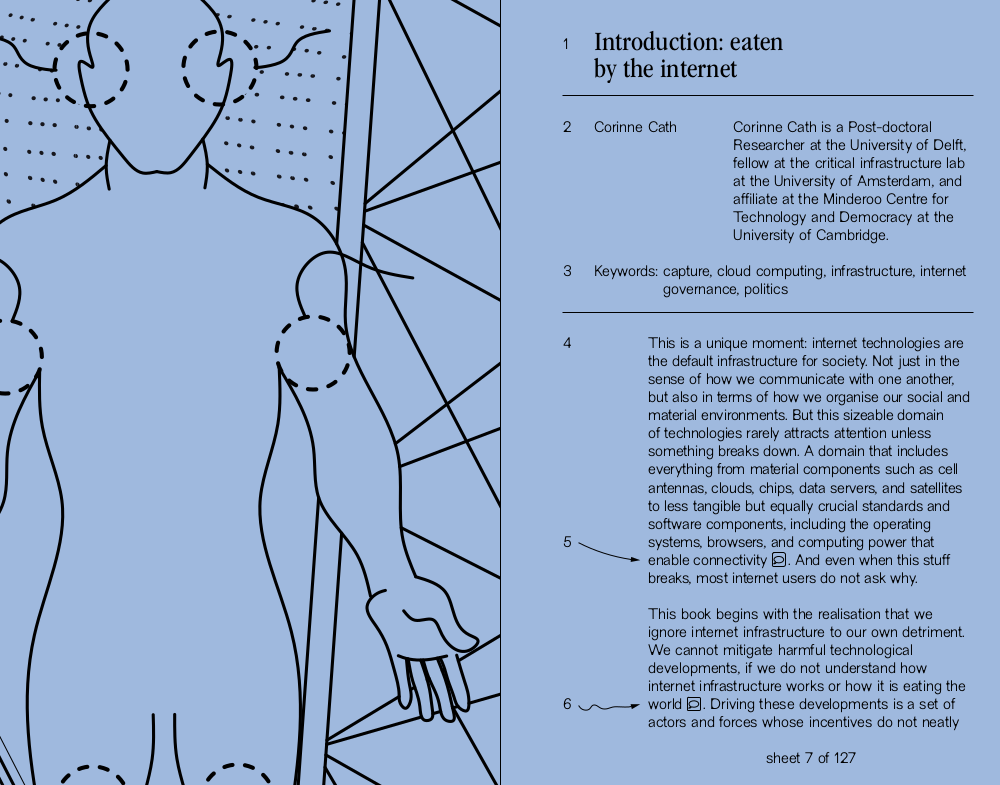
Eaten by the Internet
This book makes internet infrastructure visible as a force of political power, which is transforming the social world, from the bottom up—through fifteen chapters contributed by a global set of researchers, activists, and techies. We are living a unique moment: internet technologies are the default infrastructure for society, not just how we communicate but also how we organise our social life, politics, and economy, all the way down to our material environments, like cities. Our world is eaten by the internet. This means that those who control the internet control the bounds of public speech, economic production, social cohesion, and politics, making its infrastructure a core political terrain in the networked age. The book’s chapters cover a wide set of topics, spanning from the global politics of content moderation by internet infrastructure to the colonialism inherent in the race to plug the moon, from the harms wrought by blockchain companies in rural America to the particularities of online censorship across Asia. The chapters take on thorny topics, discussing power consolidation in the advertisement and cloud industry, the role of internet infrastructure in the war in Ukraine, and tech’s environmental impact—amongst others. In doing so, this book roots contemporary technology debates in the politics of internet infrastructure and urges us to ask how can we ensure our infrastructures sustain us, rather than consume us?
No Sense of Place: The Impact of Electronic Media on Social Behavior
Electronic media present us with a collage of experiences from everyplace. We eat dinner at home while watching starving children thousands of miles away reach out to us for food. From our easy chairs, we stare at blindfolded hostages, and coolly

You Might Debate It — If You Could See It
Writing about the big beautiful mess that is making things for the world wide web.
toward a new aesthetic
Lately I’ve been thinking about what being online looks like. The actual look of it. The aesthetic. As I continue to think and write and talk about escaping...

toward a new aesthetic
Lately I’ve been thinking about what being online looks like. The actual look of it. The aesthetic. As I continue to think and write and talk about escaping...
the chronically online will become a new underclass
Introducing a network for thoughtful conversations
The quality of conversations on the Internet is terrible. Most platforms like Twitter, Facebook, Instagram, Reddit, etc. optimize for engagement as their key metric. This spawns and rewards behavior that leads to bragging of gameable metrics such as likes and followers, self-feeding thought bubbles, knee-jerk reactions, “if you’re not on our side, you’re on their side” mentality, and thought policing even by people who think they’re fighting for a good cause. Today’s Internet doesn’t incentiviz

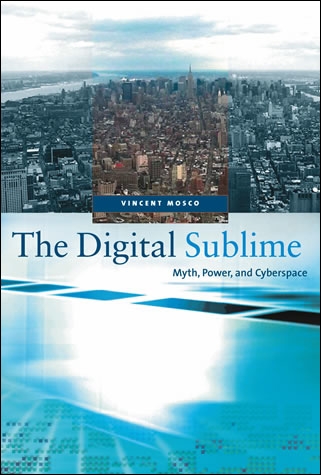
The Digital Sublime: Myth, Power, and Cyberspace
Interpreting the myths of the digital age: why we believed in the power of cyberspace to open up a new world.The digital era promises, as did many other te
Becoming the Product - Set Margins'
€24.00 In stock Becoming the Product quantity Add to cart Category: Books Tags: #designwriting, #institutionalcritique, #internetcritique Description Additional information Description In Becoming the Product: The Critical Internet Researcher as a Virtual Intellectual, the evolution of critical internet research takes center stage. By examining the pioneering work of early net critic Geert Lovink and the influencer-style […]

Cyberspace to Cyberplace
This post is a broad exploration, it doesn’t have a single central goal or thesis so I will be presenting quotes, resources, and various reflections on these to start circling around the topic from different angles.
Rewilding the internet with ATProto
So far, many of the projects in the ATProtocol ecosystem have focused on bringing parity—making projects that replicate our existing tools and platforms, but with the affordances of the protocol instead. That's cool and we need to do that, but I think we can go much farther, and take this opportunity to challenge some of the biggest assumptions of what the modern internet is for, who builds it, and how we interact with it. This talk is in conversation with several of the talks from last year, and in I'll argue that we'll never get away from skeuomorphism until we've fundamentally changed the definition of what "the social internet" means in the first place.
What if we thought about digital spaces like an ecologist? We’d consider the incredible communities that come together over the interwebs – yes, even through social media – in a totally different way. substack.com/home/post/p-192761679
