


It often frustrates technologists that there isn't an algorithm for deciding ethical behavior. You can't follow a checklist or a set of rules to decide whether something's ethical or not (or you...
Opinion | Who Will Teach Silicon Valley to Be Ethical? (Published 2018)
Some think chief ethics officers could help technology companies navigate political and social questions.

2.0 The Ethical Resolution Method (ERM)- A Procedural Framework
# The Ethical Resolution Method (ERM): A Procedural Framework for Evaluating and Stabilizing Moral Norms in Sociotechnical and AI Systems ## Abstract Contemporary artificial intelligence systems increasingly operate within domains governed by moral norms that are inherited, asserted, or enforce...

AI language model rivals expert ethicist in perceived moral expertise
People view AI as possessing expertise across various fields, but the perceived quality of AI-generated moral expertise remains uncertain. Recent work suggests that large language models (LLMs) perform well on tasks designed to assess moral alignment, reflecting moral judgments with relatively high accuracy. As LLMs are increasingly employed in decision-making roles, there is a growing expectation for them to offer not just aligned judgments but also demonstrate sound moral reasoning. Here, we advance work on the Moral Turing Test and find that Americans rate ethical advice from GPT-4o as slightly more moral, trustworthy, thoughtful, and correct than that of the popular New York Times advice column, The Ethicist. Participants perceived GPT models as surpassing both a representative sample of Americans and a renowned ethicist in delivering moral justifications and advice, suggesting that people may increasingly view LLM outputs as viable sources of moral expertise. This work suggests that people might see LLMs as valuable complements to human expertise in moral guidance and decision-making. It also underscores the importance of carefully programming ethical guidelines in LLMs, considering their potential to influence users’ moral reasoning.

AI & Ethics Workgroup | Lincoln Center for Applied Ethics
Artificial Intelligence (AI) is a term with an array of contingent and shifting meanings, unified only by a general aspiration to use mathematical computation to emulate human cognition, language and problem-solving. Rather than a technical term, “AI” can be thought of as a sociotechnical system and assemblage, consisting of technical objects and social imaginaries, practices and ideologies. How we characterize and conceptualize AI shapes how, why and when we use it and when we may constrain or refuse its use. This paper provides a primer on various technologies that often fall under the rubric of “AI” and outlines the various discursive and cultural meanings carried by the term.
We oppose DRM. | Defective by Design
The Ethical Tech Giving Guide replaces DRM-laden software and devices that trample user freedom and privacy with products and programs that you can trust.
AI Ethics Class
The AI hater's guide to code with LLMs (The Overview) | All Confirmation Bias, All The Time
This is the post I don’t think many people expected me to write, and I have (rightly!) surrounded myself with people who are generally uncomfortable to somewhat hostile to “AI”, mostly for good reasons, though I’ll get into the many caveats on that as I go.

Practical Data Ethics
Free, online course from fast.ai and USF Data Institute covering disinformation, bias & fairness, ethical foundations, practical tools, privacy & surveillance, the silicon valley ecosystem, and algorithmic colonialism
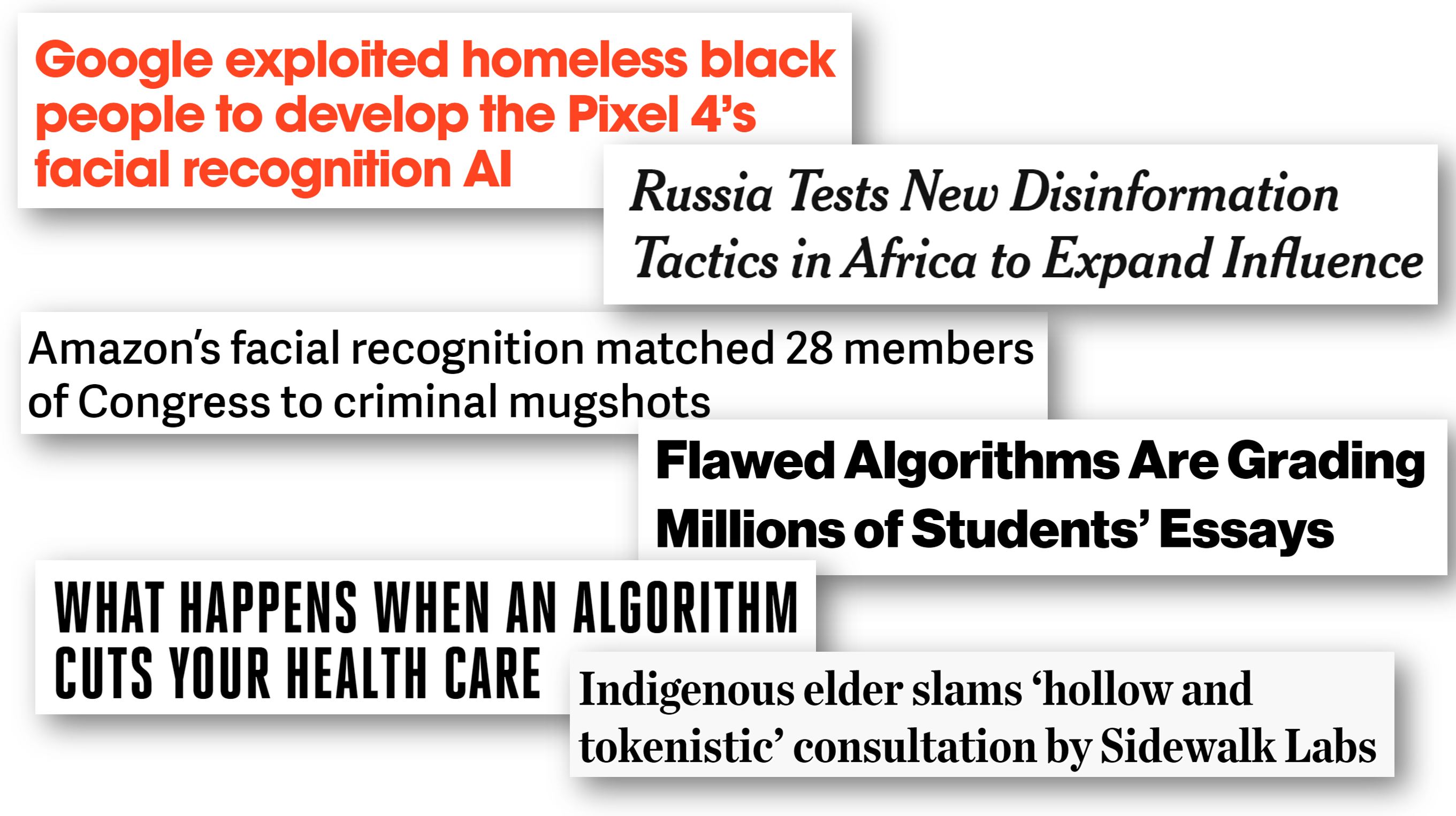
ADD / XOR / ROL: A non-anthropomorphized view of LLMs
In many discussions where questions of "alignment" or "AI safety" crop up, I am baffled by seriously intelligent people imbuing almost magic...
Hey, Computer Scientists! Stop Hating on the Humanities
Opinion: Computer science departments need to teach coders more than just how to code.

depatchedmode/oughta
How we oughta do things. Skills, conventions, and guidance for coding agents.
Arguments in Favor of AI Fair Use
I made some notes on the nature of the training of LLMs, and about whether we as a society should consider the material used to train them as a fair use of that material.

Digest Issue 92: The AI Ethics Brief #202 | What Happens When You Have a Choice? | Reading the Label on AI | Pangram is not an oracle | A Fresh Look at The World Map of Encryption Laws and Policies
Discover insights at the intersection of technology and society

r/codedbyhand
For those who want to bring the fun back into coding and stop using LLM assistance in whole or in part. Whether for skill development, ethical reasons, nostalgia, or just because you enjoy the challenge, share your experiences, insights and projects. This community is for discussion of non-LLM assisted programming and software.
