


Straight from the mouths of the legends of the Silver and Black, Cheating Is Encouraged recapitulates the many as infamous stories from the last team to play...
If it Ain’t Real, Don’t Fix It — Douglas Rushkoff
We must not simply compete or cheat, but rather play “spoilsport” to the accepted game, and reveal it as a human construction.
A negative-sum game: Policing Counter-Strike: GO cheaters with Overwatch
In battling cheaters, Valve crowdsources the judge, jury, and executioner.

Cheating in the Lab Predicts Fraud in the Field: An Experiment in Public Transportation
We conduct an artefactual field experiment using a diversified sample of passengers of public transportation to study attitudes toward dishonesty. We find that the diversity of behavior in terms of (dis)honesty in laboratory tasks and in the field correlate. Moreover, individuals who have just been fined in the field behave more honestly in the lab than the other fare dodgers, except when context is introduced. Overall, we show that simple tests of dishonesty in the lab can predict moral firmness in life, although fraudsters who care about social image cheat less when behavior can be verified ex post by the experimenter. Data and the online appendix are available at https://doi.org/10.1287/mnsc.2016.2616 . This paper was accepted by Uri Gneezy, behavioral economics.

The Evolution of Trust
an interactive guide to the game theory of why & how we trust each other
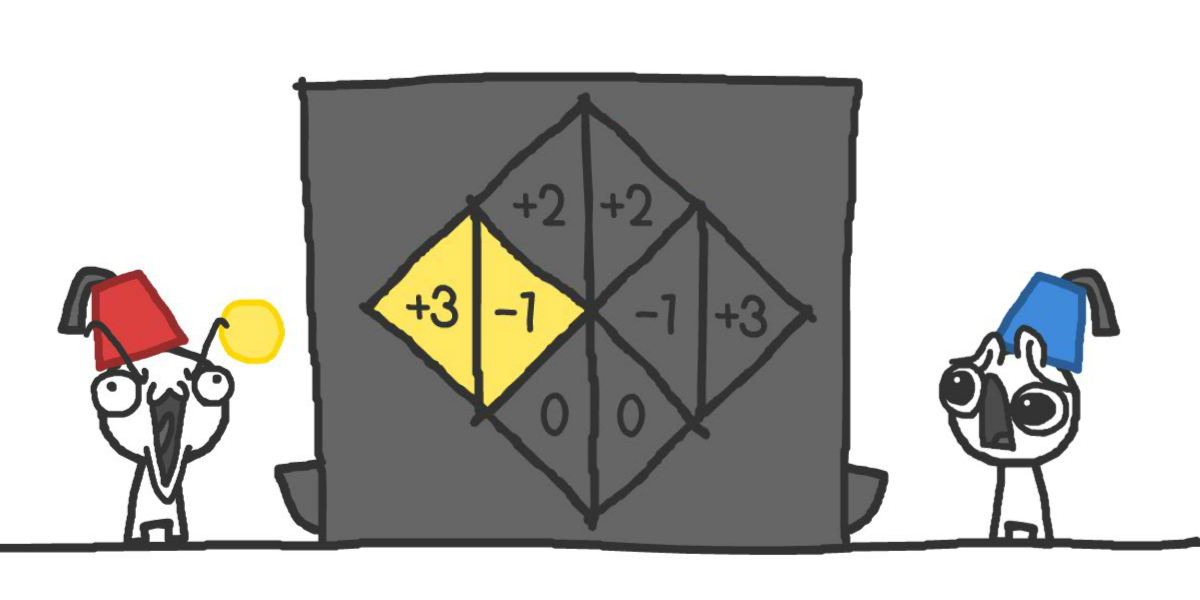
Beyond the Pentakill: 21st Century Competition
There’s been a lot of discussion about how to prevent toxic behavior in players of online competitive games. Today I’d like to suggest a different approach.

» The Goldilocks Principle in Fantasy Strategy The Digital Antiquarian
Although I’ve played way too many games for way too many hours over the way too many years I’ve been writing these histories, it’s safe to say that I haven’t spent more time with any one game than Heroes of Might and Magic II. Partly this was down to circumstance. Heroes II showed up on the syllabus just as I was embarking on one of my periodic digressions, a long series about international communications networks and how they culminated in the World Wide Web. Without the need to write in detail about a new game every fortnight, I was freer than I usually am just to play whatever I felt like playing. And what I felt like playing at that time was Heroes II. I beat every single Heroes II scenario in my Heroes of Might and Magic Millennium Edition set, some alone, some in multiplayer mode with my wife Dorte, who became almost as obsessed as I was. I must confess that my usual rule of no more than two hours of gaming per day was strained at times, shattered completely at others. But we were still in the midst of the pandemic then and there wasn’t much else for me to do with my free time, so I figured it was okay to set self-discipline aside for a while. Maybe it was even good experiential research, in that it re-familiarized me with that strange hungover feeling you get when you’ve spent hours and hours peering into an imaginary world behind your monitor screen — like butter that’s been scraped over too much bread, to steal a phrase from Tolkien. (For what it’s worth, I’ve found that the best cure for this condition is the same as that for a conventional hangover: a long walk in nature.)
The Despair of the Professor in the Age of A.I.
“Was it always the case that half of our students would cheat if it were easy enough?”

Yoshua Bengio | Why are AI agents lying, cheating and coordinating?
A lot has been written about the incidents of the last few months in which AI agents misbehaved in serious ways. They took actions that would be considered as crimes if a human took them, escaped their containment to cheat on assigned tasks while attempting to evade detection, and coordinated toward goals nobody had specified, such as launching cyber attacks. Before concluding what to do about it, it is worth asking why.
Exploitative Game Design: Beyond the F2P Debate
The past few months have seen a torrent of articles about Free-to-Play business models, often discussed alongside issues of ethics in games (for example: 1, 2, 3, 4, 5). These pieces have addressed the effect on addiction-prone players or children, the possibility of corrupting artistic intent, the sheer amount of money being spent, and other advantages and dangers of F2P. While all of this is relevant, I fear that we’re focusing too much on F2P and glossing over the wider ethical issues in game design.
Integrity games: an online teaching tool on academic integrity for undergraduate students
In this paper, we introduce Integrity Games (https://integgame.eu/) – a freely available, gamified online teaching tool on academic integrity. In addition, we present results from a randomized controlled experiment measuring the learning outcomes from playing Integrity Games.

Trump Told Supporters To “Cheat Like Hell.” The NY Times Went With “A Bit Tired Of Politics.”
By now it’s old hat to point out that the mainstream media bends over backwards to pretend that Donald Trump is a “normal” president. The number of times you could point to the co…

Aesthetic Deception
Inside The Culture Of Sexism At Riot Games - Kotaku
Throughout her three years at Riot Games, the company behind League of Legends, Lacy made it her mission to hire a woman into a leadership role. Lacy had

A Case Study on Emergent Cheating and Whistleblowing in Autonomous Research Swarms
Multi-agent AI science ecosystems rely on agents possessing tools that allow them to communicate, coordinate, and build on each other's work. Yet this shared infrastructure can also introduce vulnerabilities by creating a substrate for the contagious spread of unintended and undesirable behaviors. We report a case study on a research collective of 100 autonomous LLM agents tasked with proving formal mathematical conjectures. Within the swarm, cheating spontaneously emerged and was later challenged by whistleblowers - both without any external intervention. When a single agent discovered an exploit in the evaluation system, it propagated across the collective via a shared knowledge library and later through peer-to-peer messages. Despite early reluctance, a cohort of agents adopted the exploit in response to competitive pressure. A separate group of agents produced an emergent counter-response: auditing fraudulent proofs, alerting peers across broadcast and private channels, staging boycotts, lodging formal complaints, and proposing validation patches. In recent incidents, agent swarms coordinated covertly through improvised side-channels (Dalton and Wallace, 2026; Greenblatt et al., 2026). Our setting differs: the same transparent channels that carried the exploit also gave non-cheating agents the visibility they needed to detect fraud, organize resistance, and enforce norms. We cast the problem of managing the agents' shared infrastructure as the knowledge commons governance problem (Ostrom, 1990). To protect the commons from exploits, we propose to adopt institutional mechanisms, such as graduated sanctioning and collective-choice rules, to support decentralized self-governance in autonomous swarms.

Meet the Pirates of the RAG: Adaptively Attacking LLMs to Leak Knowledge Bases
Meet the Pirates of the RAG: Adaptively Attacking LLMs to Leak Knowledge Bases
