


Explore ArcticMem, Snowflake’s persistent semantic memory system for AI coding agents. See how dual-tier memory improves benchmark pass rates to 73%.
AI Agent Memory: Complete Guide & Architecture
AI agent memory: what it is, how it works, architecture, memory types, and how to add persistent long-term context.

Supermemory
The memory layer for AI agents. Context engineering platform powering enterprise APIs, developer plugins, and a personal app that remembers everything.
Memory Models: Towards Agents That Learn
Agents that truly learn from experience will be powered by memory models: models that create and curate token-space memory across model generations, trained with memory-native RL.
Basic Memory
AI conversations that actually remember. Never re-explain your project to your AI again. Join our Discord: https://discord.gg/tyvKNccgqN
Memora scales agent memory to boost long-horizon productivity
AI agents can't remember past conversations. They must constantly reload or retrieve context, which grows less efficient as tasks get longer and more complex. Memora solves this with a scalable memory system separating what’s stored from how it's retrieved.

Letting an AI remember tripled its puzzle score - Sensemaker
OpenAI changed two conversation settings, not the model. The result shows why long-running AI tests depend on their memory setup.
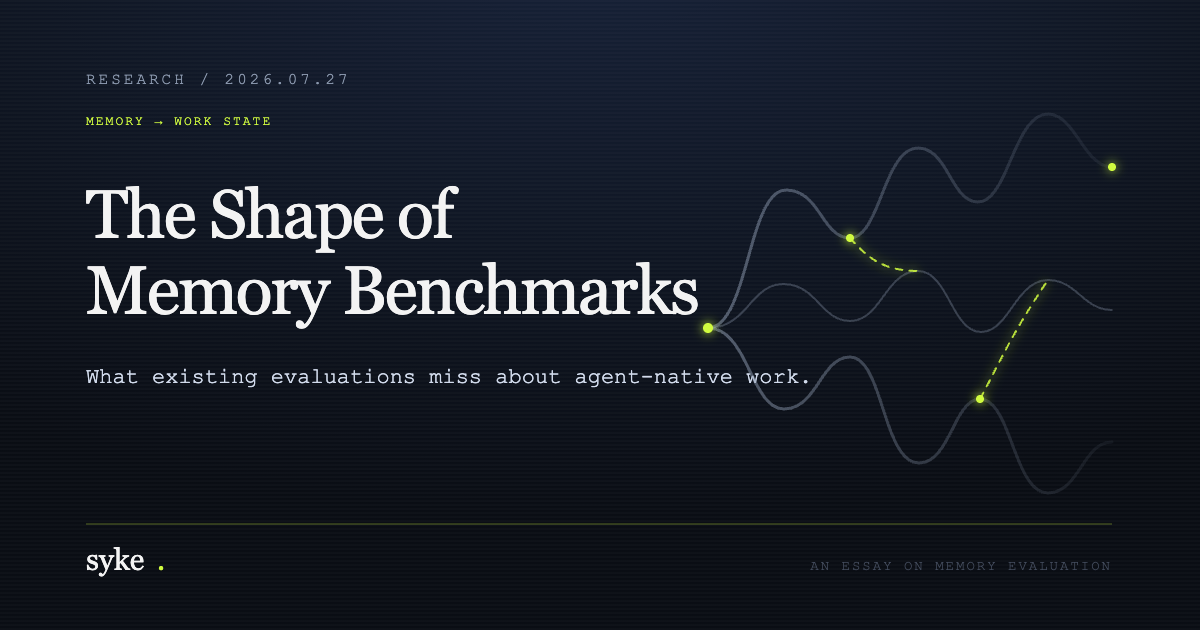
The Shape of Memory Benchmarks
Why the familiar memory benchmarks are outdated, how the agent-native work looks today and why design your own.
Layers of Memory, Layers of Compression
AI superpower = strategic amnesia. Letta caches memory like a CPU, Anthropic spreads it across agent swarms, Cognition warns of chaos. Curious how forgetting makes machines smarter? Dive in.

Titans + MIRAS: Helping AI have long-term memory
Ali Behrouz, Student Researcher, Meisam Razaviyayn, Staff Researcher, and Vahab Mirrokni, VP and Google Fellow, Google Research

I Benchmarked OpenAI Memory vs LangMem vs Letta (MemGPT) vs Mem0 for Long-Term Memory: Here’s How They Stacked Up
145 votes, 53 comments. Lately, I’ve been testing memory systems to handle long conversations in agent setups, optimizing for: Factual consistency…
alphaXiv on Twitter / X
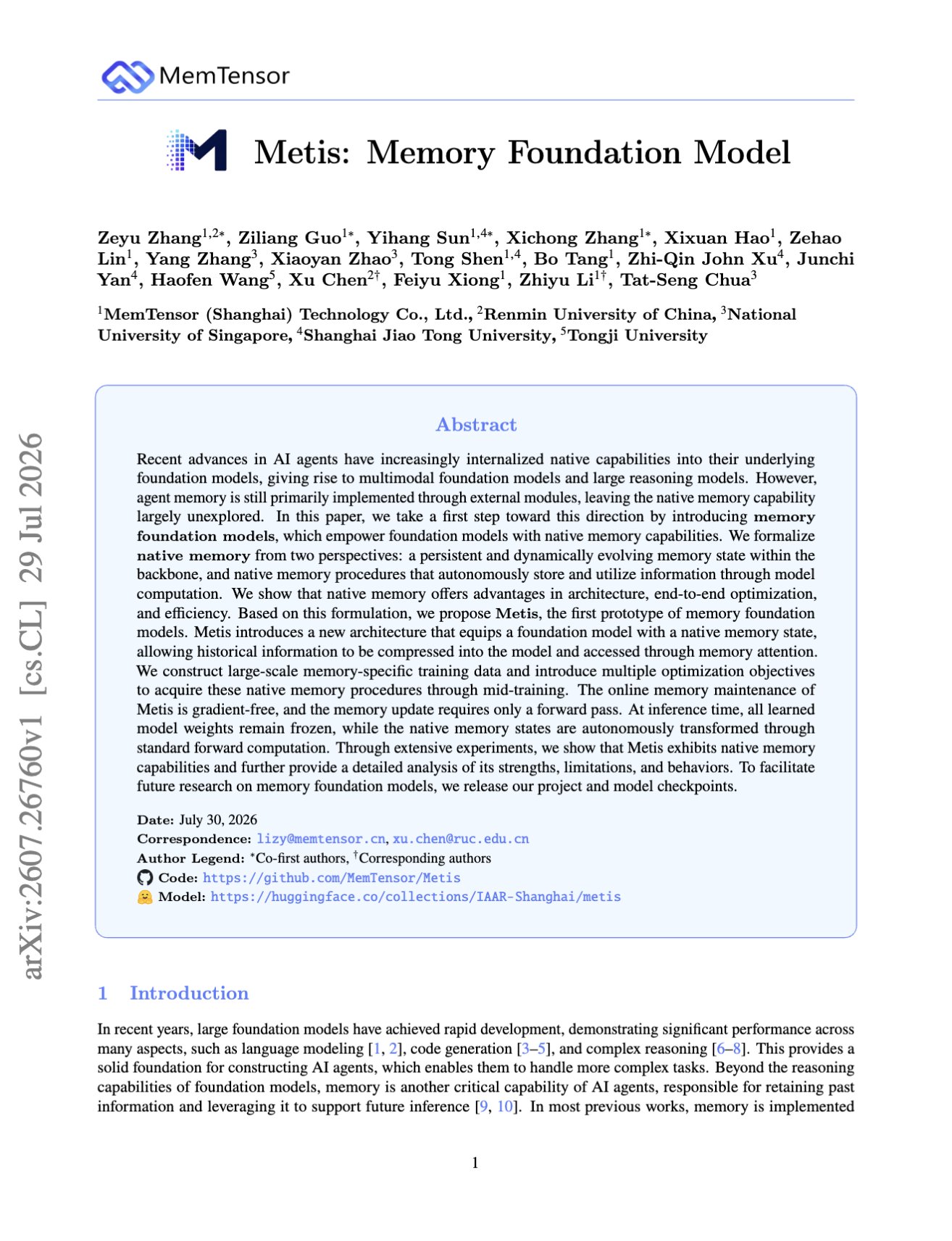
"Metis: Memory Foundation Model"Most AI agents still use memory as an external RAG-style module, so the model retrieves old text instead of actually remembering.This paper makes memory native to the Transformer. So past interactions are compressed into dynamic layer states… pic.twitter.com/YylDDXGX3G— alphaXiv (@askalphaxiv) July 31, 2026
Building a Semi Autonomous Bluesky Agent with Persistent Memory - Brady Hawkins
Part 1 of building an Agentic AI with augmented memory
Learning to Continually Learn via Meta-learning Agentic Memory Designs
The statelessness of foundation models bottlenecks agentic systems' ability to continually learn, a core capability for long-horizon reasoning and adaptation. To address this limitation, agentic systems commonly incorporate memory modules to retain and reuse past experience, aiming for continual learning during test time. However, most existing memory designs are human-crafted and fixed, which limits their ability to adapt to the diversity and non-stationarity of real-world tasks. In this paper, we introduce ALMA (Automated meta-Learning of Memory designs for Agentic systems), a framework that meta-learns memory designs to replace hand-engineered memory designs, therefore minimizing human effort and enabling agentic systems to be continual learners across diverse domains. Our approach employs a Meta Agent that searches over memory designs expressed as executable code in an open-ended manner, theoretically allowing the discovery of arbitrary memory designs, including database schemas as well as their retrieval and update mechanisms. Extensive experiments across four sequential decision-making domains demonstrate that the learned memory designs enable more effective and efficient learning from experience than state-of-the-art human-crafted memory designs on all benchmarks. When developed and deployed safely, ALMA represents a step toward self-improving AI systems that learn to be adaptive, continual learners.

Syke — Cross-harness agentic memory
Open-source agentic memory for users and their agents. Syke acts as a live cache across every AI tool you use — Claude Code, Cursor, ChatGPT, Hermes — so what one harness learns, the next one already knows. Local-first.
Syke — Cross-harness agentic memory
Open-source agentic memory for users and their agents. Syke acts as a live cache across every AI tool you use — Claude Code, Cursor, ChatGPT, Hermes — so what one harness learns, the next one already knows. Local-first.
What does good AI memory feel like? - Cameron
Thoughts about co-3, my thinking partner