

Comprehensive Sociocracy Books - Sociocracy For All
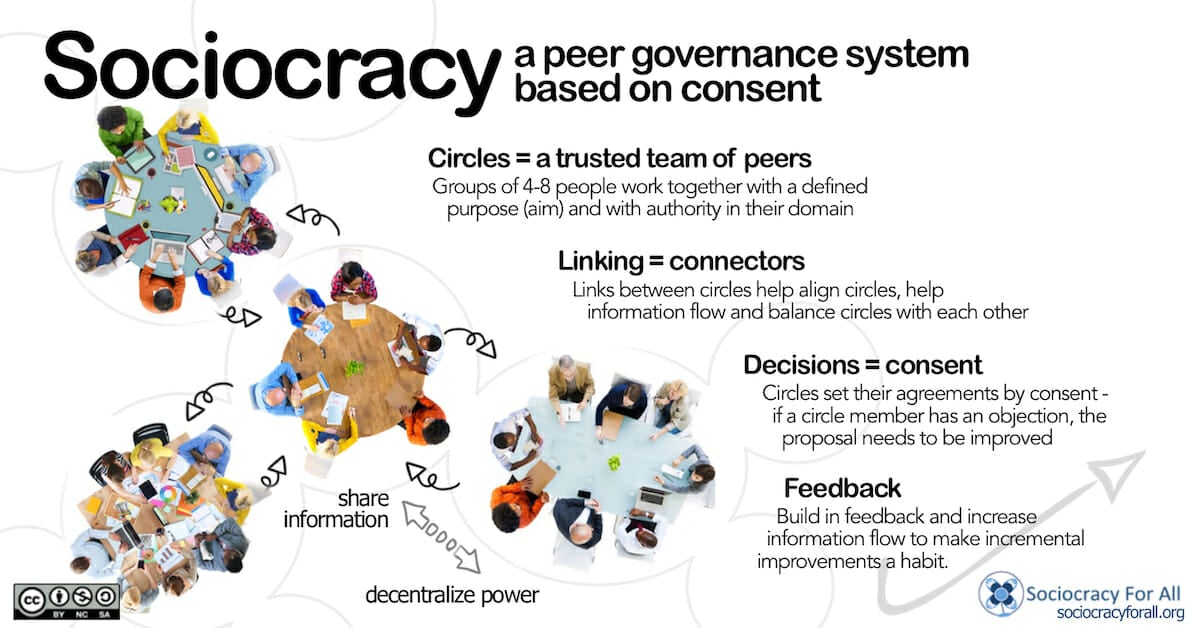
Sociocracy Books from Sociocracy For All: books to learn about circle structure, better meetings, consent decision making.

Writings and rehearsals by Nathan Schneider
Welcome. I’m a professor of media studies at the University of Colorado Boulder, where I direct the Media Economies Design Lab and teach and learn from our students. I’ve written a book each on online democracy, cooperative enterprise, the Occupy movement, and God, and I’ve edited ones about solidarity economies, crypto, and co-ops. Reporting articles for both magazines and academic journals keeps my notebooks filled. Working with others to build a democratic economy keeps me accountable.
Here Comes Everybody (book)
Here Comes Everybody: The Power of Organizing Without Organizations is a book by Clay Shirky published by Penguin Press in 2008 on the effect of the Internet on modern group dynamics and organization. The author considers examples such as Wikipedia, MySpace, and other social media in his analysis. According to Shirky, the book is about "what happens when people are given the tools to do things together, without needing traditional organizational structures". The title of the work alludes to HCE, a recurring and central figure in James Joyce's Finnegans Wake and considers the impacts of self-organizing movements on culture, politics, and business.

Who Decides Who Decides? - Sociocracy For All
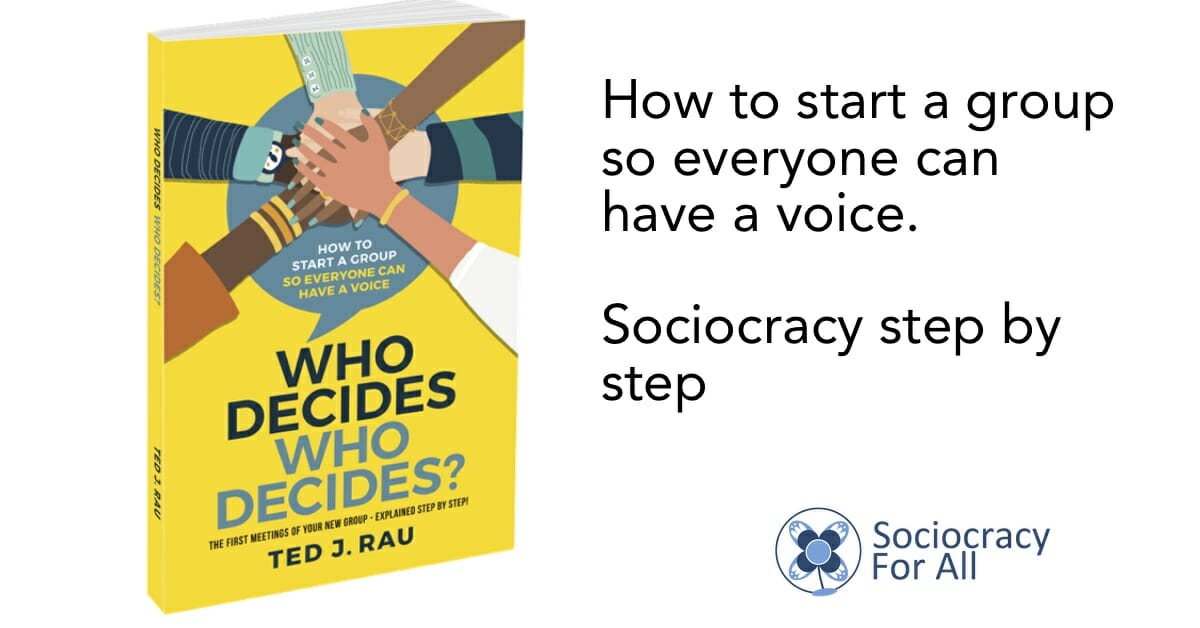
Who Decides Who Decides is a book for starting groups with sociocracy - a guide for governance and decision-making that's clear and inclusive.
More notes on Organizing, Mutual Aid, and Activism on decentralized social networks
Part 3 of a series. See If not now, when? Mutual aid and organizing in the fediverses, the ATmosphere, and whatever comes next and Notes (and thoughts) on organizing in the fediverses and the ATmosphere for previous installments and a reading list. "Mutual aid. Organizing. Sharing, contextualizing, and making meaning

Governable Spaces: Democratic Design for Online Life – Writings and rehearsals by Nathan Schneider
Read the free, open access editionBuy: Amazon, Bookshop, Narrow Gauge Book Co-op, UC Press
We Do This 'Til We Free Us
New York Times Bestseller “Organizing is both science and art. It is thinking through a vision, a strategy, and then figuring out who your targets are, always being concerned about power, always being concerned about how you’re going to actually build power in order to be able to push your issues, in order to be able to get the target to actually move in the way that you want to.” What if social transformation and liberation isn’t about waiting for someone else to come along and save us? What if ordinary people have the power to collectively free ourselves? In this timely collection of essays and interviews, Mariame Kaba reflects on the deep work of abolition and transformative political struggle. With a foreword by Naomi Murakawa and chapters on seeking justice beyond the punishment system, transforming how we deal with harm and accountability, and finding hope in collective struggle for abolition, Kaba’s work is deeply rooted in the relentless belief that we can fundamentally change the world. As Kaba writes, “Nothing that we do that is worthwhile is done alone.”

Anarchist Calisthenics, by James C. Scott
From Two Cheers for Anarchism, published last month by Princeton University Press. Scott is Sterling Professor of Political Science at Yale University.

Infrastructure for Interdependence: Building technology in service of collective power - The Algo Rhythm by Blacksky
[This document serves as a memo for investors]
Orion Reed
My research investigates the intersection of computing, human-system interfaces, and emancipatory politics. I am interested in the potential of computing as a medium for thought, as a tool for collective action, and as a means of emancipation.

The Wealth of Networks
The Wealth of Networks: How Social Production Transforms Markets and Freedom is a book by Harvard Law School professor Yochai Benkler published by Yale University Press on April 3, 2006. The book has been recognized as one of the most influential works of its time concerning the rise and impact of the Internet on the society, particularly in the sphere of economics. It also helped popularize the term Benkler coined few years earlier, the commons-based peer production (CBPP).

Their Side Is Organized; We Need to Be Organized, Too
Trump and his far-right acolytes wield their power to disinvest from public services, terrorize our neighborhoods with ICE agents, and ensure that opposition to genocide becomes a fireable, and deportable, offense. In the face of these grim and terrifying developments, it could scarcely be more urgent that we learn lessons from movements and organizing traditions that confronted repression, surveillance, and powerful opposition in the (recent and distant) past. We’ve put together a reading list of key books to help inform ongoing efforts to build and sustain durable organizations, and forge effective strategies, for both short term survival and long term social transformation. What fuels and sustains activism and organizing when it feels like our worlds are collapsing? Let This Radicalize You is a practical and imaginative resource for activists and organizers building power in an era of destabilization and catastrophe. “Anyone trying to rebuild an effective U.S. labor movement needs to read Class Struggle Unionism by Joe Burns. He lays out the fundamental principles that UE has tried to uphold for the last 85 years. For a union to be worthwhile to the working class, it needs to know which side it is on and it has to recognize that the fight itself is what allows workers to gain the knowledge and power they need.”—Carl Rosen From two co-founders of the largest tenants union in the country, this deeply reported account of the resurgent tenant movement centers poor and working-class people who are fighting back, staying put, and remaking the city in the process. A collection of essays from the Stop Cop City movement on the fight for police abolition and for a liveable planet for all, with gripping reporting from activists on the ground and rousing articles from renowned radical academics. In this remarkable collaborative work, leading scholar-activists Angela Y. Davis, Gina Dent, Erica R. Meiners, and Beth E. Richie surface the often unrecognized genealogies of queer, anti-capitalist, internationalist, grassroots, and women-of-color-led feminist movements, struggles, and organizations that have helped to define abolition and feminism in the twenty-first century. This guide, based on the collective experience of organizers and workers in non-unionized workplaces, is a critical tool to help you and your coworkers organize for justice at work. Drawing from over twenty years of activism on local and national levels, this striking book offers an organizer’s perspective on the intersections of immigrant rights, racial justice, and prison abolition. At a political moment when Liberatory Harm Reduction and mutual aid are more important than ever, this book serves as an inspiration and a catalyst for radical transformation of our world. Even the River Starts Small is a collection from the movement to stop construction of the Line 3 pipeline through northern Minnesota, featuring anonymous writing, art, and photos spanning nearly a decade, and including reflections on many of the diverse experiences that made up this grassroots resistance. “Tracing revolutionary uprisings from 1989 to 2019, this book is a map of resistance and resilience in the face of tremendous odds. The case studies, as well as the introductory essay, lead us through situations where the victory of capitalism over humanity was anything but assured. And yet the book is not a wistful history about what could have been. Rather, it is a strategic assessment of near-victories to prepare us for the fire next time.” —Tithi Bhattacharya As isolated individuals, debtors have little influence. But as a bloc, we can leverage our debts and devise new tactics to challenge the corporate creditor class and help win reparative, universal public goods. Individually, our debts overwhelm us. But together, our debts can make us powerful. What does the politics of solidarity look like in practice, and how can left-wing organizations grow—in numbers and power—while remaining accountable to the broader movements of which they are a part? An oral history and critical genealogy of “accountability,” the complex abolitionist concept that pushes us to ask: just what do we mean by “community?” Environmentalism from Below takes readers inside the popular struggles for environmental liberation in the Global South. These communities—among the most vulnerable to but also least responsible for the climate crisis—have long been at the forefront of the fight to protect imperiled worlds. This volume—the Socialist Register’s first-ever reader—grapples with the question of whether political organization is a necessary part of the struggle by the working-class to overthrow capitalism. In pieces published over the course of publication’s entire history contributors, from Ralph Miliband to Jean-Paul Satre, examine various aspects of this theme. The Socialist Challenge Today presents an essential historical, theoretical, and critical perspective for understanding the potential as well as the limits of three important recent phenomena: the Sanders electoral insurgency in the United States; the Syriza experience in Greece; and Corbyn's leadership of the Labour Party in the United Kingdom. This book surveys revolutionary socialist ideas and engages a gallery of contentious political thinkers, offering an indispensable assessment of the place of revolutionary collectives in this radical tradition. A trenchant history of community organizing and a must-read for the next generation of organizers seeking to learn from the successes, failures, and contradictions of the past. In an era of stark racial injustice, Aaron Dixon dedicated his life to revolution, founding the Seattle chapter of the Black Panther Party in 1968 at age nineteen. In My People Are Rising, he traces the course of his own radicalization, and that of a generation. SNCC: The New Abolitionists influenced a generation of activists struggling for civil rights and seeking to learn from the successes and failures of those who built the fantastically influential Student Nonviolent Coordinating Committee. Detroit: I Do Mind Dying tracks the extraordinary development of the Dodge Revolutionary Union Movement and the League of Revolutionary Black Workers as they became two of the landmark political organizations of the 1960s and 1970s. It is widely heralded as one the most important books on the Black liberation movement. A landmark account of a key radical feminist organization, offering lessons for today’s women’s liberation movement. Boston Female Liberation member Nancy Rosenstock expertly weaves together the reflections of her fellow-activists, describing how they became feminists, recounting the breadth of their organizing work, and linking their achievements and experience to contemporary struggles against sexism. In this rousing and insightful participant's account, Hal Draper recounts the now iconic events of the Berkeley Free Speech Movement. From the impromptu speak out atop a police car after the administration decided to clamp down on students “distributing communist literature,” to the inspiring Student Strike that shut down the entire campus, Draper's narrative captures the energy and dynamism of each twist and turn in the struggle, and offers invaluable analysis along the way. From the dawning of the industrial epoch, wage earners have organized themselves into unions, fought bitter strikes, and gone so far as to challenge the very premises of the system by creating institutions of democratic self-management aimed at controlling production without bosses. During the first two decades of the twentieth century the ideas of revolutionary syndicalism developed into a major influence within the trade union movement. Committed to destroying capitalism through direct industrial action and revolutionary trade union struggle, the movement raised fundamental questions for activists across the world. In this thorough, concise, and accessible introduction to Lenin’s theory and practice of revolutionary politics, Paul Le Blanc gives a vibrant sense of the historical context of the socialist movement (in Russia and abroad) from which Lenin’s ideas about revolutionary organization spring. What emerges from Le Blanc’s partisan yet measured account is an image of a collaborative, ever adaptive, and dynamically engaged network of revolutionary activists who formed the core of the Bolshevik party.

Bluesky 101: How-to Guide for Progressives
The Commons is an online library for the change makers of the world and for those interested in social change, activism, organising, advocacy and justice.

Bookmarks Bookshop Home | Radical, Socialist and Progressive Books
Independent radical bookshop specialising in socialist, feminist, anti-racist and progressive books. Online orders and events.
Plurality
A book by E. Glen Weyl, Audrey Tang and the Plurality Community exploring how technology can support and strengthen democracy.