

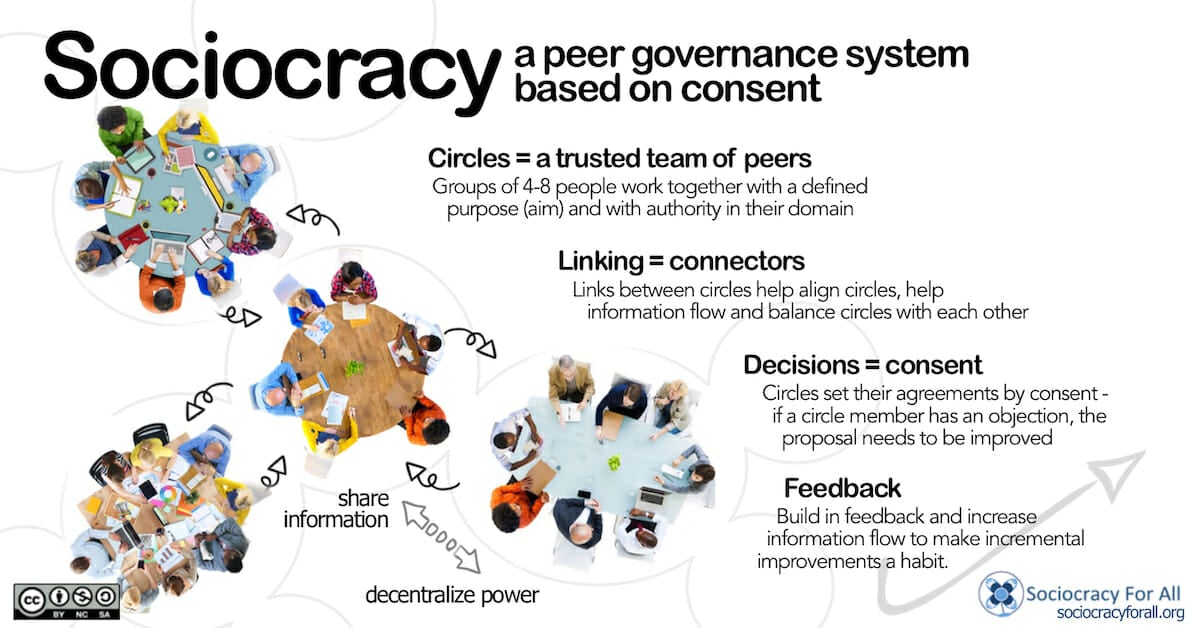
Brief overview of sociocracy: basic concepts and principles, history, its use in organizations, its limits and differences to voting, consensus and hierarchical forms of organizing.
Comprehensive Sociocracy Books - Sociocracy For All
Sociocracy Books from Sociocracy For All: books to learn about circle structure, better meetings, consent decision making.

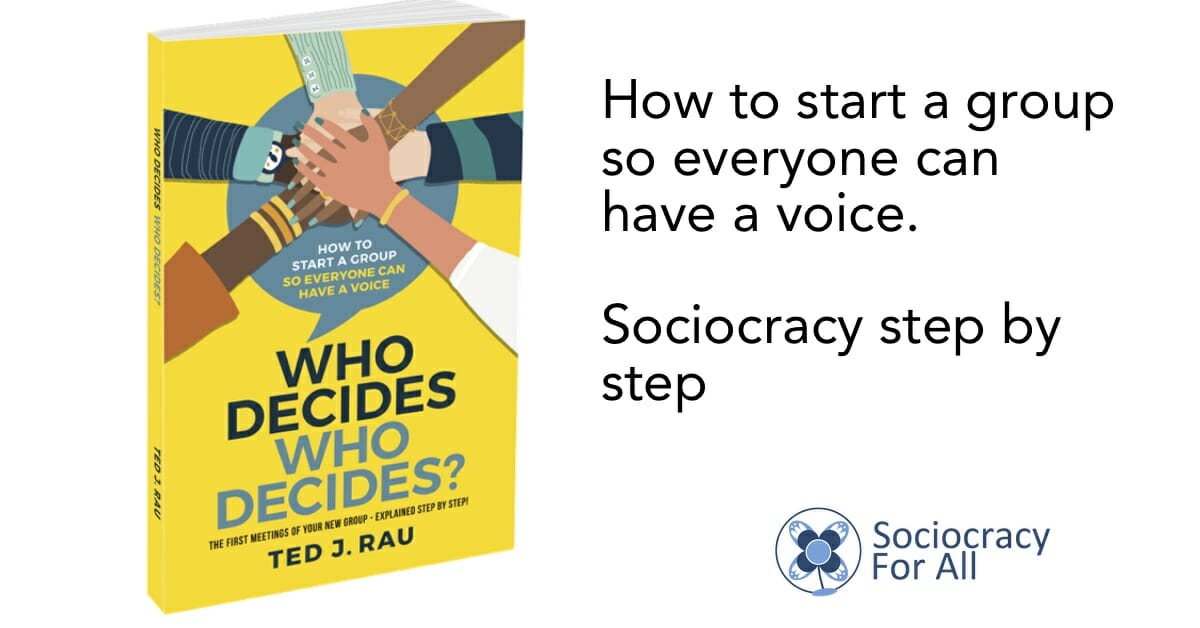
Who Decides Who Decides? - Sociocracy For All
Who Decides Who Decides is a book for starting groups with sociocracy - a guide for governance and decision-making that's clear and inclusive.
Sociocracy and Anarchism: Neither Gods nor Masters, but Systems and Structures - Sociocracy For All
Understand the similarities and the diferences between Sociocracy and Anarchism and how Systems and Structures can help.

"Collective Power: Patterns for a Self-Organized Future by Ted J. Rau" [english edition] (ebook) - Sociocracy For All
by Ted Rau Preorder Ebook

Social system
In sociology, a social system is the patterned network of relationships constituting a coherent whole that exist between individuals, groups, and institutions. It is the formal structure of role and status that can form in a small, stable group. An individual may belong to multiple social systems at once; examples of social systems include nuclear family units, communities, cities, nations, college campuses, religions, corporations, and industries. The organization and definition of groups within a social system depend on various shared properties such as location, socioeconomic status, race, religion, societal function, or other distinguishable features.

The Technological Construction of Social Power
This essay presents a theory of the role of technology in the distribution and exercise of social power. The paper studies how technical artefacts and systems are used to construct, maintain or st...

Technocracy | The Paper Pilot
The Paper Pilot's digital garden of thoughts on philosophy, politics, and sociology
What is Communalism?
Murray Bookchin What is Communalism? The Democratic Dimension of Anarchism

Consensus Democracy | The Paper Pilot
The Paper Pilot's digital garden of thoughts on philosophy, politics, and sociology
More notes on Organizing, Mutual Aid, and Activism on decentralized social networks
Part 3 of a series. See If not now, when? Mutual aid and organizing in the fediverses, the ATmosphere, and whatever comes next and Notes (and thoughts) on organizing in the fediverses and the ATmosphere for previous installments and a reading list. "Mutual aid. Organizing. Sharing, contextualizing, and making meaning

Technology is Society Made Durable
Is it possible to devise a set of concepts that could replace the technology/society divide? This set of new concepts - association and substitution - might help to rephrase some of the traditional questions of social order and especially that of the durability of domination of power. However, instead of using different tools to analyse power and weakness, it is argued that power and domination are simply different values of variables that should be studied in their whole range. By reconstructing networks it is argued that a full description of power and domination may be obtained.

a practical guide to decentralization (for my friends) - tim's tinkerings
Governing Together: Toward Infrastructure for Community-Run Social Media
Decentralizing the governance of social computing systems to communities promises to empower them to make independent decisions, with nuance and in accordance with their values. Yet, communities do not govern in isolation. Many problems communities face are common, or move across their boundaries. We therefore propose designing for "inter-community governance:" mechanisms that support relationships and interactions between communities to coordinate on governance issues. Drawing from workshops with 24 individuals on decentralized, community-run social media, we present six challenges in designing for inter-community governance surfaced through ideas proposed in workshops. Together, these ideas come together as an ecosystem of resources, infrastructures, and tools that highlight three key principles for designing for inter-community governance: modularity, forkability, and polycentricity. We end with a discussion of how the ideas proposed in workshops might be implemented in future work aiming to support community governance in social computing systems broadly.

Decentralized Social Media | The Paper Pilot
The Paper Pilot's digital garden of thoughts on philosophy, politics, and sociology
Sociopolitical analysis

General collection for now (may reorganize into more specific collections)
Organizing

Governance, collaboration, how to work together without being awful.
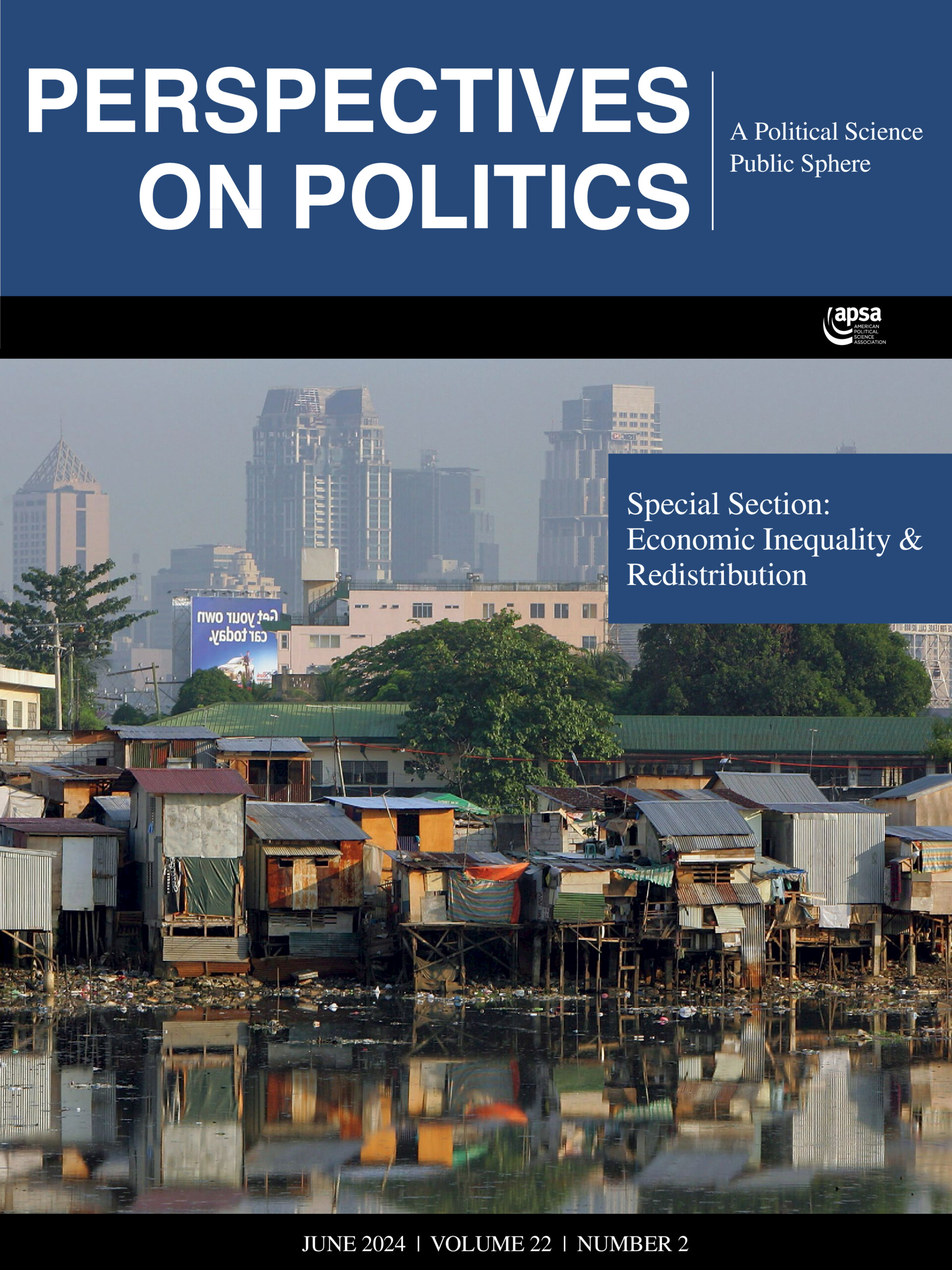
It’s Not Polarization; It’s the Radicalization of the Political Right

The Leftist Manosphere and Identity Politics
Conflict Systems
Spaces as Layers - Nick's Blog
web.archive.org
Axioms for Organizers by Fred Ross, Sr. | Fred Ross, Sr.
The Tyranny of Stuctureless
cdn.fastly.steamstatic.com