

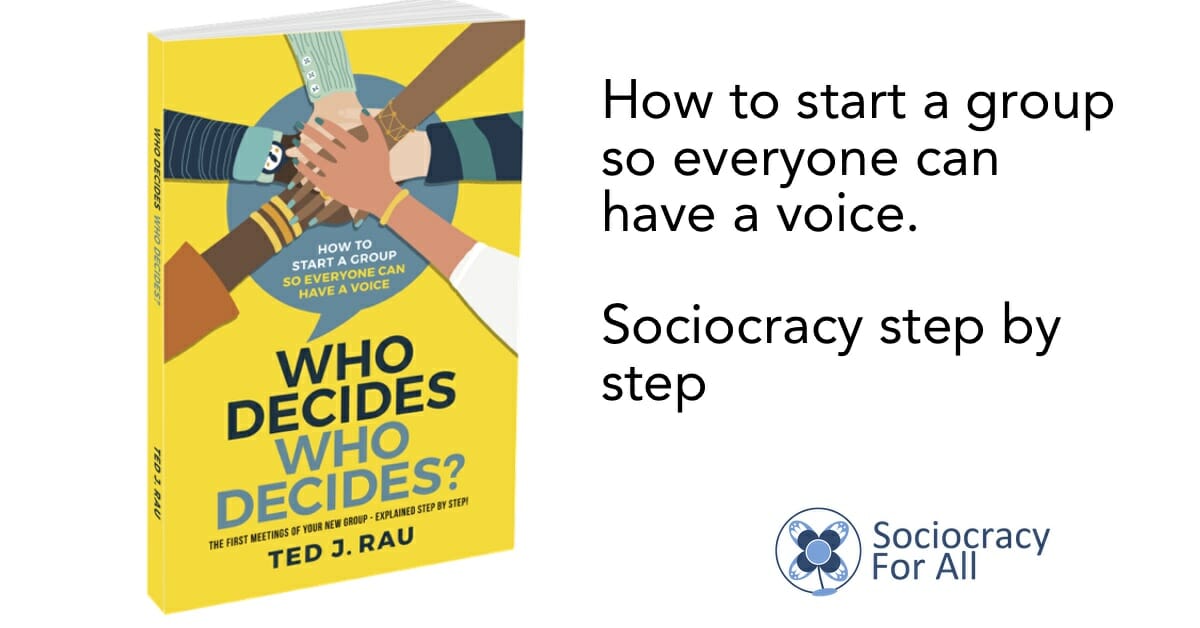
Who Decides Who Decides is a book for starting groups with sociocracy - a guide for governance and decision-making that's clear and inclusive.
Comprehensive Sociocracy Books - Sociocracy For All
Sociocracy Books from Sociocracy For All: books to learn about circle structure, better meetings, consent decision making.

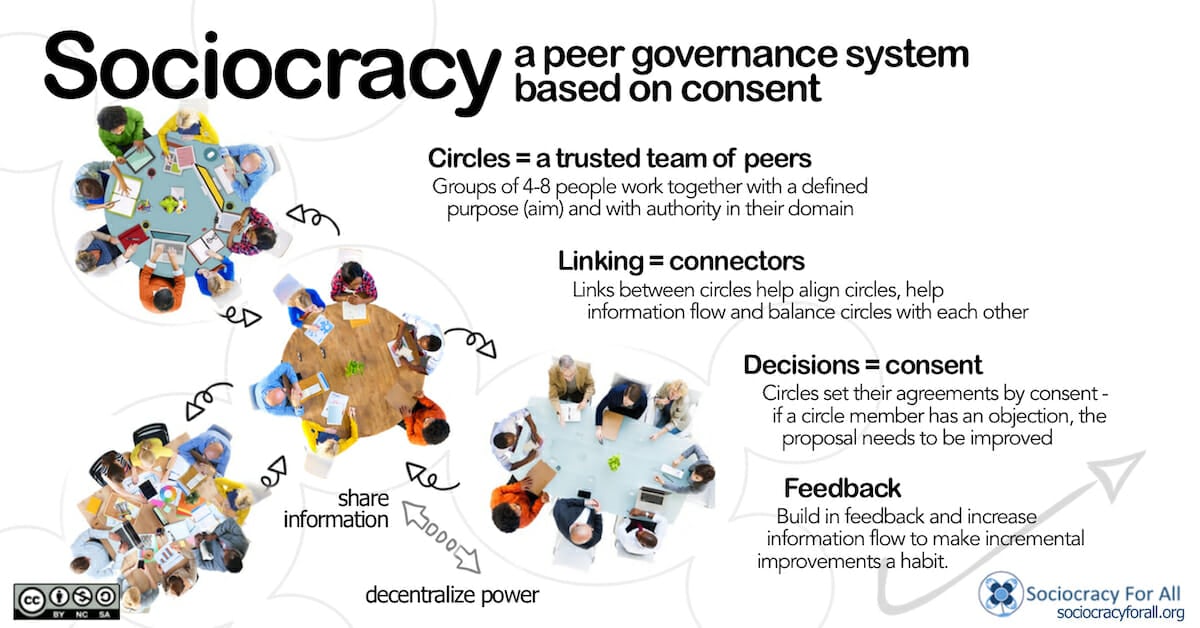
Sociocracy - basic concepts and principles
Brief overview of sociocracy: basic concepts and principles, history, its use in organizations, its limits and differences to voting, consensus and hierarchical forms of organizing.
"Collective Power: Patterns for a Self-Organized Future by Ted J. Rau" [english edition] (ebook) - Sociocracy For All
by Ted Rau Preorder Ebook
How to choose a governance system for your organization
Is your nonprofit, small business, or volunteer group looking for a new way to make decisions? Many groups are questioning our mainstream systems — and that includes the systems by which we make decisions. Governance used to be one of the things we’d all take for granted, and now it’s one of the cho

Sociocracy and Anarchism: Neither Gods nor Masters, but Systems and Structures - Sociocracy For All
Understand the similarities and the diferences between Sociocracy and Anarchism and how Systems and Structures can help.

Consensus Democracy | The Paper Pilot
The Paper Pilot's digital garden of thoughts on philosophy, politics, and sociology
Dilemmas in a general theory of planning
The search for scientific bases for confronting problems of social policy is bound to fail, becuase of the nature of these problems. They are “wicked” problems, whereas science has developed to deal with “tame” problems. Policy problems cannot be definitively described. Moreover, in a pluralistic society there is nothing like the undisputable public good; there is no objective definition of equity; policies that respond to social problems cannot be meaningfully correct or false; and it makes no sense to talk about “optimal solutions” to social problems unless severe qualifications are imposed first. Even worse, there are no “solutions” in the sense of definitive and objective answers.

adhocracy+/adhocracy+ is launched
adhocracy+ is more than just a platform. With adhocracy+ digital democracy becomes easy: for everyone and everywhere. On 14 November, our guests were able to see for themselves how they can use adhocracy+ for their projects in NGOs, municipalities or politics.

Designing decentralized moderation
In decentralized social networks, moderation decisions are made locally by users, servers, or other network entities. This basic…

Decidim, a Technopolitical Network for Participatory Democracy
This Open Access book explains the philosophy, design principles, and community organization of Decidim and provides essential insights into the platform.

Turing-Complete Governance — The Collective Intelligence Project
It is fiendishly difficult to get lots of people to make decisions and work together both non-hierarchically and effectively. Because blockchain technology enables decentralized consensus at scale, the implications for human decision-making and coordination are immensely promising; if we can use it

Democracy Tracker | The Global State of Democracy
Each report describes an event that affects the state of democracy in a given country, with assessments made relative to that country's context, not as comparisons or rankings between countries.
Direct Democracy | The Paper Pilot
The Paper Pilot's digital garden of thoughts on philosophy, politics, and sociology
Collective Governance Directory
A collection of links to publicly available governance documents, published by the collectives that use them.
"people’s councils are exercises in critical pedagogy, of learning together about situated problems and about what needs to be done... the logic of the assembly emerges in situations where people realise they can’t rely on whichever institution or sovereign force claims legitimacy over an issue."
AI, Decomputing and the Interregnum
zenodo.org