For this Solidarity Syllabus, we are learning alongside Indigenous organizers, leaders, and communities whose work offers important solidarity lessons and invitations for how we might understand land, water, sovereignty, and resistance to data centers. Indigenous Peoples Day is observed
Indigenous Knowledges and Data Governance Protocol — Indigenous Innovation Initiative
Between March 2020 and March 2021, the Indigenous Innovation Initiative co-created the Indigenous Knowledges and Data Governance Protocol with the community, to guide how we collect and use Indigenous Knowledges and Data. Click on the image below to learn more about this Protocol. Since then, t

Indigenous Data Sovereignty (DDN3-A11)
This article explores Indigenous data sovereignty, identifies some of the data-related challenges faced by Indigenous Peoples and highlights the work done to overcome these challenges.

The Shared Patterns of Indigenous Culture, Permaculture and Digital Commons | David Bollier
Rarely have I read an essay that knits together some very different commons with such wisdom and depth. Joline Blais' 2006 essay, “Indigenous Domain: Pilgrims, Permaculture and Perl,” is a wonderfully insightful analysis that reveals the underlying unity and logic of commons principles. Her piece appeared in Intelligent Agent (vol. 6, no. 2), published by the Inter-Society for the Electronic Arts.
Animikii: Indigenous Technology for an Equitable Future
Animikii empowers Indigenous communities with culturally informed technology solutions like Niiwin—our groundbreaking tool for Indigenous data sovereignty and community empowerment.

Solidarity Infrastructures
Solidarity Infrastructures is a class that brings together creative practitioners to investigate, strategize, upskill, and dream toward alternative socio-technological systems.
Treating data like land — data sovereignty in the AI age - ICT
Artificial intelligence front and center at North America’s largest Indigenous tech conference
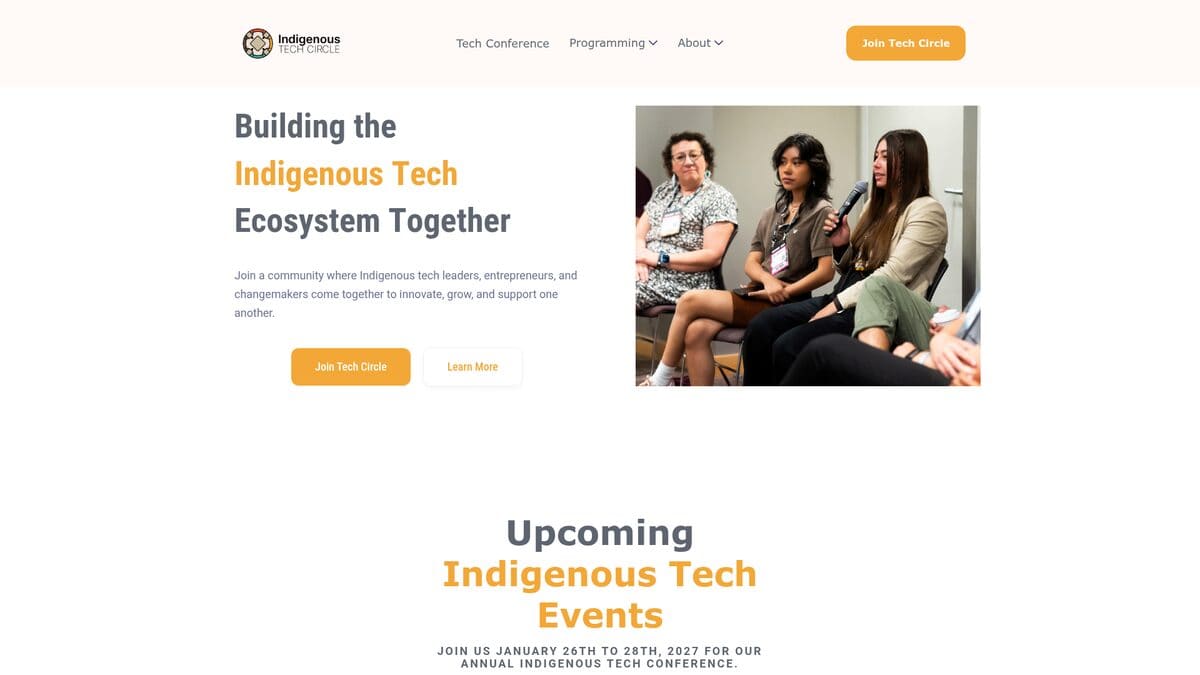
Indigenous Tech Circle | Indigenous-led Tech in Canada
Indigenous-led community connecting technologists, founders, investors, and changemakers across Canada — host of the largest Indigenous tech conference.
Framework for Economic Reconciliation
Drawing on Indigenous worldviews about wealth and sustainability, along with the wisdom and lived experiences of Indigenous thought leaders and practitioners in the economic sector in BC, Step into the River: A Framework for Economic Reconcilation explores ways in which economic reconciliation can be a catalyst for transforming our economic system.

Abundant intelligences: placing AI within Indigenous knowledge frameworks
The current trajectory of artificial intelligence development suffers from fundamental epistemological shortcomings, resulting in the systematic operationalization of bias against non-white, non-male, and non-Western peoples. We argue that these failings are, in part, the result of certain Western rationalist epistemologies that exclude many ways of knowing about the world, and therefore they cannot provide a sufficient foundation on which to adequately, robustly, and humanely conceptualize intelligence. We present a new research agenda, Abundant Intelligences, an Indigenous-led, Indigenous-majority international, interdisciplinary research program that imagines anew how to conceptualize and design artificial intelligence (AI) based on Indigenous knowledge (IK) systems. Abundant Intelligences draws on the rich plurality of Indigenous knowledge systems, bringing together diverse sets of thought, culture, and protocol together. We show IK systems provide one way to rebuild AI’s epistemological foundations and transform these tools’ current role in reinforcing colonial practices of exclusion, extraction, manipulation, and eradication into engines of abundance that enable us to care better for ourselves, our communities, and our world. Our proposition is to fully engage with AI to explore how different conceptions of intelligence could be embodied in these technologies. In this paper, we present the tenets of the research program in detail, account for our methodological approach, describe the impact and limitations, and conclude on a discussion of the implications of the program.

Indigenous Cooperatives in Canada: The Complex Relationship between Cooperatives, Community Economic Development, Colonization, and Culture
This paper describes the intersection of the cooperative movement and Indigenous communities in Canada. The paper brings a lens of nation and race to an analysi

Awana Digital • Co-developing Technology for Social Justice
Awana Digital works in solidarity with Indigenous peoples to use technology to defend their rights and fight climate change.
Home
Solidarity Infrastructures is a class that brings together creative practitioners from respective communities to investigate, strategize, upskill, and dream toward alternative socio-technological systems.
Solidarity Guide for Defending Immigrant Communities
This solidarity guide is designed to help everyone continue to fight back with practical guidance to help protect your immigrant neighbors, your community, and yourself.

DIY Infrastructure Building for Power – Esther Han Beol Jang
Can data collectives help strengthen vulnerable cultures in the face of AI?
"Data collectives and cooperatives, which let creators control the collection and distribution of their data, are emerging as preferred alternatives to big tech companies."

In pursuit of Cognitive Solidarity
Guest post by Pip Sanderson, National Institute of Teaching (England)