

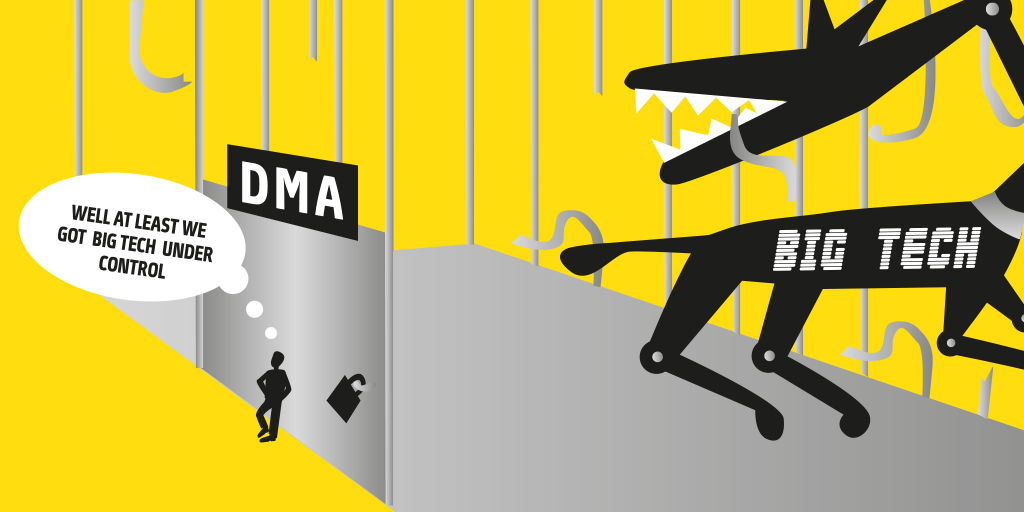
Big Tech companies control markets and rules for people, businesses, and public services. Big Tech's monopoly power needs to be broken up.
Big Tech
Big Tech is a name given to the largest technology companies in the United States, which dominate consumer computing technology around the world. The individual companies change, but the interests and practices of these companies largely remain the same, and are at odds with many of the principles of permacomputing.
How Big Tech Becomes Ungovernable
Big Tech companies like Google, SpaceX, and Meta aren't just monopolies—they're becoming ungovernable through tech extensivity. Why €4B in fines went uncollected.

Big Tech’s attention economy can be reformed. Here’s how.
The business model is doing irreparable harm to society. But there is an alternative, and we don’t need to destroy the tech giants to get there.
Laws of Tech: Commoditize Your Complement
A classic pattern in technology economics, identified by Joel Spolsky, is layers of the stack attempting to become monopolies while turning other layers into perfectly-competitive markets which are commoditized, in order to harvest most of the consumer surplus; discussion and examples.
How One 1990s Browser Decision Created Big Tech’s Data Monopolies (And How We Might Finally Fix It) - Above the Law
From the take-back-control dept

Seize the Means of Computation - ProMarket
To regain internet autonomy from Big Tech companies, lower switching costs with legislation that allows new services to subvert network effects and encourage adversarial interoperability. Too often, our discussion of Big Tech’s dominance starts and ends with a simplistic account of network-effects-driven inevitability, as though the winner-take-all market we have today could not have been […]

Break Up the Tech Giants? No, Just Level the Field
Facebook, Google and Uber should be held to the same rules as their older rivals.

The web can be weaponised – and we can't count on big tech to stop it | Tim Berners-Lee
It’s dangerous having a handful of companies control how ideas and opinions are shared. A regulator may be needed

The New Utilities: Private Power, Social Infrastructure, and the Revival of the Public Utility Concept
From the renewed controversies over financial regulation and the problem of too-big-to-fail (TBTF) financial firms, to the clash over the FCC’s ‘net neutrality’

Open Up Vs Break Up - AVC
There have been many calls to break up the large Internet monopolies; Amazon, Google, Facebook, Apple, etc. Breaking up a large monopoly feels like a very 19th/20th century move to me. I would prefer that politicians and policy makers think about opening up as the better intervention. A good way to explain this is to […]
How the Tech World Turned Evil
Once upon a time, they were counterculture idealists bringing power to the people. Today they’re greedy monopolists who’d sooner destroy our democracy than be reined in by government in any way—and they have to be stopped.
Opinion | The Monopolization of America (Published 2018)
In one industry after another, big companies have become more dominant over the past 15 years, new data show.

Supermodular — The Collective Intelligence Project
There are many situations where it is cheaper to provide a benefit to many people all at once, rather than providing them to one person at a time. Examples range from shipping networks to public health to digital infrastructure to scientific research. As technological development accelerates, more and more goods fall into this category, incentivizing economic actors to provide goods in a massively “wholesale”, rather than retail way. This points toward greater efficiency, but also deeper economic and social vulnerabilities. It results in more and more vital infrastructure that is open to private capture and monopoly. And AI accelerates these dynamics to an unprecedented degree.

Strengthening Online Communities | Rise Against Big Tech Powerbase
The Antitrust Revolution, by Barry C. Lynn
Liberal democracy’s last stand against Big Tech

When (not if) the Tech Monopolies come for the Atmosphere, can we create the institutional structures to protect what we have? Right now we're nowhere near ready. No company harmed the web more than Google, not even close, while claiming to help which many believed. What can we learn and how fast?

kottke.org
“The Metric Is Not the Mission is a ten-part examination of how Big Tech moved from building and expanding the open internet to increasingly shaping it around its own metrics, incentives and assumptions.” techdirt.com/2026/09/21/the-metric-is-not-…
