

Note to readers: The Starling Lab welcomed Rebecca MacKinnon as a Summer 2021 fellow to launch our own research on corporate governance and accountability in Web3. Her broad experience, as a bureau chief for CNN in China and Japan as well as a digital policy scholar for leading think tanks and university research centers, placed her at the epicenter of the internet’s most complex policy challenges. But it was her years holding internet giants to account for their lofty and largely failed commitments on human rights that was the most instructive. Both pragmatic and inspiring, she helped us set the frame and tone for a broader investigation into how ethics on a decentralized internet can realistically transform data integrity across Starling Lab’s domains of history, journalism, and law.
Ecological Awareness for the Decentralized Web - Internet Archive Blogs
This is the third in a series of guest blog posts exploring the real-world implications of the Decentralized Web Principles. By Kelsey Breseman Kelsey Breseman is a Rita Allen Civic Science Fellow at the Environmental Data & Governance Initiative, where she works on environmental accountability, data ownership models, and intentional community. Kelsey has founded and managed
The Internet Was Built by Movements w Sasha Costanza-Chock
Custodians of the Internet
A revealing and gripping investigation into how social media platforms police what we post online—and the large societal impact of these decisions Most use...
How J. Nathan Matias is fighting for our digital rights | Rise25
Salome Viljoen
Salomé is an Assistant Professor of Law at Michigan Law School, where she teaches and writes about contracts, privacy, commercial surveillance and data governance. Salomé works on the law and political economy of data and AI and the role of law in structuring digital life. She is especially interested in platform power, how information law structures inequality, and how law theorizes data about people (i.e. ‘social data’). Some of her recent and forthcoming work develops a theory of affirmative, socially beneficial uses of social data, and examines the role of public agencies in gathering, governing, and using social data as a form of public governance. Other recent and forthcoming work considers under what kinds of conditions the datafication of social life is morally or legally wrongful. Broadly, she is interested in what legal status social data enjoys, what kinds of legal interests social data production and use implicates, and how the law does (and should) regulate the digital economy.
ĐApps: What Web 3.0 Looks Like
As we move into the future, we find increasing need for a zero-trust interaction system. Even pre-Snowden, we had realised that entrusting our information to arbitrary entities on the internet was fraught with danger. However, post-Snowden the argument plainly falls in the hand of those who believe that large organisations and governments routinely attempt to stretch and overstep their authority. Thus we realise that entrusting our information to organisations in general is a fundamentally broken model. The chance of an organisation not meddling with our data is merely the effort required minus their expected gains. Given they tend to have an income model that requires they know as much about people as possible the realist will realise that the potential for convert misuse is difficult to overestimate.
Dan Shipper 📧 on Twitter / X
The smallest technical decisions become humanity's biggest pivots:The same-origin policy—a well-intentioned browser security rule from the 1990s—accidentally created Facebook, Google, and every data monopoly since. It locks your data in silos—and you stayed where your stuff… pic.twitter.com/G87qsuPHxN— Dan Shipper 📧 (@danshipper) July 9, 2025

A couch-to-5K plan for digital governance
Mozilla has long championed more responsible use of data, with everything we do living up to the Mozilla Lean Data Practices. The question is: are there ways we can go further? Are there ways we can more actively engage with people around their data that builds trust -- and that helps the tech industry shift the way it thinks about and uses data? We explore these questions in this four part blog series.
De-google-ify Internet - Main Page
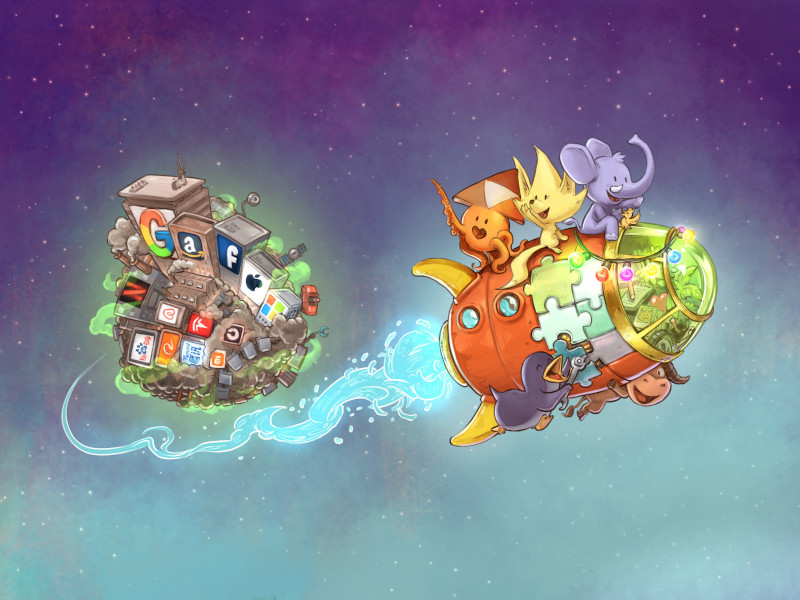
The web giants centralize our digital lives in exchange for their services The Free Software community offers alternative ethical services The Framasoft network intends to prove itby hosting them
The Archive as a Dataset
Information derived from primary and secondary sources contains bias, and as a corollary, the systems that emerge from that information replicate it. The digital world and AI are no exception. We will convene a conversation between Anisa Abeytia (C& Advisory Board member, AI governance specialist at the UNHCR and the Center for AI and Digital Policy) and Nan Collymore (C& Head of Business Development, writer and curator), on the significance of building digital and analog datasets that make cultural knowledge more accessible, representative, and accountable.

2026 IC2S2: Keynote Presentation by Kate Starbird
Data Scientist: The Sexiest Job of the 21st Century
Back in the 1990s, computer engineer and Wall Street “quant” were the hot occupations in business. Today data scientists are the hires firms are competing to make. As companies wrestle with unprecedented volumes and types of information, demand for these experts has raced well ahead of supply. Indeed, Greylock Partners, the VC firm that backed Facebook and LinkedIn, is so worried about the shortage of data scientists that it has a recruiting team dedicated to channeling them to the businesses in its portfolio. Data scientists are the key to realizing the opportunities presented by big data. They bring structure to it, find compelling patterns in it, and advise executives on the implications for products, processes, and decisions. They find the story buried in the data and communicate it. And they don’t just deliver reports: They get at the questions at the heart of problems and devise creative approaches to them. One data scientist who was studying a fraud problem, for example, realized it was analogous to a type of DNA sequencing problem. Bringing those disparate worlds together, he crafted a solution that dramatically reduced fraud losses. In this article, Harvard Business School’s Davenport and Greylock’s Patil take a deep dive on what organizations need to know about data scientists: where to look for them, how to attract and develop them, and how to spot a great one.

Why Big Tech's Privacy Promises Are Lies
Beyond APIs: Collecting Web Data for Research using the National Internet Observatory
Widespread Internet use offers unprecedented opportunities to study human behavior at scale, yet researchers face significant ethical and technical barriers when attempting to collect data for academic studies.
Gathering the Custodians of the Internet: Lessons from the First CivilServant Summit - Citizens and Technology Lab
An agenda for citizen behavioral science to maintain and protect the communities we love online.

Internet for the People: The Fight for Our Digital Future
"For all the informational convenience the internet offers, it is deeply flawed. How can it be improved? Writer Ben Tarnoff proposes one possibility in this intriguing book, which urges the development of 'a public lane on the information superhighway.' It's worth checking out for yourself." – Seth MacFarlane Why is the internet so broken, and what could ever possibly fix it? In Internet for the People, leading tech writer Ben Tarnoff offers an answer. The internet is broken, he argues, because it is owned by private firms and run for profit. Google annihilates your privacy and Facebook amplifies right-wing propaganda because it is profitable to do so. But the internet wasn't always like this—it had to be remade for the purposes of profit maximization, through a years-long process of privatization that turned a small research network into a powerhouse of global capitalism. Tarnoff tells the story of the privatization that made the modern internet, and which set in motion the crises that consume it today. The solution to those crises is straightforward: deprivatize the internet. Deprivatization aims at creating an internet where people, and not profit, rule. It calls for shrinking the space of the market and diminishing the power of the profit motive. It calls for abolishing the walled gardens of Google, Facebook, and the other giants that dominate our digital lives and developing publicly and cooperatively owned alternatives that encode real democratic control. To build a better internet, we need to change how it is owned and organized. Not with an eye towards making markets work better, but towards making them less dominant. Not in order to create a more competitive or more rule-bound version of privatization, but to overturn it. Otherwise, a small number of executives and investors will continue to make choices on everyone’s behalf, and these choices will remain tightly bound by the demands of the market. It's time to demand an internet by, and for, the people now.