Open access made much of the scientific record openly available. An enormous opportunity now exists to make it computable and systemic.
From Albums to Streams: How Modularity Changes Systems
Scientific publishing is breaking under document-centric formats designed for a physical world. Borrowing from music’s shift from albums to streaming, we make the case that open access alone cannot deliver reuse, trust, or scale. The future of science depends on modular, interoperable research components that move across tools, enabling new workflows, tools, and ecosystems.
The Minimum Viable Scientific Record
The open science movement does not lack a shared vision. Decades of declarations, statements of principle, and calls to action have failed to put that vision into practice. This essay proposes a minimum viable scientific record (MVR) that would make the open science vision possible, and asks funders to make operating on it a condition of their money.

Open Exchange Architecture
A specification for representing scientific documents and their components as structured objects.
Open Exchange Architecture
A specification for representing scientific documents and their components as structured objects.
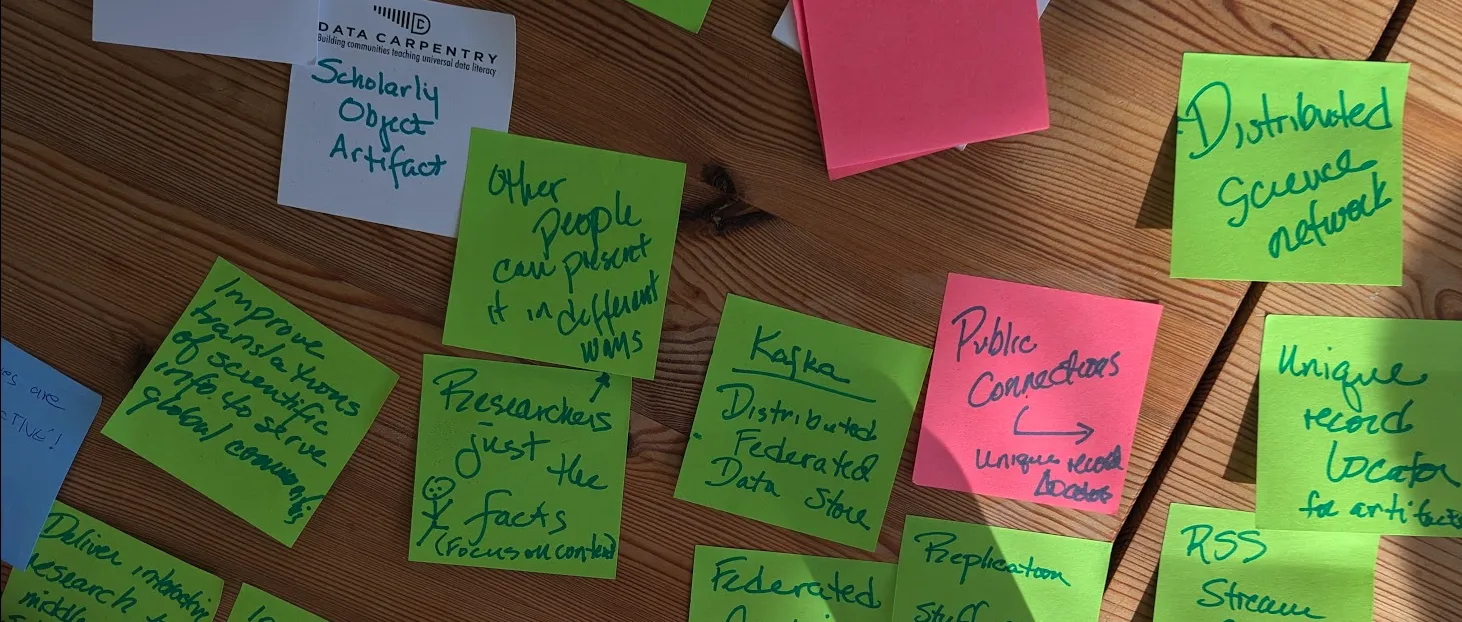
Open Exchange Architecture
A specification for representing scientific documents and their components as structured objects.
A Science Funding System Beyond the Linear Model
Research funders should embrace a new ontology of scientific work to improve the relationship between science and the public.

jedisct1/Qwen3.6-35B-rust.mlx · Hugging Face
We’re on a journey to advance and democratize artificial intelligence through open source and open science.

Center for Open Science
At the Center for Open Science, our mission is to increase openness, integrity, and reproducibility of scholarly research. Promoting these practices within the research funding and publishing communities accelerates scientific progress

Universal Scientific Protocols, Inc.
Universal Scientific Protocols, Inc. — research publishing, reconsidered. A knowledge management platform for machine learning researchers.
A budding discipline around how science gets read and judged - Aris
Scholarly publishing spent thirty years arguing about access. It has barely begun arguing about what readers do with the paper once they have it. At Aris we call that second argument scholarly interface design. Mike Morrison's community calls it ScienceUX. Either way it is becoming a field, and here is why it is worth your attention.
The new way we’ll do science
Papers should become human-readable views over a graph of data, tools, results, and certificates.

The Consensus Trap: Dissecting Subjectivity and the “Ground Truth” Illusion in Data Annotation
As part of the Digital Library's transition to Open Access, new features for researchers are available in the Premium Edition. Click here to learn more.

Reproducible research: methodological principles for transparent…
This Mooc proposes methodological principles for open and transparent science. It deals in a practical way with note-taking, computational documentation, replicability of analyses.