


This paper presents the state of the art of post-car urban transitions. It begins with an overview of the impact of automobility on planetary and human well-being. The benefits of post-car cities a...
Paris said au revoir to cars. Air pollution maps reveal a dramatic change.
Air pollution fell substantially as the city restricted car traffic and made way for parks and bike lanes.

Urban problems: nature-based solutions and a Green New Deal everywhere
Nature-based Solutions with localised Green New Deals could save our settlements, and provide a just transition to a low-carbon society

Planning for isolation? The role of urban form and function in shaping mobility in Brasilia
Brasília offers a rare test of how urban form shapes experienced segregation. Built almost at once around modernist neighbourhood units, then expanded through planned satellites and informal peripheries, it lets us ask whether urban form turns mobility into mixing or into a more efficient engine of separation. We combine data on human mobility with urban morphometrics, amenities, road networks, along with enclosures and tessellations that capture segregation at the scales where access is structured: districts, neighbourhoods, blocks, and street-and-building cells. We find that segregation intensifies as resolution sharpens, from 0.282 at the district scale to 0.545 at the block scale, indicating that Brasília looks most integrated at coarse units and most segregated where everyday encounters are actually organised. Mobility softens home segregation for most users, but not symmetrically: poorer groups travel farther, while affluent groups remain the most selectively exposed. civic cores and mid-rise, mixed-use areas are the least segregated morphotypes, yet they occupy only a sliver of the metropolis. Elsewhere, rich lakefront suburbs and dense poor settlements reach similarly high segregation through opposite spatial logics. Amenities predict lower segregation, while barriers and enclosed residential interiors predict higher segregation. Built form explains more of this pattern than visit volume alone in the segregation models: integration is less a property of residential design than of shared destinations and porous connections. Planned capitals can build order without building isolation if they distribute mixing space rather than sequestering it.

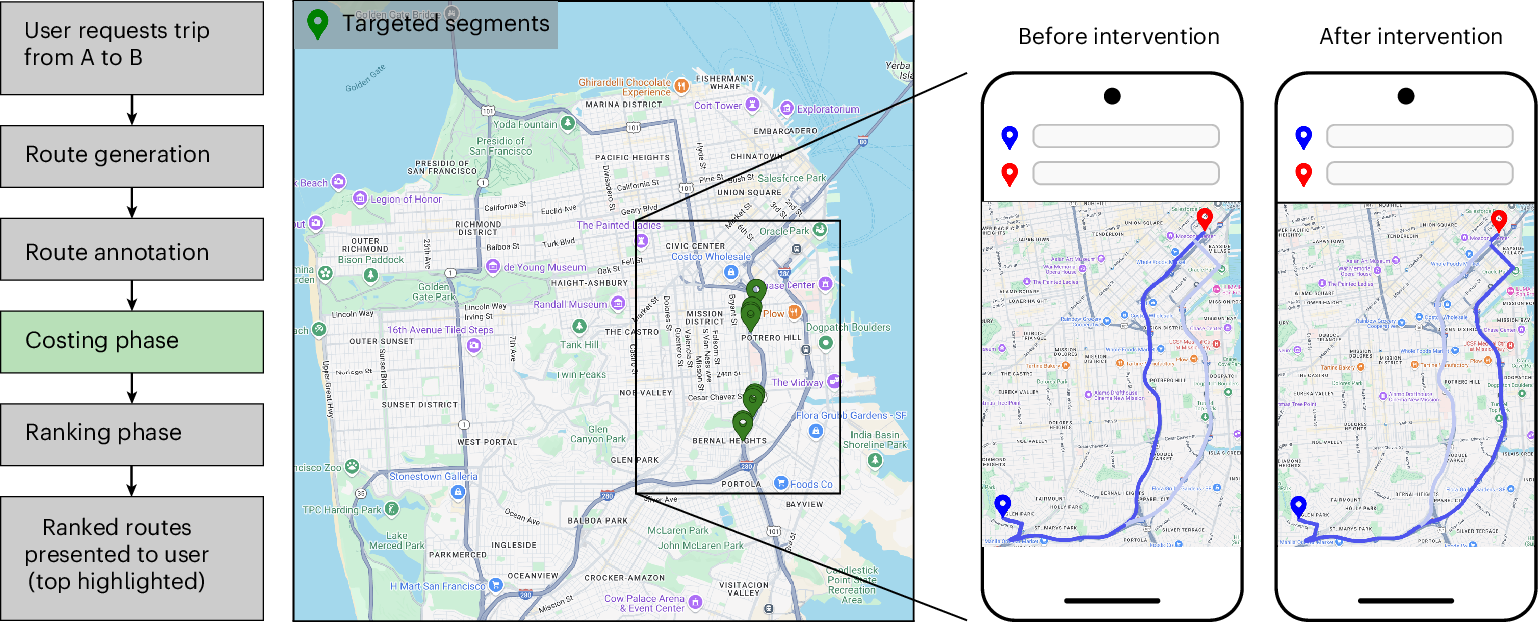
Urban congestion relief experiments through routing-app interventions
Traffic congestion remains a persistent challenge for urban mobility, increasing travel delays and elevating CO2 emissions. The widespread use of smartphones and GPS navigation creates new opportunities to mitigate congestion through routing optimizations in apps, yet real-world evidence for the effectiveness of such interventions is limited. Here we report large-scale empirical experiments evaluating routing-based traffic interventions on ~100 highly congested road segments across 10 major US cities. By rerouting a small share of Google Maps trips from targeted congested highway and arterial segments to less congested alternatives of equivalent road-classes with comparable travel times, we observe a city-average 2% increase in vehicle speeds on the intervened segments, along with improved travel times 0.7% and potential annual reductions exceeding 1,000 tons of CO2-equivalent emissions per city in the majority of studied locations. These findings provide evidence that marginal routing interventions involving a small proportion of vehicles can measurably enhance overall road network efficiency, offering a practical pathway to easing congestion and advancing urban sustainability.
Post-growth: the science of wellbeing within planetary boundaries
There are increasing concerns that continued economic growth in high-income countries might not be environmentally sustainable, socially beneficial, or economically achievable. In this Review, we explore the rapidly advancing field of post-growth research, which has evolved in response to these concerns. The central idea of post-growth is to replace the goal of increasing GDP with the goal of improving human wellbeing within planetary boundaries. Key advances discussed in this Review include: the development of ecological macroeconomic models that test policies for managing without growth; understanding and reducing the growth dependencies that tie social welfare to increasing GDP in the current economy; and characterising the policies and provisioning systems that would allow resource use to be reduced while improving human wellbeing.

This guy held back urban cycling for 30 years, but we still use his ideas
We don’t just need electric cars, we need fewer cars - Greenpeace International
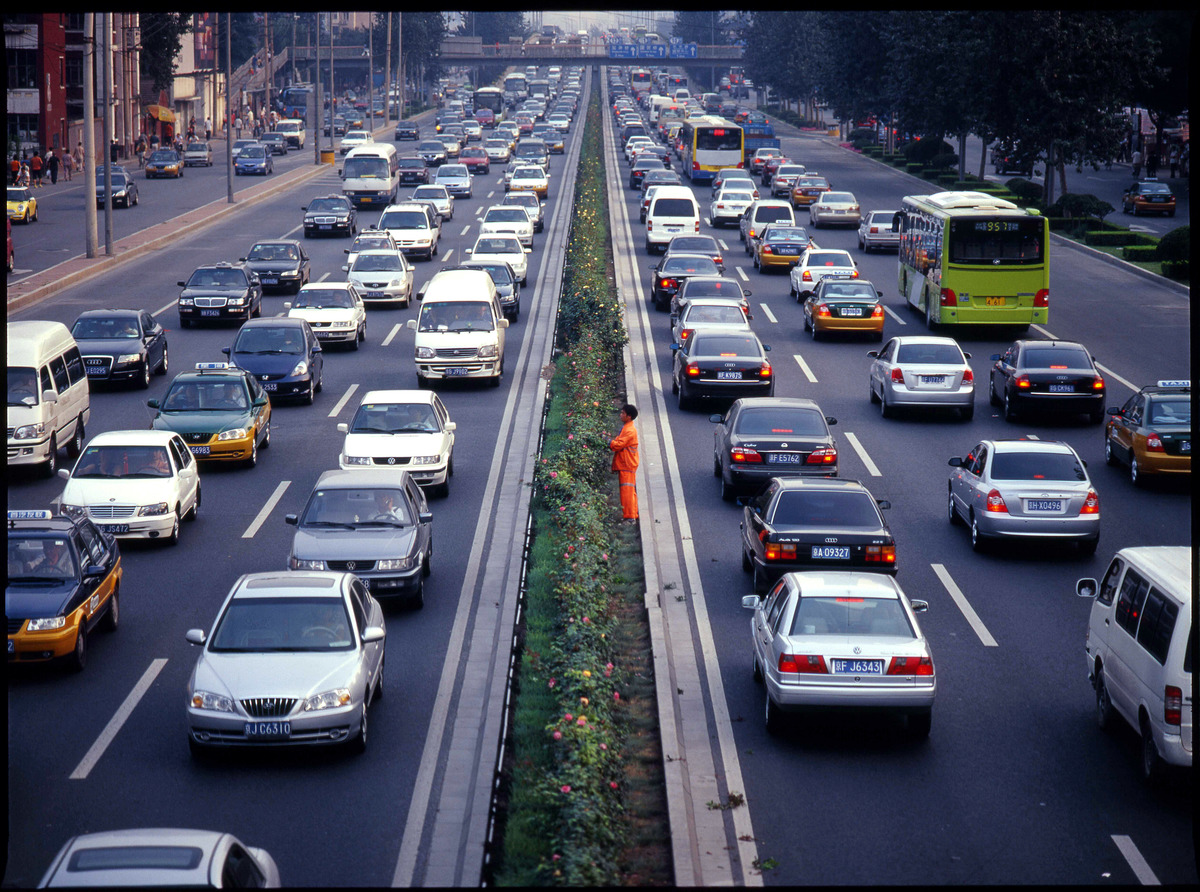
Ever since the first production car rolled off the assembly line more than 100 years ago, our love affair with automobiles has grown and grown.
The Disappearing Art Of Maintenance
The noble but undervalued craft of maintenance could help preserve modernity’s finest achievements, from public transit systems to power grids, and serve as a useful framework for addressing climate change and other pressing planetary constraints.

Last-Mile Optimism
Reducing Waste. Eliminating Fraud. Promoting Civic Responsibility. At least that’s what the city bureaucrats said.

Post-Growth - P2P Foundation
"The term postgrowth defines a range of approaches to socioecological challenges. They address these challenges in ways that are diametrically opposed to green-growth, which expresses the belief that society can simultaneously expand economic activity and reduce emissions and the demand for materials. Postgrowth approaches, by contrast, argue that the unlimited expansion of production and consumption is impossible and undesirable on a finite planet.
Cycling Toward a Cooler Toronto | The Power of Bike Lanes
Opinion: The e-bike revolution is here. San Francisco isn’t ready for it
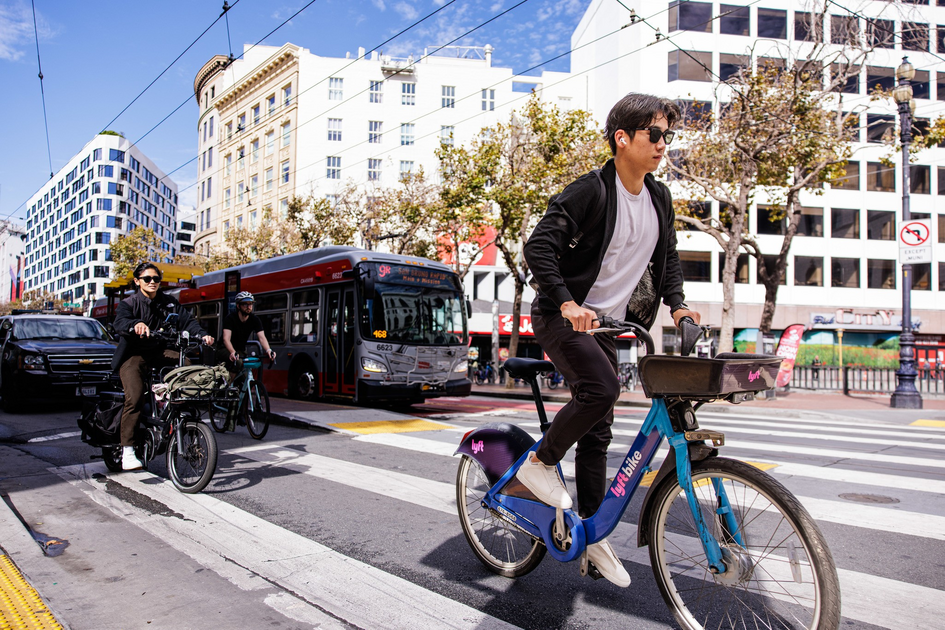
Bike commutes are up 52%, shared bike and scooter usage has doubled, and injuries are rising too. What the city needs isn’t a ban — it’s a backbone.
Home - Schumacher Center for a New Economics
Our mission is to envision a just and regenerative economy; apply the concepts locally; then share the results for broad replication. Programs Library Lectures & Publications The Decentralism File Community Land Trust Local Currencies Reinventing The Commons All Programs eNewsletters All News “Since there is now increasing evidence of environmental deterioration, particularly in … Continued

Third Places as Mini-Cosmopolitans - Surfing Modernity
What happens to identity in times of movement and change? In my second post, I proposed the importance of cultivating a third space that is not dependent on…
If there’s a war on cars in the USA then the cars have won
American vehicles have grown heavier, faster, and wider every decade since 1982 — and federal fuel economy rules reward the growth. Evidence from 50 years of EPA data.

cars are bad for humans

equity, mental, social, health issues caused by cars and car infra. #fuckcars

Motorists in one of a Montreal’s busiest boroughs support bike lanes
Killing someone with a car costs $1.6 million. California requires drivers to carry $30,000

Paying for driving
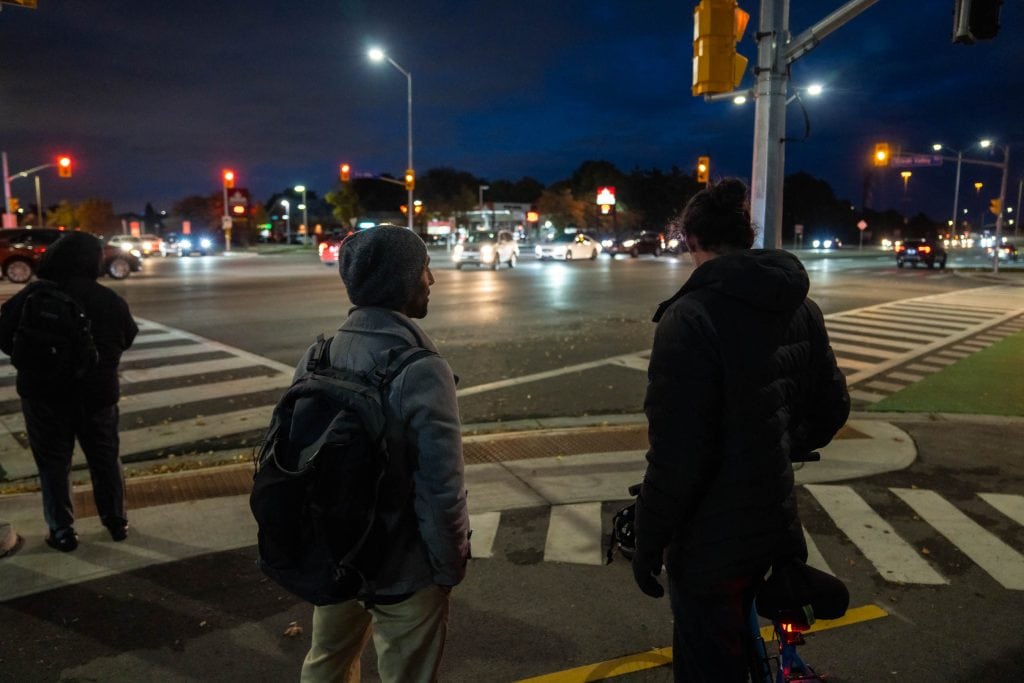
Will Canada’s gas tax holiday drive up emissions and help the rich? | The Narwhal

Transit push in Montreal could generate more GDP than vehicular focus: study - Montreal | Globalnews.ca

Every Right On Red Frays The Social Contract A Little Further | Defector