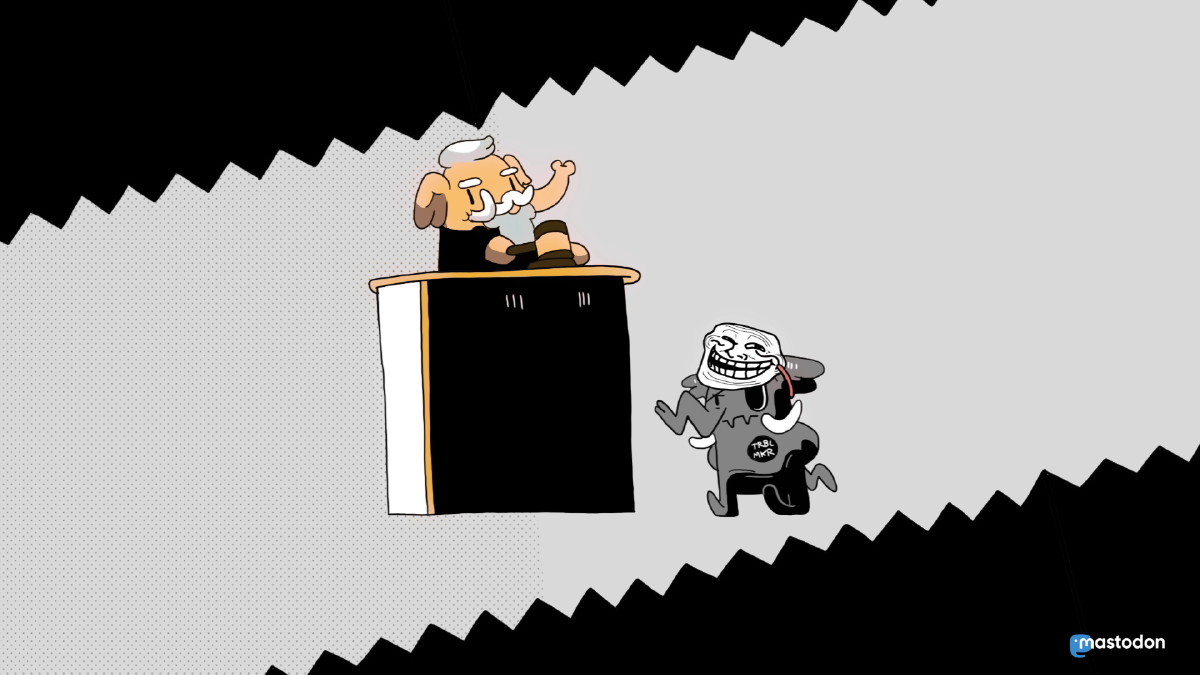
Here’s how to get into a lot of trouble: Suppose you (like me) love the intellectual wealth found in free-form text on the Internet. And (like me) are a reasonably competent programmer. And (like me) have derived value and pleasure searching Twitter. And (like me) you look at this nifty new Fediverse thing and see that it has nice Web APIs so you could build an app to vacuum up all the stories and laments and cheers and dunks and love letters and index ’em and let everyone search ’em and find wonderful things! So you lurch into the Mastodon conversation, all excited, and blurt out “Hey folks, I’m gonna index all this stuff and let the world in!” That’s when you get your face torn off.
Mastodon Status Check
My social-media life has been Fediverse-first for a year now. I stick my head into Bluesky and Threads regularly, but visit Twitter rarely if at all. This piece takes a close look at Mastodon-land as things stand in late summer 2023. What’s working, what’s not, what are the alternatives? [Originally published August 2023, updated November 27th for my one-year Twitter-exit anniversary.]
Mastodon Exit Interview
I am currently winding down the Mastodon bots I used to post sunrise and sunset times. The precipitating event is that the admin of the instance hosting the associated accounts demanded they be made nigh-undiscoverable, but the underlying cause is that it’s become increasing clear that Mastodon isn’t, and won’t ever be, a good platform for “asynchronous ephemeral notifications of any kind”. I’d also argue (more controversially) that it’s simply not good infrastructure for social networking of any kind. There are lots of interesting people using Mastodon, and I’m sure it will live on as a good-enough space for certain niche groups. But there is no question that it will never offer the fun of early Twitter, let alone the vibrancy of Twitter during its growth phase. I’ve long since dropped Mastodon from my home screen, and have switched to Bluesky for text-centric social media.
Mastodon - Decentralized social media
Learn more about Mastodon, the radically different, free and open-source decentralized social media platform.


How Does Mastodon Work? - Kev Quirk
I’ve spoken about Mastodon numerous times on this blog. It is the social media platform I use more than any other, but for a new user it can be confusing because it doesn’t work like other social media sites.
Mastodon Features That Twitter Should Steal (but Won’t)
Elon Musk's platform could learn a thing or two from its most popular alternative—like how to build a social platform people actually want to be on.

Mastodon and federation
The more I read about Mastodon promoters' opinions on how it should work, the more I think, "How could you possibly think that is how it is going to go?" One group of people want a Federated Feed Reader: They want to read the clever updates and memes from their friends and favorite celebrities. They want to post a GIF and have their friends validate them by hitting "like" on it. They want to ...
FediFind: Discover the Open Social Web, Your Way
Live search across Mastodon, Flipboard Social and Bluesky. No algorithm, no walls — your keywords become your feed.

Connecting the world through thriving online communities
A message from our Executive Director about Mastodon's vision and mission.

How The Enshittification Of Social Media Is Decreasing The Switching Costs And Enabling Something New
In the last few weeks I’ve written about how Elon Musk’s “changes” to how Twitter is running have done an amazing job convincing people to join Mastodon. And I’ve also…

Twitter alternative: how Mastodon is designed to be “antiviral”
The new social software is subtly designed to reduce the huge, viral surges of attention we see on Twitter
Coho
Discover a simpler way to socialize online with Coho, the Mastodon app that prioritizes ease-of-use and clean design. Experience the open-source, decentralized social network without the clutter. Join communities, share your thoughts, and connect with like-minded individuals all with just a few taps. Say goodbye to overwhelming feeds and complicated features, Coho simplifies the social media experience.
Protect Me From What I Want
Over on Mastodon, there are many people who enjoy not being in the grip of software like Facebook or Twitter that single-mindedly tries to maximize “engagement”, which means the amount of time you stare at the screen so they can show you ads. These algorithms don’t care what they’re showing you and if it turns out that showing you exclusively stories vilifying or praising Donald Trump (depending) maximizes engagement, then that’s what you’ll see. So the chant over there is “No algorithms on Mastodon!” This chant is wrong, and the discussion around it teaches us that we need clarity on what algorithms are, what moral weight they can carry, and whether they can be avoided. (Spoiler: They can’t.)
Understanding Decentralized Social Feed Curation on Mastodon
Amid rising concerns over moderation, algorithmic control, and platform governance on centralized social media, people are increasingly turning to decentralized alternatives like Mastodon to regain control over their feeds. This shift offers new opportunities to understand how people perceive and curate their feeds. We conducted a two-part study with 21 Mastodon users: first, interviews exploring how they perceive and manage their feeds; and second, a design probe study using BRAIDS.SOCIAL, a web-based feed curation prototype informed by the first part of our initial findings. We learned how seamful design can increase people's trust in algorithmic curation, and surfaced trade-offs people navigate between machine learning-based and rule-based filtering approaches. We also identify a core design tension in decentralized platforms: whether to support personalization through new applications or extensions layered atop existing ones.

The fediverse is an opportunity learned societies can’t ignore - LSE Impact
Björn Brembs argues that learned societies should lead developments on federated social media platforms, such as Mastodon.

Cage the Mastodon
A year ago I wrote about Mastodon’s improvements over Twitter’s lacking protections against abuse and harassment. Development in that area has not been standing still, and it’s about time we do another comparison.