


Earlier this year, I was a part of a CNN documentary, Twitter: Breaking the Bird, which gave me much pause for reflection about the state of social media and how we got here. This year alone weR…
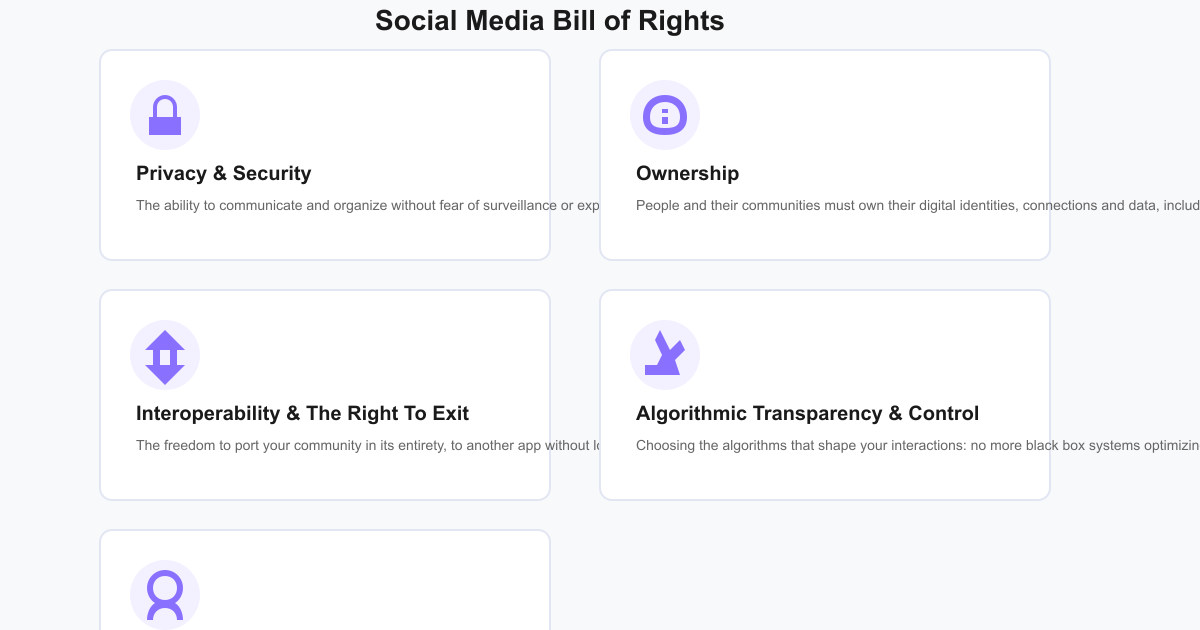
Declaration of Social Media Rights
Five fundamental rights we need for a free, open, and humane social media ecosystem
Improving social media for democratic discourse
Social media have expanded opportunities for communication and political participation, but today's dominant platforms are optimized primarily for engagement and advertising revenue, contributing...

Shifts in U.S. Social Media Use, 2020–2024: Decline, Fragmentation, and Enduring Polarization
The social media ecosystem appears to be in flux. Twitter’s rebranding to X has come to symbolize a broader reorganization of online publics – political reshuffling, user attrition, and uncertainty over the role of legacy platforms. Simultaneously, the shift from text-based, networked feeds toward algorithmically curated, short-form video has accelerated, with TikTok setting the pace for the wider ecosystem [18, 14, 16]. At the same time, everyday communication increasingly migrates from large, open networks to semi-private spaces such as group chats and messaging apps. Commentators describe a digital public sphere in transition: smaller, more fragmented, less dominated by traditional social networking sites, and rise of more broadcast-oriented forms of media – with some even suggesting that we are seeing the beginning of the end of the social media era.
How Social Media Brings Out the Worst in Us
A new book argues that social media does more harm than good and we might be happier and healthier using it less.
It’s Not 2006 Anymore; The Useful, Vernacular Institution; What Is Free Our Feeds, Anyway?
This issue explores emerging alternatives to centralized social media platforms and the institutional forms that might support them. The newsletter connects reflections from the ATMosphere Conference…
Measuring The Health of Our Public Conversations - Cortico
By Deb Roy, Eugene Yi, Russell Stevens Published: March 1, 2018 The Internet and social media have transformed modern society in many positive ways by connecting us to the world’s information, enabling social connections that transcend space and time, and giving everyone a voice. Within this transformation, social media have become an essential part of
Do social media threaten democracy?
Facebook, Google and Twitter were supposed to save politics as good information drove out prejudice and falsehood. Something has gone very wrong

The Nightmare of Eternal Spring: Why Social Media Can't Survive on "Niceness" Alone - Nightflight
Free Our Feeds
Social media is broken: controlled by a handful of billionaires who shape what people see, say, and believe. These platforms profit from division, exploit user data, and lock people into closed systems.
Shifts in U.S. Social Media Use, 2020-2024: Decline,...
Using nationally representative data from the 2020 and 2024 American National Election Studies (ANES), this paper traces how the U.S. social media landscape has shifted across platforms,...
Big Tech tried to get young people addicted. Now we’re fighting back
Two seismic court decisions in the US have intervened where legislators have failed to defend social media users from exploitation, writes campaigner Zamaan Qureshi

Brett Scott (@brettscott)
Marshall McLuhan is famous for his observation that the form of a communication technology can shape our mind and society The age of the printed book, for example, carried with it a particular way of being. Regardless of the differing content of different books, all books required a particular mindset in which a thread is followed from the beginning to the end through an arc I feel the age of social media is like the age of a ripped up book, as if we were surrounded by torn shards and shreds of paper floating like confetti around us. We grab for them, hoping for some tiny insight, but not having any way of knowing where it fits in the overarching narrative This note is one such shard. You can toss it away now

The Safe Social Media Act needs major fixes
Safety legislation is one step forward, two steps back
Do our social media algorithms correctly reflect our values? Our new article published today in @pnas.org shows that the answer is often not, and that the content that gets promoted into their ranked feeds is often actively counter to our values.
It's not much but at least we surpassed Truth Social here and I'm okay with that. #bluesky #socialMedia #us #usa #uspol #pew #research

Americans’ Social Media Use 2025
www.pewresearch.org🐝 Social Media (SB Commentary)

things I said about social media

Bee 🐝 (@sweetbee.vip)
Bee 🐝 (@sweetbee.vip)
Bee 🐝 (@sweetbee.vip)
