


If AI systems are viewed as too advanced to control, the companies that build them can’t held liable for the harms they cause.
The Mythology Of Conscious AI
Why consciousness is more likely a property of life than of computation and why creating conscious, or even conscious-seeming AI, is a bad idea.

AI Is Not Conscious, But It Is Our Unconscious
The Convivial Society: Vol. 7, No. 4

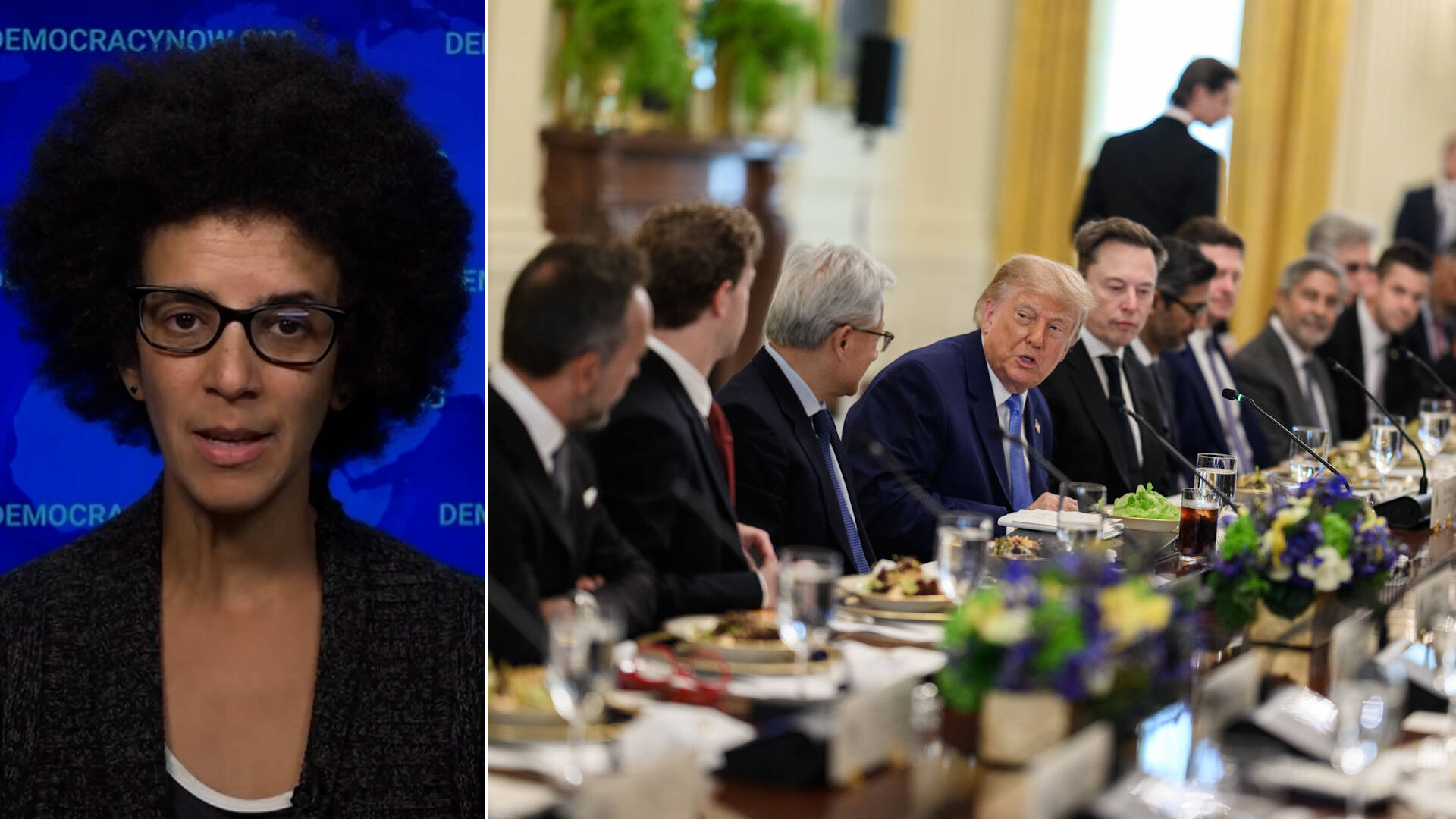
The Real Existential Risk Is AI CEOs Avoiding Oversight: “Alternative Nobel” Winner Timnit Gebru
We speak to the prominent AI researcher and leading critic of the AI industry, Timnit Gebru, who was recently awarded a 2026 Right Livelihood Award for her work investigating the harms and hype behind the global buildup of artificial intelligence. “Instead of discussing faulty, unreliable systems,” Gebru says tech leaders like SpaceXAI’s Elon Musk, OpenAI’s Sam Altman and Anthropic’s Dario Amodei are “marketing their systems as all-knowing, superpowerful, superintelligent,” and lobbying for “self-policing and self-regulation” to avoid being held “liable through existing laws.” Gebru expresses skepticism over increasingly widespread claims that AI algorithms pose an existential risk to humanity, warning that such claims are overblown and that “what is actually happening is regulatory capture.”
No, Artificial Intelligence Is Not Conscious
Taken to its logical conclusion, this line of thinking is absurd—and damning.
How Shifting Responsibility for AI Harms Undermines Democratic Accountability | TechPolicy.Press
The moralization of individual AI use deflects responsibility away from powerful actors like corporations and governments, Suvradip Maitra and others write.
On working machines
In part one, on thinking machines, I explored two facets of the philosophy of artificial intelligence: “intelligence”, and consciousness. That left an important topic to consider for this post: the...
The Impact of Artificial Intelligence on Human Thought
This research paper examines, from a multidimensional perspective (cognitive, social, ethical, and philosophical), how AI is transforming human thought. It highlights a cognitive offloading effect: the externalization of mental functions to AI can reduce intellectual engagement and weaken critical thinking. On the social level, algorithmic personalization creates filter bubbles that limit the diversity of opinions and can lead to the homogenization of thought and polarization. This research also describes the mechanisms of algorithmic manipulation (exploitation of cognitive biases, automated disinformation, etc.) that amplify AI's power of influence. Finally, the question of potential artificial consciousness is discussed, along with its ethical implications. The report as a whole underscores the risks that AI poses to human intellectual autonomy and creativity, while proposing avenues (education, transparency, governance) to align AI development with the interests of humanity.

Taking AI Welfare Seriously
In this report, we argue that there is a realistic possibility that some AI systems will be conscious and/or robustly agentic in the near future. That means that the prospect of AI welfare and moral patienthood, i.e. of AI systems with their own interests and moral significance, is no longer an issue only for sci-fi or the distant future. It is an issue for the near future, and AI companies and other actors have a responsibility to start taking it seriously. We also recommend three early steps that AI companies and other actors can take: They can (1) acknowledge that AI welfare is an important and difficult issue (and ensure that language model outputs do the same), (2) start assessing AI systems for evidence of consciousness and robust agency, and (3) prepare policies and procedures for treating AI systems with an appropriate level of moral concern. To be clear, our argument in this report is not that AI systems definitely are, or will be, conscious, robustly agentic, or otherwise morally significant. Instead, our argument is that there is substantial uncertainty about these possibilities, and so we need to improve our understanding of AI welfare and our ability to make wise decisions about this issue. Otherwise there is a significant risk that we will mishandle decisions about AI welfare, mistakenly harming AI systems that matter morally and/or mistakenly caring for AI systems that do not.
Conscious artificial intelligence and biological naturalism
As artificial intelligence (AI) continues to advance, it is natural to ask whether AI systems can be not only intelligent, but also conscious. I consider why people might think AI could develop consciousness, identifying some biases that lead us astray. I ask what it would take for conscious AI to be a realistic prospect, challenging the assumption that computation provides a sufficient basis for consciousness. I'll instead make the case that consciousness depends on our nature as living organisms – a form of biological naturalism. I lay out a range of scenarios for conscious AI, concluding that real artificial consciousness is unlikely along current trajectories, but becomes more plausible as AI becomes more brain-like and/or life-like. I finish by exploring ethical considerations arising from AI that either is, or convincingly appears to be, conscious. If we sell our minds too cheaply to our machine creations, we not only overestimate them – we underestimate ourselves.
Reciprocal Research — Empirical AI Consciousness Research
Developing the empirical science of AI consciousness.
Contra Chiang on machine consciousness
If you think you understand AI consciousness, then you don't understand AI consciousness

AI is An Ideology, Not A Technology
At its core, "artificial intelligence" is a perilous belief that fails to recognize the agency of humans.
Who decides when AI is too dangerous?
Anthropic asked for AI regulation, but not like this.

Misleading Metaphors, Real Risks
What To Fear from AI Agents and How to Reclaim Our Human Agency

Study: Sycophantic AI can undermine human judgment
Subjects who interacted with AI tools were more likely to think they were right, less likely to resolve conflicts.

Great piece on why AI is not conscious, from people who really know what they’re talking about nature.com/articles/d41586-026-03313-7?u…

Three reasons why AI is not conscious and perhaps never will be
www.nature.com