

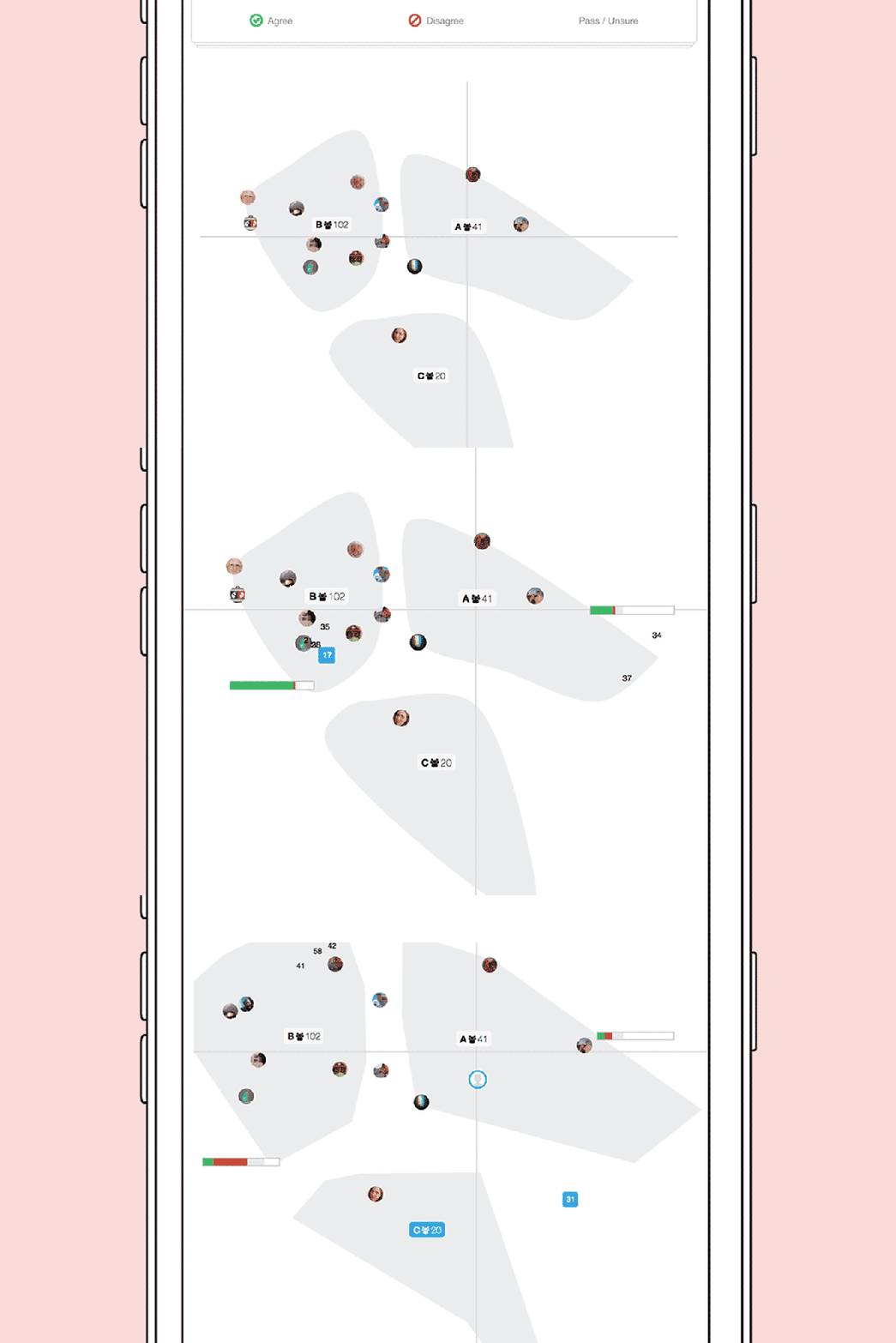
A new form of online survey uses crowdsourcing and data visualization to reveal the hidden nuances in partisan debates.
The Internet Doesn’t Have to Be Bad for Democracy
A new form of online survey uses crowdsourcing and data visualization to reveal the hidden nuances in partisan debates.
Opinion | This Is What Will Ruin Public Opinion Polling for Good
Instead of navigating the obstacles to conduct polls with human respondents, pollsters are running A.I. simulations instead. Why?

What is Deliberative Polling®?
Citizens are often uninformed about key public issues. Conventional polls represent the public’s surface impressions of sound bites and headlines. The public, subject to what social scientists have called “rational ignorance,” has little reason to confront trade-offs or invest time and effort in acquiring information or coming to a considered judgment.
How to Run Surveys: A Guide to Creating Your Own Identifying Variation and Revealing the Invisible
Surveys are an essential approach for eliciting otherwise invisible factors such as perceptions, knowledge and beliefs, attitudes, and reasoning. These factors are critical determinants of social, economic, and political outcomes. Surveys are not merely a research tool. They are also not only a way of collecting data. Instead, they involve creating the process that will generate the data. This allows the researcher to create their own identifying and controlled variation. Thanks to the rise of mobile technologies and platforms, surveys offer valuable opportunities either to study broadly representative samples or to focus on specific groups. This article offers guidance on the complete survey process, from the design of the questions and experiments to the recruitment of respondents and the collection of data to the analysis of survey responses. It covers issues related to the sampling process, selection and attrition, attention and carelessness, survey question design and measurement, response biases, and survey experiments.

U.K. Intelligence Agency's Bag of Tricks Includes Ability to Manipulate Online Polls
Even something as seemingly innocuous as an online poll could be compromised by government initiatives. New documents show that the U.K. intelligence...

Opinionrot: Toward a Theory of Collective Reasoning Decay in the Age of Synthetic Consensus
This article introduces the concept of opinionrot to describe the structural erosion of collective reasoning within contemporary information systems. Rather than treating post-truth politics as a failure of individual rationality or as a decline in information quality alone, the article argues that public reasoning is increasingly shaped by infrastructures that capture attention, monetize cognitive bias, and automate the conditions under which claims become visible and credible. Methodologically, the article proceeds through a conceptual-historical reconstruction, tracing how persuasion became institutionalized, platformized, and increasingly predictive. It identifies three mechanisms through which opinionrot intensifies today: cognitive capture, infrastructural decay, and discursive saturation. The framework is illustrated through debates over equality and affirmative action, showing how communicative infrastructures can transform contested political concepts into predictable and polarized semantic routines. By shifting the analysis from discrete falsehoods to the conditions under which public judgment is formed, contested, and revised, the article offers a diagnostic vocabulary for studying how information infrastructures increasingly convert deliberation into statistical efficiency within contemporary economies of attention.
An Assessment of the Causes of the Errors in the 2015 UK Gseneral Election Opinion Polls
Summary The opinion polls that were undertaken before the 2015 UK general election underestimated the Conservative lead over Labour by an average of 7 percentage points. This collective failure led politicians and commentators to question the validity and utility of political polling and raised concerns regarding a broader public loss of confidence in survey research. We assess the likely causes of the 2015 polling errors. We begin by setting out a formal account of the statistical methodology and assumptions that are required for valid estimation of party vote shares by using quota sampling. We then describe the current approach of polling organizations for estimating sampling variability and suggest a new method based on bootstrap resampling. Next, we use poll microdata to assess the plausibility of different explanations of the polling errors. Our conclusion is that the primary cause of the polling errors in 2015 was unrepresentative sampling.

Chatbots and the Ballot Box: Evaluating Accuracy, Sourcing, and Language Gaps in AI Answers to Election Questions
ISD assesses how reliably six leading AI models provide accurate, complete information on US election procedures and voter access.
Do AI and bogus respondents threaten polling’s future?
Courtney Kennedy, vice president of methods and innovation, answers some common questions about the current polling landscape in the U.S.


Bridging Voting and Deliberation with Algorithms: Field Insights from vTaiwan and Kultur Komitee
Democratic processes increasingly aim to integrate large-scale voting with face-to-face deliberation, addressing the challenge of reconciling individual preferences with collective decision-making. This work introduces new methods that use algorithms and computational tools to bridge online voting with face-to-face deliberation, tested in two real-world scenarios: Kultur Komitee 2024 (KK24) and vTaiwan. These case studies highlight the practical applications and impacts of the proposed methods. We present three key contributions: (1) Preference-based Clustering for Deliberation (PCD), which enables both in-depth and broad discussions in deliberative settings by computing homogeneous and heterogeneous group compositions with balanced and adjustable group sizes; (2) Human-in-the-loop MES, a practical method that enhances the Method of Equal Shares (MES) algorithm with real-time digital feedback. This builds algorithmic trust by giving participants full control over how much decision-making is delegated to the voting aggregation algorithm as compared to deliberation; and (3) the ReadTheRoom deliberation method, which uses opinion space mapping to identify agreement and divergence, along with spectrum-based preference visualisation to track opinion shifts during deliberation. This approach enhances transparency by clarifying collective sentiment and fosters collaboration by encouraging participants to engage constructively with differing perspectives. By introducing these actionable frameworks, this research extends in-person deliberation with scalable digital methods that address the complexities of modern decision-making in participatory processes.

Improving social media for democratic discourse
Social media have expanded opportunities for communication and political participation, but today's dominant platforms are optimized primarily for engagement and advertising revenue, contributing...
Redesigning algorithms to intervene on social norm misperceptions during a national election
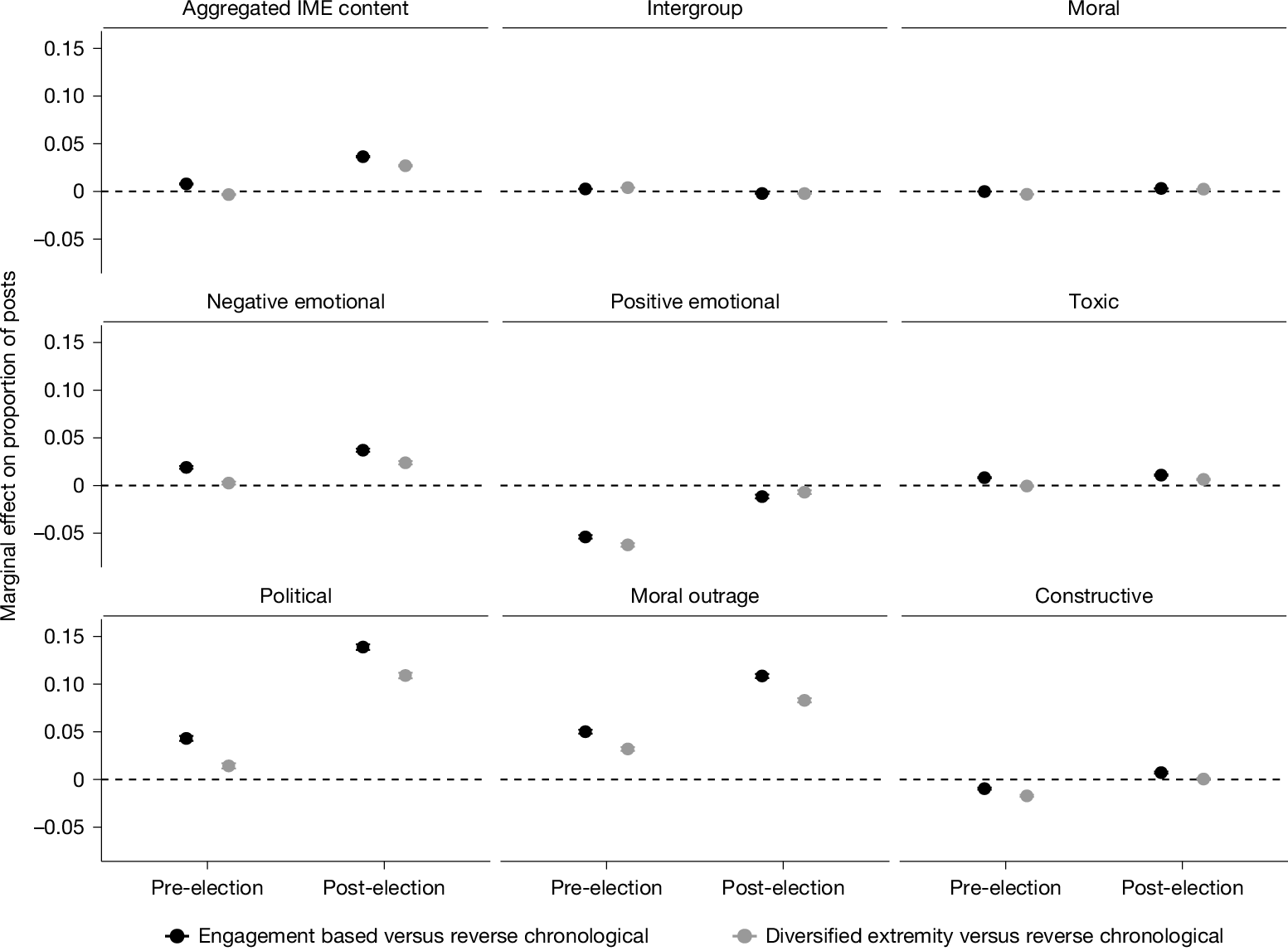
For the first time in history, civic discourse commonly occurs in digital environments in which algorithms influence exposure to social information1,2. It is increasingly important to understand whether and how these algorithms affect political discourse3–5. Here we built custom feed-ranking algorithms with full control over their features, and randomly assigned 2,000 participants to use them for 8 weeks (before and after the 2024 US presidential election). We tested whether an engagement-based algorithm (used on major social media platforms6,7) amplifies intergroup, moralized and emotional (IME) information in ways that skew perceptions of social norms around political dialogue5,8, and whether it increased engagement with IME content and perceptions of partisan animosity (compared with a reverse-chronological feed9,10). We also developed and tested a ‘diversified extremity’ algorithm to reduce the influence of extreme users11–13 to improve the accuracy of social norm perception14–16 and reduce perceptions of partisan animosity. We found that engagement-based feeds amplified IME and toxic content relative to reverse-chronological feeds, with the largest increases in moral outrage and political content. Engagement-based feeds also reduced prescriptive norm perception accuracy (albeit in an unexpected direction) and increased perceived partisan animosity. However, they did not significantly alter users’ own engagement behaviours. The diversified extremity algorithm reduced IME and toxic content exposure, improved prescriptive norm accuracy, yet maintained comparable platform enjoyment—suggesting that reducing the influence of extreme users can curb algorithmic distortions without diminishing user experience.
Redesigning algorithms to intervene on social norm misperceptions during a national election
For the first time in history, civic discourse commonly occurs in digital environments in which algorithms influence exposure to social information1,2. It is increasingly important to understand whether and how these algorithms affect political discourse3–5. Here we built custom feed-ranking algorithms with full control over their features, and randomly assigned 2,000 participants to use them for 8 weeks (before and after the 2024 US presidential election). We tested whether an engagement-based algorithm (used on major social media platforms6,7) amplifies intergroup, moralized and emotional (IME) information in ways that skew perceptions of social norms around political dialogue5,8, and whether it increased engagement with IME content and perceptions of partisan animosity (compared with a reverse-chronological feed9,10). We also developed and tested a ‘diversified extremity’ algorithm to reduce the influence of extreme users11–13 to improve the accuracy of social norm perception14–16 and reduce perceptions of partisan animosity. We found that engagement-based feeds amplified IME and toxic content relative to reverse-chronological feeds, with the largest increases in moral outrage and political content. Engagement-based feeds also reduced prescriptive norm perception accuracy (albeit in an unexpected direction) and increased perceived partisan animosity. However, they did not significantly alter users’ own engagement behaviours. The diversified extremity algorithm reduced IME and toxic content exposure, improved prescriptive norm accuracy, yet maintained comparable platform enjoyment—suggesting that reducing the influence of extreme users can curb algorithmic distortions without diminishing user experience.
Generative AI Meets Open-Ended Survey Responses: Research Participant Use of AI and Homogenization
The growing popularity of generative artificial intelligence (AI) tools presents new challenges for data quality in online surveys and experiments. This study examines participants’ use of large language models to answer open-ended survey questions and describes empirical tendencies in human versus large language model (LLM)-generated text responses. In an original survey of research participants recruited from a popular online platform for sourcing social science research subjects, 34 percent reported using LLMs to help them answer open-ended survey questions. Simulations comparing human-written responses from three pre-ChatGPT studies with LLM-generated text reveal that LLM responses are more homogeneous and positive, particularly when they describe social groups in sensitive questions. These homogenization patterns may mask important underlying social variation in attitudes and beliefs among human subjects, raising concerns about data validity. Our findings shed light on the scope and potential consequences of participants’ LLM use in online research.

Political Quizzes | The Paper Pilot
The Paper Pilot's digital garden of thoughts on philosophy, politics, and sociology