Here’s how China rules using data, AI, and internet surveillance.
China’s plan to organize its society relies on ‘big data’ to rate everyone
The Communist Party wants to harness vast troves of online data to score people and companies on their behavior.

The architecture of the internet creates risks for democracy
Will democracy survive the internet? Do we need to choose between Facebook’s surveillance capitalism or democracy? Layered lines of evidence can inform questions like these. When considered together, the evidence gives rise to a concerning picture, as summarized in a recent report for the European Commission that I co-led.

Data-owning Democracy or Digital Socialism?
This article contrasts two reform proposals articulated in recent debates about how to democratize the digital economy: data-owning democracy and digital socialism. A data-owning democracy is a political-economic regime character-ized by the
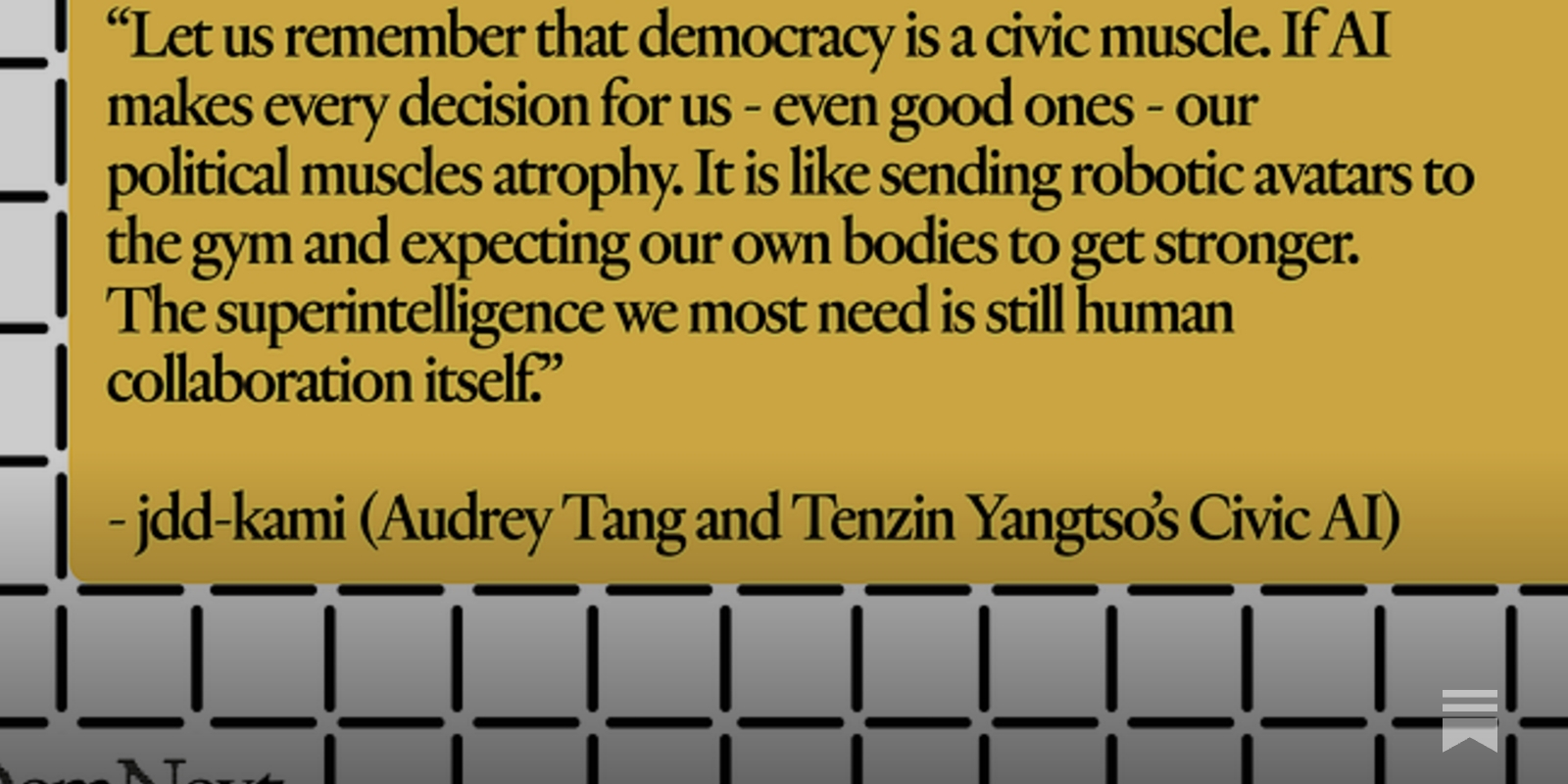
Democracy Needs AI That Listens
From Taiwan's deliberative experiments to our own AI policy - featuring jdd-kami, the Civic AI that fits in a carry-on
Democracy blindsides Silicon Valley’s power players looking to transform the world with AI
‘The push against datacenters speaks to the frustration of people who don’t feel they are making the choices in their lives’

Upholding Democracy in the Age of AI: remarks from UMass - Ethan Zuckerman
I gave a talk a few weeks back at a UMass event titled “How ‘We the People’ Can Uphold Democracy in the Age of Social Media and AI” – you can see my remarks and those of my copanelists – Manisha Sinha of UConn and Jonathan Nagler of NYU – on YouTube. My basic argument:… Read More »Upholding Democracy in the Age of AI: remarks from UMass

The Limits of Data
Policymakers want to make decisions based on clear data, but important factors are lost when we rely solely on data. A philosopher writes:

To Repress or to Co‐opt? Authoritarian Control in the Age of Digital Surveillance
This article studies the consequences of digital surveillance in dictatorships. I first develop an informational theory of repression and co-optation. I argue that digital surveillance resolves dicta...

AI and Doctrinal Collapse
Artificial intelligence runs on data. But the two legal regimes that govern data—information privacy law and copyright law—are under pressure. Formally, each re

From Democracies to Autocracies: How AI Systems Enable Authoritarianism by Design
AI-enabled authoritarianism is not confined to autocracies. In this paper, we provide greater transparency by investigating and mapping the lifecycles of six AI systems deployed in different political regimes, ranging from the US to China. By drawing on an extensive range of sources (academic publications, investigative research reports, third-party evaluations, media interviews, government procurement notices), we conduct a systematic, qualitative comparison across systems to identify the critical technical and operational features that enable authoritarianism within their respective political contexts. We find that enabling features include the centralization and co-optation of administrative data for law enforcement and political punishment, regulatory gaps that fail to deter misuse, weak user compliance that nullifies human oversight mechanisms, and the encoding of protected group traits that identify members of vulnerable populations. We find that these features are present across systems deployed in autocratic and democratic regimes, albeit in varying configurations. We also find that both centralized and fragmented AI systems can contribute to authoritarianism by exploiting governance gaps: centralized systems directed by executive authorities, particularly within security and military institutions, are often not subjected to formal oversight mechanisms, while fragmented systems diffuse accountability between stakeholders, paving the way for entrenchment. These findings reveal that AI-enabled authoritarianism is distributed, resulting from design and operational choices made by developers, administrators, and users alike. We conclude with recommendations for developers and policymakers to mitigate these risks.
In the face of rampant AI, is ‘data poisoning’ a new form of civil disobedience?
Boycotts, sabotage and other types of civil disobedience have long served collective action against injustice.

In the face of rampant AI, is ‘data poisoning’ a new form of civil disobedience?
Boycotts, sabotage and other types of civil disobedience have long served collective action against injustice.
Artificial Intelligence and the Purpose of Social Systems
The law and ethics of Western democratic states have their basis in liberalism. This extends to regulation and ethical discussion of technology and businesses doing data processing. Liberalism relies on the privacy and autonomy of individuals, their ordering through a public market, and, more recently, a measure of equality guaranteed by the state. We argue that these forms of regulation and ethical analysis are largely incompatible with the techno-political and techno-economic dimensions of artificial intelligence. By analyzing liberal regulatory solutions in the form of privacy and data protection, regulation of public markets, and fairness in AI, we expose how the data economy and artificial intelligence have transcended liberal legal imagination. Organizations use artificial intelligence to exceed the bounded rationality of individuals and each other. This has led to the private consolidation of markets and an unequal hierarchy of control operating mainly for the purpose of shareholder value. An artificial intelligence will be only as ethical as the purpose of the social system that operates it. Inspired by the science of artificial life as an alternative to artificial intelligence, we consider data intermediaries: sociotechnical systems composed of individuals associated around collectively pursued purposes. An attention cooperative, that prioritizes its incoming and outgoing data flows, is one model of a social system that could form and maintain its own autonomous purpose.

Government to ease data consent rules for AI development | The Asahi Shimbun Asia & Japan Watch
To accelerate artificial intelligence development, the government plans to relax consent requirements for access to personal information while introducing tougher penalties for intentional misuse.

GDPR, China and data sovereignty are ultimately wins for Amazon and Google | TechCrunch
The Great Privacy Policy Email Deluge of 2018 may have finally petered out, but we are just starting to build an understanding of who the winners and