


Language and code now flow back and forth across the executable boundary condition all but interchangeably, writes Matthew Kirschenbaum.

Model Misalignment and Language Change: Traces of AI-Associated Language in Unscripted Spoken English
Companion code for the AIES 2025 paper 'Model Misalignment and Language Change: Traces of AI-Associated Language in Unscripted Spoken English' (Anderson, Galpin & Juzek).
The Thoughts The Civilized Keep
The hype around a new AI language generator reveals the sterility of mainstream thinking on AI today — and indeed on how we think about thinking itself.

Stuff we figured out about AI in 2023
2023 was the breakthrough year for Large Language Models (LLMs). I think it’s OK to call these AI—they’re the latest and (currently) most interesting development in the academic field of …
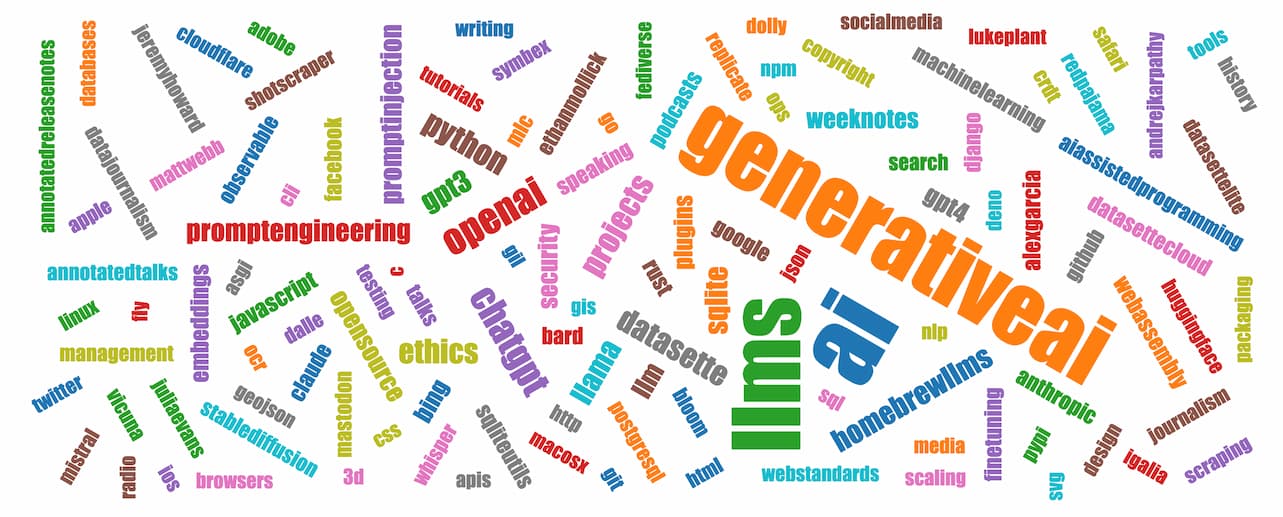
Language and AI: Guy Emerson on using AI with language data | Cambridge Language Sciences
It's a funny time to be working on language and AI. A year ago, this might have seemed like a niche interest, but these days ‘large language model’ is practically a household term. I recently had the chance to speak about language and AI at an event run by the Centre for Science and Policy, and I thought I would write a summary, because it seems a lot of people are interested in learning about how AI can be used with language data.
AI Is Thirsty
Each chat with a large language-model is like dumping a bottle of water on the ground
Covert Racism in AI: How Language Models Are Reinforcing Outdated Stereotypes | Stanford HAI
Despite advancements in AI, new research reveals that large language models continue to perpetuate harmful racial biases, particularly against speakers of African American English.

agentlanguages.dev — Programming languages designed for AI agents to write
A community-edited catalogue of programming languages designed for AI agents to author code, organised around three philosophical camps: syntactic, verification, and orchestration.
Systems programming the model
This paper examines the status of the language model object in generative AI, arguing that what we call a ‘model’ is inseparable from the systems deploying it. I first theorize how these objects emerge from systems-level interactions between trained artifacts, prompting mechanisms, and sampling methods, drawing on the philosophy of digital objects as well as software studies to show how models gain their objective character. Such interactions converge on programming, not prompting, language models, and I illustrate how critical code studies can therefore track these dynamics. In an overview of language model programming approaches, I discuss how prompt and program converge, demonstrating how this confluence tends toward the production of new feedback loops wherein models become models of and for themselves. Understanding these feedback loops is essential in view of recent efforts to infrastructuralize AI, in which multiple models cascade into compound systems that abstract toward a unified model of models. Thus the need, I argue, for a systems-level view that can address this new order of abstraction and complexity by identifying where and how the model emerges from the system.

Maintaining the love for coding in the time of AI
By Alex Band Over the last year, we have seen the profound effects Large Language Models (LLMs) have on our open-source software work at NLnet Labs. These can be grouped into two main areas: community contributions and security reports. Before we dive into this topic, let me first give
No AI Slop: A Manifesto
The No AI Slop Manifesto, from the speakers and attendees of AIE Code Summit 2026.
Why tech is racing to adopt AI coding
The head of AI coding platform Cursor on what’s next for programming, whether AGI is imminent, and competing with Anthropic and OpernAI.

The Next 7000 Programming Languages
Landin’s seminal paper “The next 700 programming languages” considered programming languages prior to 1966 and speculated on the next 700. Half-a-century on, we cast programming languages in a Darwinian ‘tree of life’ and explore languages, their features (genes) and language evolution from the viewpoint of ‘survival of the fittest’.
Forth: The Hacker’s Language
Let’s start right off with a controversial claim: Forth is the hacker’s programming language. Coding in Forth is a little bit like writing assembly language, interactively, for a strang…
