


Use this comprehensive glossary of AI terms to understand the language of artificial intelligence.
Artificial Intelligence
Summary. The term artificial intelligence (AI) is typically used as if it refers to a coherent, extant or near-future set of technologies, but, in fact, it

Glossary of Terms: Generative AI Basics - MIT Sloan Teaching & Learning Technologies
Learn key AI terms. This glossary defines and explains important concepts like generative AI, large language model, natural language processing, and more.

Artificial Intelligence Glossary | Stanford HAI
Artificial Intelligence (AI) is rapidly growing, with new terms and concepts being introduced at a breakneck speed. You may have seen terms such as AGI, machine learning, or foundation models in media headlines, emerging legislation, or in your everyday life.
Opaque recurrence, and other AI terms that you should probably know | TechCrunch
The rise of AI has brought an avalanche of new terms and slang. Here is a glossary with definitions of some of the most important words and phrases you might encounter.

Glossary of Terms for Artificial Intelligence | Columbia Business School
Columbia University in the City of New York 665 West 130th Street, New York, NY 10027 Tel. 212-854-1100
Machine Learning Glossary | Google for Developers
This glossary defines a wide range of machine learning terms, including those specific to TensorFlow and large language models.

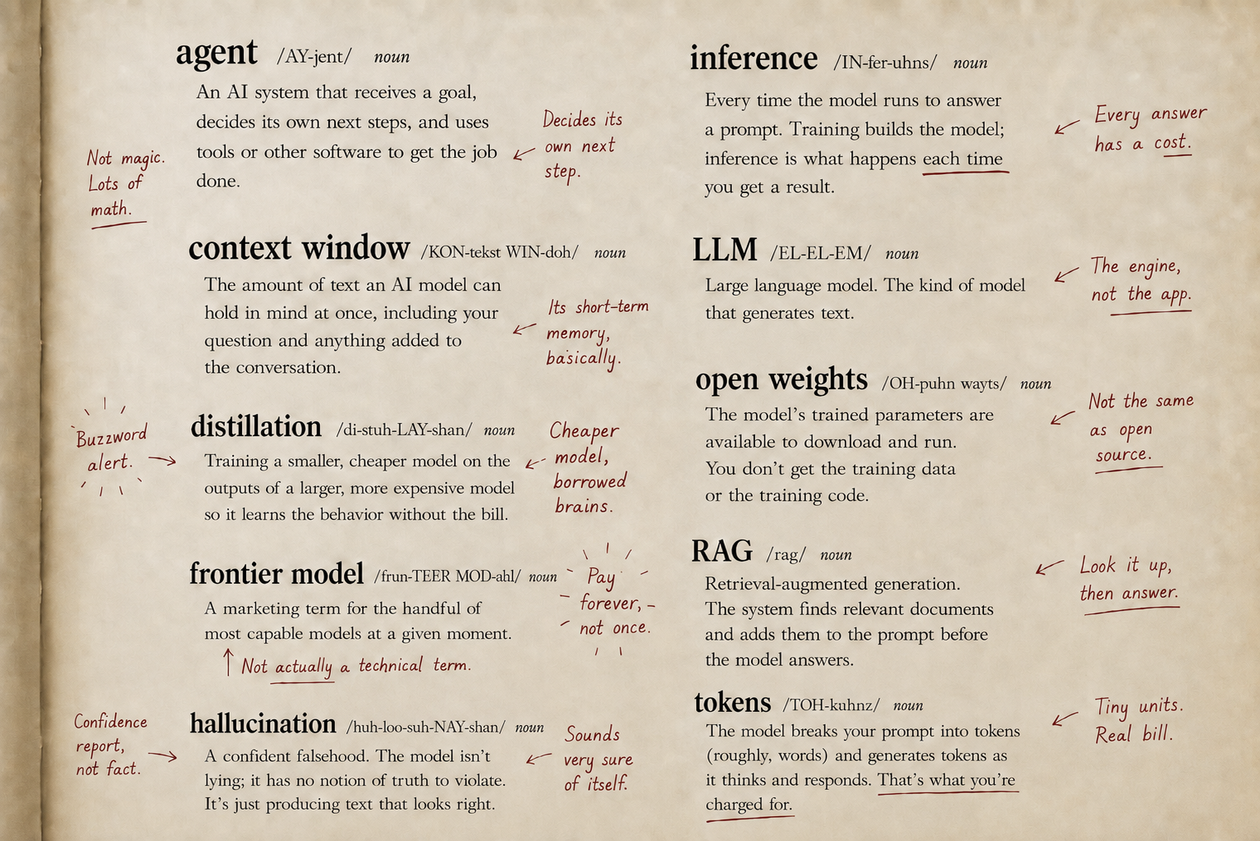
Etzioni on AI: An Opinionated Glossary of AI
Everyone in tech says things like LLM, open weights, RAG and agent; far fewer could define precisely what they all mean. Oren Etzioni sorts out about 30 AI terms in plain English, with a blunt verdict on each and one novel phrase he believes isn't used enough.
Wikipedia:Artificial intelligence resources
This is a directory related to artificial intelligence (AI) in various administrative namespaces including; protocols, essays, collaboration groups, maintenance resources, discussions and news.
Artificial intelligence
Artificial intelligence (AI) is the capability of computational systems to perform tasks typically associated with human intelligence, such as learning, reasoning, problem-solving, perception, and decision-making. It is a field of research in engineering, mathematics and computer science that develops and studies methods and software that enable machines to perceive their environment and use learning and intelligence to take actions that maximize their chances of achieving defined goals.[1]
AI Agent Memory: Complete Guide & Architecture
AI agent memory: what it is, how it works, architecture, memory types, and how to add persistent long-term context.

Ali Alkhatib: Defining AI
The main issue I have with a lot of work that tries to define AI is that the criteria they use to draw boundaries often turn out to be functionally useless for my needs; these definitions lead us to weird places, letting scholars fixate on strange, unworkable frameworks. Those pedantic fixations don’t really benefit the organizers, activists, regular people who are getting crushed by the systems they’re trying to work against. So I’m going to try to unpack how I think about AI; how I trace the boundaries of the term in a way that’s as useful as possible for me and my needs; and how I would encourage you to scope or define ideas that are important to your work.
What is Agentic AI? Examples, Use Cases, and Platforms [wcyear]
Everything you need to know about agentic AI solutions, including real-life examples of use cases, workflows, and frameworks.

AI Agents: Key Concepts and How They Overcome LLM Limitations
An AI agent is an autonomous software entity that is often used to augment a large language model. Here's what developers need to know.

Machine understanding
What do artificial intelligence (AI) systems “understand”? This question arises not only in assessing a system’s intelligence but also in evaluation practices to ensure the safe and responsible deployment of AI. Drawing on scholarship from philosophy and cognitive science, and informed by current practices in AI, we develop a framework for asking more precise questions and making more precise claims about machine understanding. We conceptualize understanding as a relation between a system (S) and a target of understanding (T), and we discuss how to specify the relation, the system, and the target, offering a landscape of options in each case. Our goal is not to defend a particular account of understanding, but to provide conceptual tools for those working to assess or advance machine understanding.

Artificial intelligence how is it different from human intelligence?
Discover key differences between artificial intelligence and human intelligence in this post from MSc AI Programme Director Rameez Kureshi.

When people ask me what the phrase "artificial intelligence" means, my short answer is, it means "venture capitalists, give me some money". But OUP asked me for a longer answer, given here and summarized in the section headings: doi.org/10.1093/9780197852712.003.006…
