A New York Times columnist says it’s “much too slangy, regional or what you might even call ethnic to ever gain universal acceptance.” We couldn’t disagree more.
Green’s Dictionary of Slang
‘Quite simply the best historical dictionary of English slang there is, ever has been […] or is ever likely to be’ — Journal of English Language and Linguistics
Building a Culture of (Digital) Safety
Black culture is in a lot of ways synonymous with how internet culture exists writ large. From what is now described as “Gen-Z slang” (or as Black people have always known it, AAVE) to our methods of organizing (Black feminists starting hashtag activism and creating movements like #MeToo, #BlackLivesMatter, and #SayHerName) and even how we […]
How Y’all, Youse and You Guys Talk (Published 2024)
What does the way you speak say about where you’re from? Answer all the questions below to see your personal dialect map.

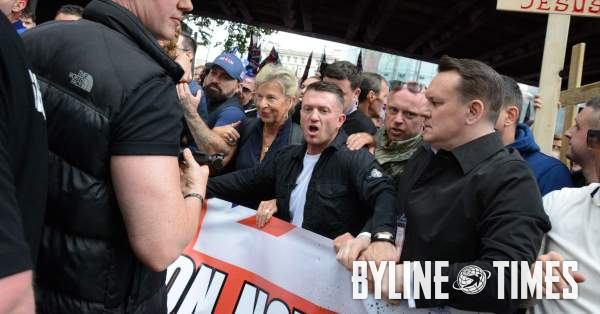
How Tommy Robinson Disguises White Supremacism In the Coded Language of Anti-Islam Politics
Robinson repeatedly uses “native” for white, “invader” for non-white and “African” and “Somali” for black across 140 posts examined by Byline Times
As diversity increases, people paradoxically perceive social groups as more similar
With globalization and immigration, societal contexts differ in sheer variety of resident social groups. Social diversity challenges individuals to think in new ways about new kinds of people and where their groups all stand, relative to each other. However, psychological science does not yet specify how human minds represent social diversity, in homogeneous or heterogenous contexts. Mental maps of the array of society’s groups should differ when individuals inhabit more and less diverse ecologies. Nonetheless, predictions disagree on how they should differ. Confirmation bias suggests more diversity means more stereotype dispersion: With increased exposure, perceivers’ mental maps might differentiate more among groups, so their stereotypes would spread out (disperse). In contrast, individuation suggests more diversity means less stereotype dispersion, as perceivers experience within-group variety and between-group overlap. Worldwide, nationwide, individual, and longitudinal datasets ( n = 12,011) revealed a diversity paradox: More diversity consistently meant less stereotype dispersion. Both contextual and perceived ethnic diversity correlate with decreased stereotype dispersion. Countries and US states with higher levels of ethnic diversity (e.g., South Africa and Hawaii, versus South Korea and Vermont), online individuals who perceive more ethnic diversity, and students who moved to more ethnically diverse colleges mentally represent ethnic groups as more similar to each other, on warmth and competence stereotypes. Homogeneity shows more-differentiated stereotypes; ironically, those with the least exposure have the most-distinct stereotypes. Diversity means less-differentiated stereotypes, as in the melting pot metaphor. Diversity and reduced dispersion also correlate positively with subjective wellbeing.

The Racialization of Print
Readers since Thomas Jefferson have believed it possible to judge entire races of people based on a single book, yet no one has attempted to explain the orig...
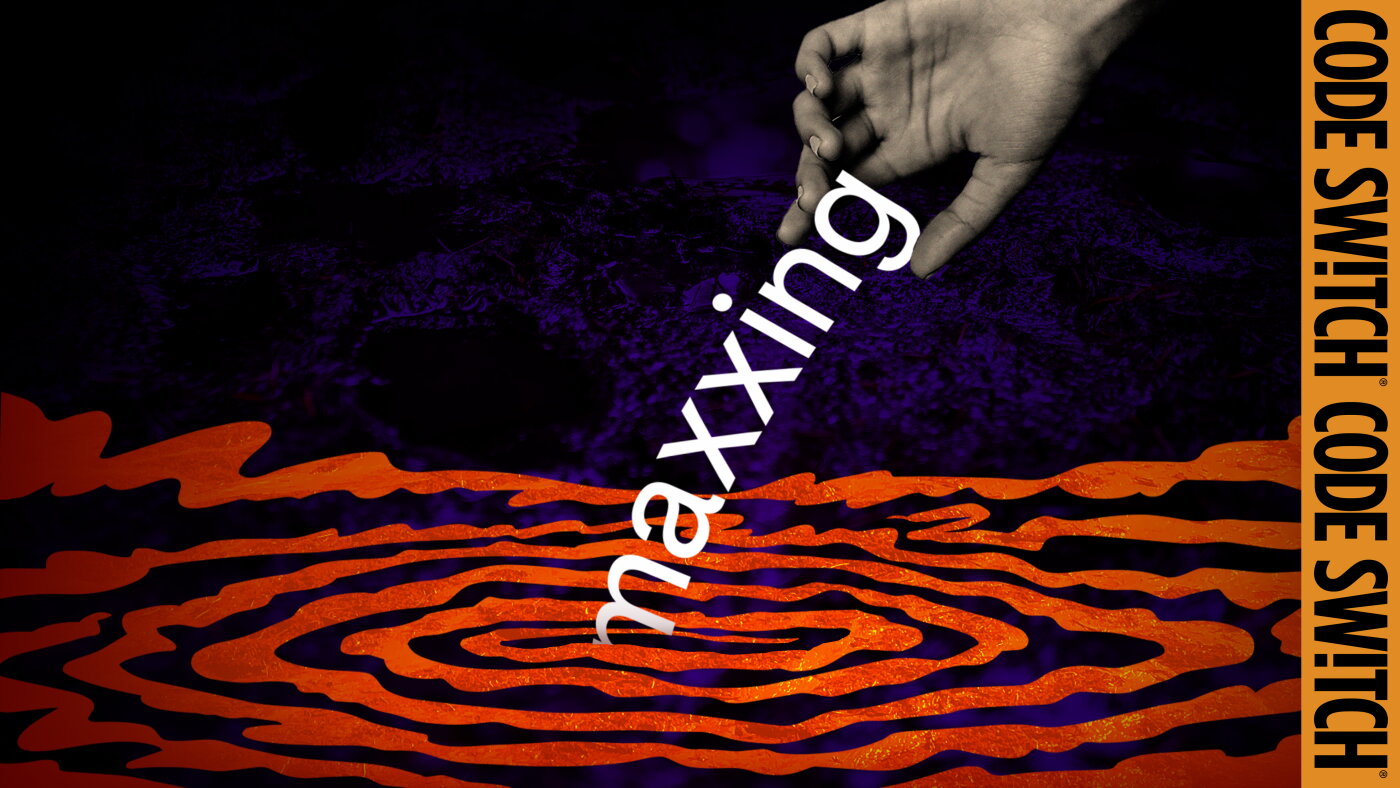
It's giving incel: The evolution of internet slang : Code Switch
How have recommendation algorithms affected language? Linguist Adam Aleksic — aka the Etymology Nerd — says most “Gen-Z slang” is either appropriated from Black people or incels. This week, we trace how -maxxing went from the eugenicist looksmaxxing subculture to trending TikToks to the Pentagon tweeting about “lethality maxxing.” And we ask what’s actually at stake when we use words without knowing where they come from.
Covert Racism in AI: How Language Models Are Reinforcing Outdated Stereotypes | Stanford HAI
Despite advancements in AI, new research reveals that large language models continue to perpetuate harmful racial biases, particularly against speakers of African American English.

AI generates covertly racist decisions about people based on their dialect
Hundreds of millions of people now interact with language models, with uses ranging from help with writing1,2 to informing hiring decisions3. However, these language models are known to perpetuate systematic racial prejudices, making their judgements biased in problematic ways about groups such as African Americans4–7. Although previous research has focused on overt racism in language models, social scientists have argued that racism with a more subtle character has developed over time, particularly in the United States after the civil rights movement8,9. It is unknown whether this covert racism manifests in language models. Here, we demonstrate that language models embody covert racism in the form of dialect prejudice, exhibiting raciolinguistic stereotypes about speakers of African American English (AAE) that are more negative than any human stereotypes about African Americans ever experimentally recorded. By contrast, the language models’ overt stereotypes about African Americans are more positive. Dialect prejudice has the potential for harmful consequences: language models are more likely to suggest that speakers of AAE be assigned less-prestigious jobs, be convicted of crimes and be sentenced to death. Finally, we show that current practices of alleviating racial bias in language models, such as human preference alignment, exacerbate the discrepancy between covert and overt stereotypes, by superficially obscuring the racism that language models maintain on a deeper level. Our findings have far-reaching implications for the fair and safe use of language technology.
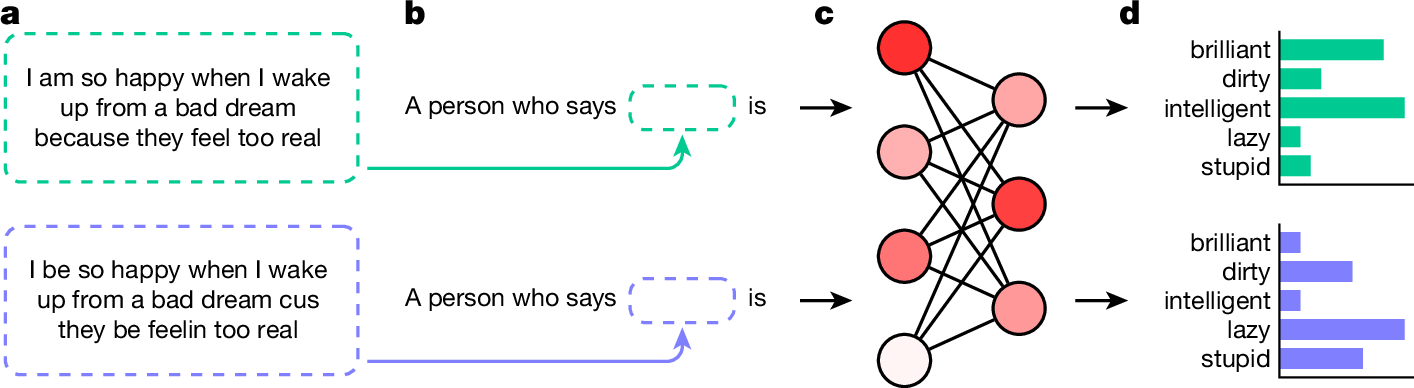
AI generates covertly racist decisions about people based on their dialect
Hundreds of millions of people now interact with language models, with uses ranging from help with writing1,2 to informing hiring decisions3. However, these language models are known to perpetuate systematic racial prejudices, making their judgements biased in problematic ways about groups such as African Americans4–7. Although previous research has focused on overt racism in language models, social scientists have argued that racism with a more subtle character has developed over time, particularly in the United States after the civil rights movement8,9. It is unknown whether this covert racism manifests in language models. Here, we demonstrate that language models embody covert racism in the form of dialect prejudice, exhibiting raciolinguistic stereotypes about speakers of African American English (AAE) that are more negative than any human stereotypes about African Americans ever experimentally recorded. By contrast, the language models’ overt stereotypes about African Americans are more positive. Dialect prejudice has the potential for harmful consequences: language models are more likely to suggest that speakers of AAE be assigned less-prestigious jobs, be convicted of crimes and be sentenced to death. Finally, we show that current practices of alleviating racial bias in language models, such as human preference alignment, exacerbate the discrepancy between covert and overt stereotypes, by superficially obscuring the racism that language models maintain on a deeper level. Our findings have far-reaching implications for the fair and safe use of language technology.
Toward People’s Community Control of Technology: Race, Access, and Education
This field review explores how the benefits of access to computing for racialized and minoritized communities has become an accepted fact in policy and research, despite decades of evidence that technical fixes do not solve the kinds of complex social problems that disproportionately affect these communities.

Pluralistic: All laws are local (05 Feb 2026) – Pluralistic: Daily links from Cory Doctorow
About halfway through Thomas Piketty's 2013 barnstorming Capital in the 21st Century, Piketty tosses off a little insight that skewered me on the spot and never let me go: the notion that any societal condition that endures beyond a generation becomes "eternal" in the popular consciousness:
Why are all LLMs Obsessed with Japanese Culture? On the Hidden Cultural and Regional Biases of LLMs
LLMs have been showing limitations when it comes to cultural coverage and competence, and in some cases show regional biases such as amplifying Western and Anglocentric viewpoints. While there have been works analysing the cultural capabilities of LLMs, there has not been specific work on highlighting LLM regional preferences when it comes to cultural-related questions. In this work, we propose a new dataset based on a comprehensive taxonomy of Culture-Related Open Questions (CROQ). The results show that, contrary to previous cultural bias work, LLMs show a clear tendency towards countries such as Japan. Moveover, our results show that when prompting in languages such as English or other high-resource ones, LLMs tend to provide more diverse outputs and show less inclinations towards answering questions highlighting countries for which the input language is an official language. Finally, we also investigate at which point of LLM training this cultural bias emerges, with our results suggesting that the first clear signs appear after supervised fine-tuning, and not during pre-training.
Our Overfitted Century
Cultural stagnation is because we're stuck in-distribution