


The Field Guide to Digital and/as Public Space is a living document, designed to be rearranged, remixed, and expanded.
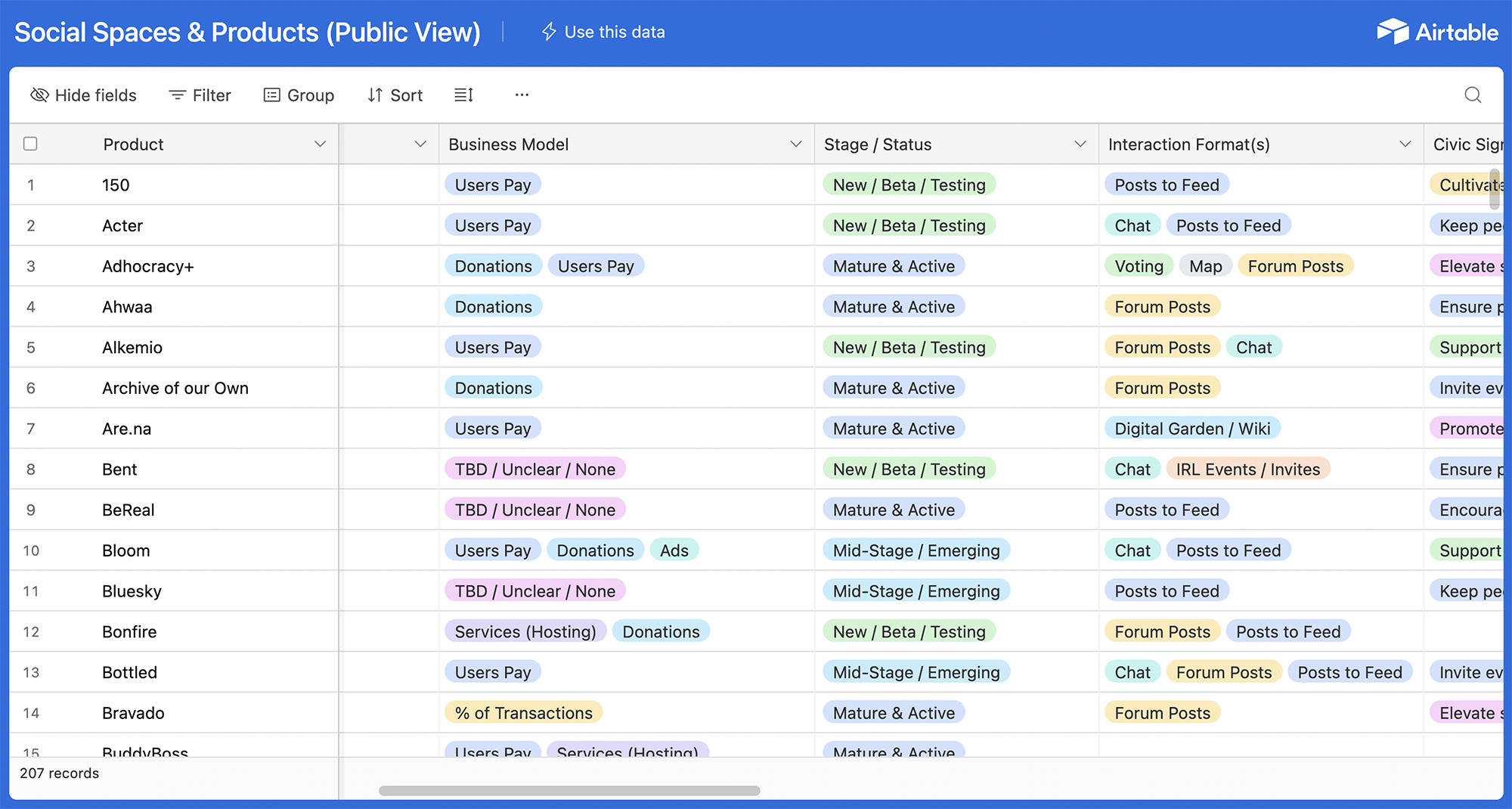
Digital Spaces Directory | New_ Public
As the social media landscape changes and a new wave of digital spaces emerges, this Directory is meant to be a resource for our field — a jumping-off-point for further exploration and research for anyone who’s interested in studying, building, stewarding, or simply using digital social platforms. We hope this will inspire creative exploration, spark new collaborations, and highlight important progress.
New_ Public
We are researchers, engineers, designers, and community leaders working together to create digital public spaces where people can thrive and connect.
Building Digital Public Spaces for Good
A Conversation with Eli Pariser, Co-Founder and Co-Director of New_ Public
New_ Public Invests in Local Online Spaces as Digital Civic Infrastru…
archived 11 Apr 2025 17:34:52 UTC

Creating a Flourishing Digital Public Space for Your Local Area | Notion
A how-to guide for admins and moderators of inclusive, uplifting, and public-spirited local Facebook groups, Discord servers, subreddits, and more...


Computational Public Space
Chapters — Intro, Communal computing, This presentation, Physicality — Globalization, Centrally-planned, Isolating, Private property, Surveillance, Consumption, Hidden — Summary, Outline
Shaping a Profession, Building a Community
Exploring how practitioners define public interest technology, and what it takes to sustain and grow the field.


Thoughts on Cyberpositionality: The Construction of Digital Communities in Digital Spaces, Damien Patrick Williams
I found Rebecca Monteleone, Martin Perez Comisso, and Elma Hajric’s “Cyberpositionality: Sociotechnical Location in the Digital Age” (2024) to be an extremely timely and important article which can…

Notes from my Beginner Computer Literacy Class Part 1 - Alex’s Writing Journal
Helping the uninitiated navigate this brave new digital world
Everything is miscellaneous : the power of the new digital disorder
Includes bibliographical references (p. [235]-257) and index; Prologue : information in space -- The new order of order -- Alphabetization and its discontents -- The geography of knowledge -- Lumps and splits -- The laws of the jungle -- Smart leaves -- Social knowing -- What nothing says -- Messiness as a virtue -- The work of knowledge -- Coda : misc; Philosopher Weinberger shows how the digital revolution is radically changing the way we make sense of our lives. Human beings constantly collect, label, and organize data--but today, the shift from the physical to the digital is mixing, burning, and ripping our lives apart. In the past, everything had its one place--the physical world demanded it--but now everything has its places: multiple categories, multiple shelves. Everything is suddenly miscellaneous. Weinberger charts the new principles of digital order that are remaking business, education, politics, science, and culture. He examines how Rand McNally decides what information not to include in a physical map (and why Google Earth is winning that battle), how Staples stores emulate online shopping to increase sales, why your children's teachers will stop having them memorize facts, and how the shift to digital music stands as the model for the future.--From publisher description; From A to Z, Everything Is Miscellaneous will completely reshape the way you think - and what you know - about the world. Includes information on alphabetical order, Amaxon.com, animals, Aristotle, authority, Bettmann Archive, blogs (weblogs), books, broadcasting, British Broadcasting Corporation (BBC), business, card catalog, categories and categorization, clusters, companies, Colon Classification, conversation, Melvil Dewey, Dewey Decimal Classification system, Encyclopaedia Britannica, encyclopedia, essentialism, experts, faceted classification system, first order of order, Flickr.com, Google, Great Books of the Western World, ancient Greeks, health and medical information, identifiers, index, inventory tracking, knowledge, labels, leaf and leaves, libraries, Library of Congress, links, Carolus Linnaeus, lumping and splitting, maps and mapping, marketing, meaning, metadata, multiple listing services (MLS), names of people, neutrality or neutral point of view, New York Public Library, Online Computer Library Center (OCLC), order and organization, people, physical space, everything having place, Plato, race, S.R. Ranganathan, Eleanor Rosch, Joshua Schacter, science, second order of order, simplicity, social constructivism, social knowledge, social networks, sorting, species, standardization, tags, taxonomies, third order of roder, topical categorization, tree, Uniform Product Code (UPC), users, Jimmy Wales, web, Wikipedia, etc

European Public Digital Infrastructure Fund White Paper · Open Future
This white paper identifies the need for a European Public Digital Infrastructure Fund as an instrument for building out Digital Public Spaces in Europe.

Rethinking the human-readability infrastructure
As part of the Digital Library's transition to Open Access, new features for researchers are available in the Premium Edition. Click here to learn more.
Thrilled to share that our project @roundabout.town (give them a follow!) will be powering new, healthy digital public spaces in Chicago! This is part of chicago.com, a partnership with Chicago Public Media, which is the @chicago.suntimes.com and @wbez.org. niemanlab.org/2026/08/can-public-media-buil…

Can public media build its own social network? Chicago Public Media teams up with New_ Public to try
www.niemanlab.orgDigital Placemaking

What does it mean to make a digital space into a place?
Computing As Social Activity

Gradients of intimacy and creating shelter: An interview with Erin Kissane

When the Internet Was a Place - Front Porch Republic

Law and Borders - the Rise of Law in Cyberspace
AI and the future of digital public squares
Ambient Co-presence
