

I was promised cheaper groceries and tariff rebates and all I got was this lousy pogrom.
Welcome Back to the Office. You Won’t Get Anything Done | The Walrus
Return to office mandates aren’t about output. They’re about asserting control

How Are SNAP Benefits Spent? Evidence from a Retail Panel
We use a novel retail panel with detailed transaction records to study the effect of the Supplemental Nutrition Assistance Program (SNAP) on house-hold spending. We use administrative data to motivate three approaches to causal inference. The marginal propensity to consume SNAP-eligible food (MPCF) out of SNAP benefits is 0.5 to 0.6. The MPCF out of cash is much smaller. These patterns obtain even for households for whom SNAP benefits are economically equivalent to cash because their benefits are below their food spending. Using a semiparametric framework, we reject the hypothesis that households respect the fungibility of money. A model with mental accounting can match the facts.
Behaviorally Informed Policies for Household Financial Decisionmaking
Low incomes, limited financial literacy, fraud, and deception are just a few of the many intractable economic and social factors that contribute to the financial difficulties that households face today. Addressing these issues directly is difficult and costly. But poor financial outcomes also result from systematic psychological tendencies, including imperfect optimization, biased judgments and preferences, and susceptibility to influence by the actions and opinions of others. Some of these psychological tendencies and the problems they cause may be countered by policies and interventions that are both low cost and scalable. We detail the ways that these behavioral factors contribute to consumers’ fiancial mistakes and suggest a set of interventions that the federal government, in its dual roles as regulator and employer, could feasibly test or implement to improve household financial outcomes in a variety of domains: retirement, short-term savings, debt management, the take-up of government benefits, and tax optimization.

Thoughts on the Trump Tariffs - Conversable Economist
It will take some time for the effects of President Trump's "Liberation Day" announcement of higher US tariffs to become apparent. Here, I'll just offer some notes and quick reactions. 1) The announced tariffs represent a very large increase. Here's a figure showing historical US tariff rates. You will notice that the average rates have

Mental accounting of product returns
Abstract Product returns incur a substantial financial loss for retailers. We demonstrate how, when, and why cross‐selling during the product returns process can reduce this loss in revenue. We find consumers more readily spend money refunded from product returns than unspent money. We theorize that this refund effect occurs because consumers psychologically realize the loss of money when purchasing products and earmark that money for spending. Thus, consumers feel a smaller psychological loss when spending refunded money than unspent money on a subsequent purchase. In six experiments, we find consumers spend refunded money more freely than unspent money, even more than windfall gains like lottery winnings, on products in similar and different product categories (e.g., groceries vs. apparel). However, the refund effect only holds when consumers do not expect to return products at the point of purchase and before refunded money is commingled with money in other accounts. Our findings identify a new fungibility violation due to mental accounting (i.e., a new source effect), and illustrate its value for generating, validating, and explaining revenue retention strategies.

Qui paie les droits de douane de l’administration Trump ?
Traduction française du billet de blog "Who pays for tariffs? Insights from recent research" de Kimberly Clausing & Maurice Obstfeld (PIIE)

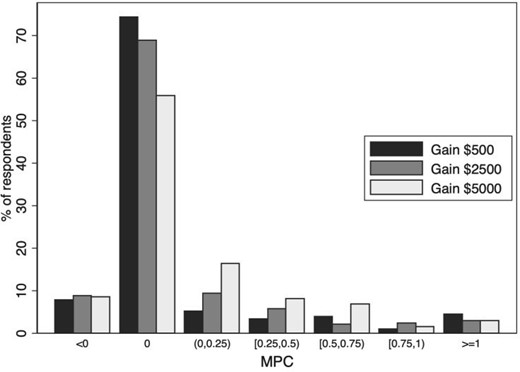
What Would You Do with $500? Spending Responses to Gains, Losses, News, and Loans
Abstract We use survey questions about spending in hypothetical scenarios to investigate features of propensities to consume that are useful for distinguishing between consumption theories. We find that (1) responses to unanticipated gains are vastly heterogeneous (either zero or substantially positive); (2) responses increase in the size of the gain, driven by the extensive margin of spending adjustments; (3) responses to losses are much larger and more widespread than responses to gains; and (4) even those with large responses to gains do not respond to news about future gains. These four findings suggest that limited access to disposable resources, and frictions in adjusting consumption, are important determinants of consumption behaviour. We also find that (5) households do not respond to the offer of a one-year interest-free loan, suggesting that this is not a consequence of short-term credit constraints; and (6) people do cut spending in response to news about future losses, suggesting that neither is this a consequence of myopia. A calibrated precautionary savings model with utility costs of changing consumption, and a sufficient fraction of low-wealth households, can account for these features of propensities to consume on both the extensive and intensive margins.
I Moved to New York to Pay More in Taxes—and I’m Glad I Did
I wasn’t getting the bang for my buck in my red-state redoubt. But if I hadn’t moved, I might never have found out how good it could get.

Trump scoffs at Iran’s demand for war reparations and other Mideast developments
U.S. President Donald Trump is scoffing at Iran's demands that the U.S. pay for devastation caused by five months of war.
Trump’s tariffs: Disregarding lessons from history and scenarios and probable outcomes
History is full of evidence that tariffs harm economic performance. This column assesses the two waves of globalisation in modern history and how they were interrupted by barriers to trade. The first wave started in the mid-19th century and lasted until WWI, while the second wave started after WWII and lasted until the Global Crisis of 2008-09. The most likely scenario going forward will feature tariffs around 12-14% on average, a mild recession, and a small hit to US longer-run potential. However, achieving diplomatic normalcy may take years of good US behaviour, and it is unlikely during the Trump administration.

The US economy is doing well. President Biden wants to know why so many Americans are still feeling bad | CNN Politics
By many metrics, the US economy is humming along. The jobs market is robust; consumers are spending again; and inflation has eased to a three-year low.
Droits de douane : comment le projet radical de Trump pourrait ruiner l’économie américaine
traduction française du billet de blog "How Trump’s radical tariff plan could wreck our economy" de Paul Krugman

The bazooka diplomacy of Trump’s tariffs
President Trump’s recent pronouncements on tariffs have received considerable attention from analysts, policymakers, and commentators. This column takes a step back and considers some of the broader arguments for raising tariffs – revenue, restriction, and reciprocity – and the potential repercussions. Even if Trump does not proceed with (all of) the announced tariffs, the increased uncertainty is likely to put off firms from trading with or from the US, lowering US exports and imports beyond the imposition of higher tariffs. In the longer term, we can expect a gradual decoupling of trade between the US and other countries.
Windfall Income and the Permanent Income Hypothesis: New Evidence
This paper examines consumer response to windfall income. By using data from the 1972–73 Consumer Expenditure Surveys, an attempt was made to test Friedman's permanent income hypothesis. The results revealed that the marginal propensity to consume regular income was greater than the marginal propensity to consume windfall income for windfalls that were large relative to regular income. However, when windfall income was less than ten percent of regular income, the relationship reversed. Implications are drawn for short and long‐run fiscal policies affecting consumers

Grâce à Trump, nous savons qui supporte les droits de douane
Traduction du billet de blog "Who pays tariffs? And how do we know?" de Paul Krugman
