

Interpret products of whole numbers, e.g., interpret 5 × 7 as the total number of objects in 5 groups of 7 objects each. For example, describe a context in which a total number of objects can be expressed as 5 × 7.
Kill Math
The power to understand and predict the quantities of the world should not be restricted to those with a freakish knack for manipulating abstract symbols.
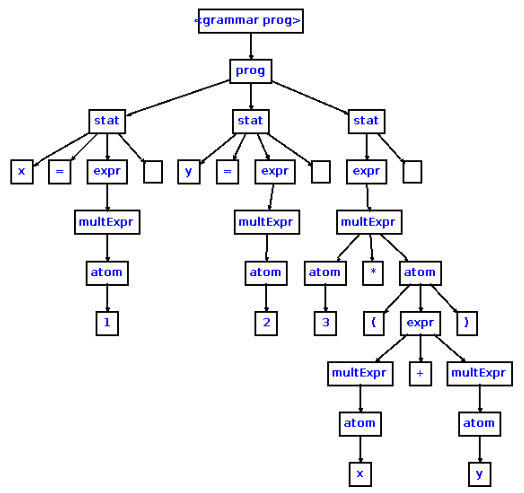
Intuiting Pratt parsing
You already know that a + b * c + d is calculated as a + (b * c) + d. But how do you encode that knowledge precisely enough for a machine to act on it?
Why Can't Transformers Learn Multiplication?...
Language models are increasingly capable, yet still fail at a seemingly simple task of multi-digit multiplication. In this work, we study why, by reverse-engineering a model that successfully...

Why Can't Transformers Learn Multiplication?...
Language models are increasingly capable, yet still fail at a seemingly simple task of multi-digit multiplication. In this work, we study why, by reverse-engineering a model that successfully...
Variety (cybernetics)
In cybernetics, the term variety denotes the total number of distinguishable elements of a set, most often the set of states, inputs, or outputs of a finite-state machine or transformation, or the binary logarithm of the same quantity.[1] Variety is used in cybernetics as an information theory that is easily related to deterministic finite automata, and less formally as a conceptual tool for thinking about organization, regulation, and stability. It is an early theory of complexity in automata, complex systems,[1]: 6  and operations research.[2]
Fidget
Fidget is a library for representing, compiling, and evaluating large-scale math expressions, i.e. hundreds or thousands of arithmetic clauses. It's mainly designed as a backend for implicit surfaces, but the library is flexible enough for many different uses!
Conceptual mathematics: a first introduction to categories
Conceptual mathematics by F. W. Lawvere, 2009, Cambridge University Press edition, in English - 2nd ed.

Calculating with lenses | Proceedings of the 20th ACM SIGPLAN workshop on Partial evaluation and program manipulation
Functional programs are particularly well suited to formal manipulation by equational reasoning. In particular, it is straightforward to use calculational methods for program transformation. Well-known transformation techniques, like tupling or the ...

J Notation as a Tool of Thought
Kenneth Iverson’s 1964 language, APL, won him the Turing Award. His award lecture, Notation as a Tool of Thought, argued that better notations would lead people to deeper insights about mathematics. He provided a number of examples ranging across linear algebra, arithmetic, probability, and logic. Unfortunately, most of the mathematics he covers isn’t relevant to programming. However, his core idea still applies, and changing how we describe programs changes how we think about them.
Basic Category Theory
This short introductory category theory textbook is for readers with relatively little mathematical background (e.g. the first half of an undergraduate mathematics degree). At its heart is the concept of a universal property, important throughout mathematics. After a chapter introducing the basic definitions, separate chapters present three ways of expressing universal properties: via adjoint functors, representable functors, and limits. A final chapter ties the three together. For each new categorical concept, a generous supply of examples is provided, taken from different parts of mathematics. At points where the leap in abstraction is particularly great (such as the Yoneda lemma), the reader will find careful and extensive explanations.
What Is To Be Done?
I don’t want to criticize people who seem to like the situation… Instead I’ll focus on people who are trying to do something other than be a number, even as they are subsumed by the new reality of number supremacy.

Mathematicians still don’t know the fastest way to multiply numbers
A 23-year-old student overturned an ancient conjecture about one of math’s simplest operations
Akin's Laws of Spacecraft Design
1. Engineering is done with numbers. Analysis without numbers is only an opinion.
Embracing AI and formalization: Experimenting with tomorrow’s mathematical tools
Embracing AI and formalization: Experimenting with tomorrow’s mathematical tools. By Jarod Alper