


Plus! Devaluation; Browsers; Slicing Up the Capital Structure; Who Audits the Auditors; International
Stuck in the middleware with you: the challenges of capitalizing a market-oriented approach to platform governance
T1 - Stuck in the middleware with you: the challenges of capitalizing a market-oriented approach to platform governance

Dutch governments builds alternative for Microsoft based on NixOS | Hacker News
1) That there is an agenda, demand and total legal abetment from the top of the power/monetary hierarchy for such corporate policies
Designing a multi-sided data platform: findings from the International Data Spaces case
The paper presents the findings from a 3-year single-case study conducted in connection with the International Data Spaces (IDS) initiative. The IDS represents a multi-sided platform (MSP) for secure and trusted data exchange, which is governed by an institutionalized alliance of different stakeholder organizations. The paper delivers insights gained during the early stages of the platform’s lifecycle (i.e. the platform design process). More specifically, it provides answers to three research questions, namely how alliance-driven MSPs come into existence and evolve, how different stakeholder groups use certain governance mechanisms during the platform design process, and how this process is influenced by regulatory instruments. By contrasting the case of an alliance-driven MSP with the more common approach of the keystone-driven MSP, the results of the case study suggest that different evolutionary paths can be pursued during the early stages of an MSP’s lifecycle. Furthermore, the IDS initiative considers trust and data sovereignty more relevant regulatory instruments compared to pricing, for example. Finally, the study advances the body of scientific knowledge with regard to data being a boundary resource on MSPs.

Open source software companies that go proprietary: A timeline | TechCrunch
Tracking open source software companies that have gone proprietary over the past 10 years: A timeline.

Privacy as EU Tech advantage - The LeafPlaza Blog
Online crime loves legal massive data collection, grey systems, and jurisdictional gaps. Privacy-first design can actually reduce crime exposure and build trust in digital services. It is also central to the EU's tech autonomy: build systems aligning with European rights and risk models. Do not rely on foreign platforms or copy outside practices that might go against the EU values and needs.
Optimizely offices
We're a global company with offices in the U.S. (HQ), Europe, Australia and the U.A.E.
A Legacy Modernization Strategy and Business Case Playbook for Enterprise Kotlin Adoption
A finance-driven framework for CTOs and VPs of Engineering evaluating Kotlin adoption. Covers investment metrics (NPV, IRR), migration costs, governance, and enterprise evidence patterns. By Yuri Geronimus, Senior Staff Engineer, EMEA Chief Architect.

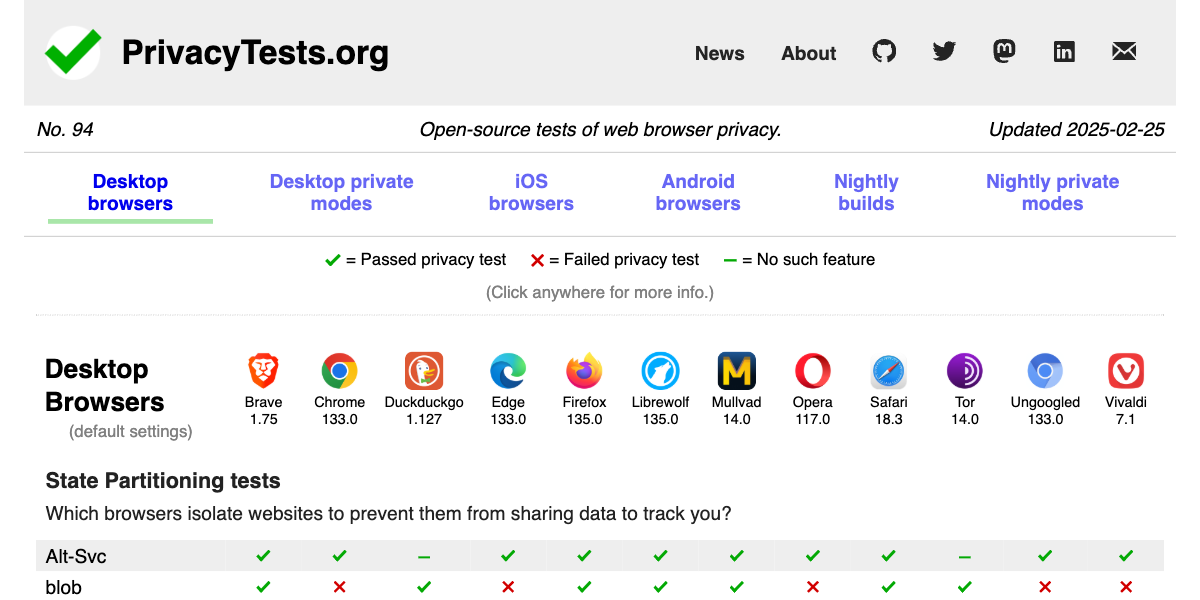
Which browsers are best for privacy?
An open-source privacy audit of popular web browsers.
The Federation Fallacy
Throughout the free software community, an unbridled aura of justified mistrust fills the air: mistrust of large corporations, mistrust of governments, and of course, mistrust of proprietary software. Each mistrust is connected by a critical thread: centralisation.
Governance of Ad Requests by a Union of Diverse Actors (GARUDA)
Governance for advertising on the Web

Your platform is not an ecosystem
Another day, another exhortation to join an “ecosystem” that’s anything but. I could pick a hundred examples, but one that recently caught my eye was an ad placed in the Financial Times by the Singapore stock exchange, SGX Group, promising “multiple growth avenues, one trusted ecosystem”. SGX wants companies to list on its exchange rather than, say, the Hong Kong one which has more or less the same exclusive offer. SGX promises “access (to) Asia through our trusted ecosystem anchored in Singapore.” Ecosystems can be a lot of things. ‘Trusted’, by which they mean centrally policed to achieve defined, lower-risk outcomes, is not one of them. Calling built environments ‘ecosystems’ is common everywhere from financial services to supply chains to – quite a stretch, here – a retirement living complex. But it’s most often used in the tech world to describe the relations between software, services and hardware typically owned by a single company. For example, it’s how Google describes everything that hangs off the Android operating system. These kinds of proprietary and deterministic architectures are called ecosystems so often that we’ve stopped noticing. And that’s kind of the point. We need to start seeing this metaphor again, and what it’s hiding in plain sight. But first, a reminder of what an ecosystem actually is.
Outsourcing plus LocalAI will soon become more economical vs Frontier labs | SignalBloom AI posts
Outsourcing plus LocalAI will soon become more economical vs Frontier labs

About Us
Around the world, building the internet’s operating system—and a better way to work. In a world of tech companies fighting for growth at any cost, imagine one that gives away its most successful pr…
