

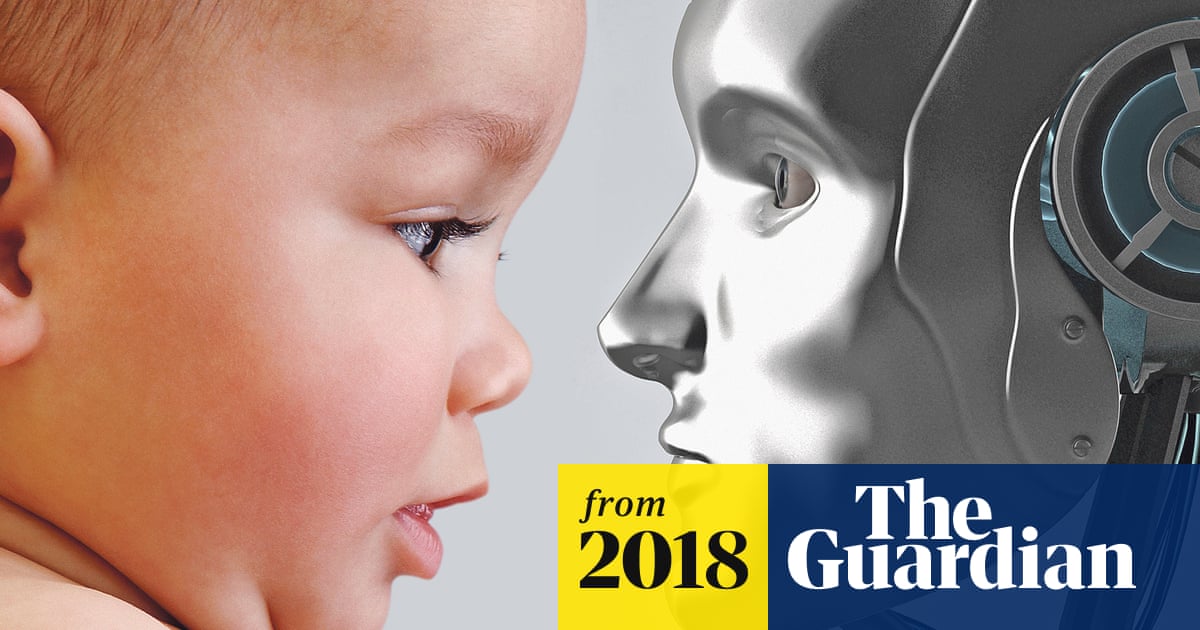
The long read: If we could understand how the infant mind develops, it might help every child reach their full potential. But seeing them as learning machines is not the answer
Does AI stop children from learning?
New data show the peril and promise of the technology

How Your Cheese-Powered Baby Trounces AI
An O.G. AI Researcher on How Being Social and Cultural Makes us Intelligent--and Whether Machines Can Ever Learn Empathy

Children of the Magenta Line
Why minimally guided AI does not work. Chatbots, novices, the automation of learning and the case for Alpha School
Babies Learning Language: My lab's AI policies and norms
Blog about fatherhood, langauge, developmental psychology, and cognitive science.
AI is reshaping childhood in China
Government support and tech companies’ drive for profit fuel a rush to integrate AI tools, from robot tutors to chatbots, in education and caretaking.

Why I believe current AI models can really think and understand - Part 1 of 2
How the human mind is different from our conception of it

Letta
Making machines that learn. Create stateful agents that remember everything, learn continuously, and improve themselves over time.

Transmission Versus Truth, Imitation Versus Innovation: What Children Can Do That Large Language and Language-and-Vision Models Cannot (Yet)
Much discussion about large language models and language-and-vision models has focused on whether these models are intelligent agents. We present an alternative perspective. First, we argue that these artificial intelligence (AI) models are cultural technologies that enhance cultural transmission and are efficient and powerful imitation engines. Second, we explore what AI models can tell us about imitation and innovation by testing whether they can be used to discover new tools and novel causal structures and contrasting their responses with those of human children. Our work serves as a first step in determining which particular representations and competences, as well as which kinds of knowledge or skill, can be derived from particular learning techniques and data. In particular, we explore which kinds of cognitive capacities can be enabled by statistical analysis of large-scale linguistic data. Critically, our findings suggest that machines may need more than large-scale language and image data to allow the kinds of innovation that a small child can produce.

The UAE embraces AI for kindergartners
The country’s approach offers a glimpse of what education could look like if AI literacy becomes as fundamental as reading and writing.

AI That Evolves in the Wild | Edge.org
I’m interested not in domesticated AI—the stuff that people are trying to sell. I'm interested in wild AI—AI that evolves in the wild. I’m a naturalist, so that’s the interesting thing to me. Thirty-four years ago there was a meeting just like this in which Stanislaw Ulam said to everybody in the room—they’re all mathematicians—"What makes you so sure that mathematical logic corresponds to the way we think?" It’s a higher-level symptom. It’s not how the brain works. All those guys knew fully well that the brain was not fundamentally logical.
‘My son genuinely believed it was real’: Parents are letting little kids play with AI. Are they wrong?
Some believe AI can spark their child’s imagination through personalized stories and generative images. Scientists are wary of its effect on creativity

Why I believe current AI models can really think and understand - Part 2 of 3
Why computers can in principle produce thinking and understanding

The Triadic Mind: How Language Reveals the Limits of Human Cognition
Languages are the most complex symbolic systems humans have ever created. Yet children acquire them effortlessly, without formal…

AI Literacy Across the Curriculum
As you have no doubt seen, AI is becoming ubiquitous in our lives and in the technologies we use every day. Generative AI is no longer an experimental tool, but a deployed technology in many of the…

Many are appropriately outraged by Altman’s comments here implying that raising a human child is akin to “training” an AI model. This is part of a broader pattern where AI industry leaders use language that collapses the boundary between human and machine. 🧵/

X2Y
SAM ALTMAN: “People talk about how much energy it takes to train an AI model … But it also takes a lot of energy to train a human. It takes like 20 years of life and all of the food you eat during that time before you get smart.”
