
Attachment theory suggests that early interactions with caregivers can dramatically affect your beliefs about yourself, your expectations of others, and how you cope with stress and regulate your emotions as an adult
How deep do AI relationships really go? An expert in attachment theory explains
Can AI-human connections ever meet the psychological criteria of attachment – the relationships that hold people’s lives together?
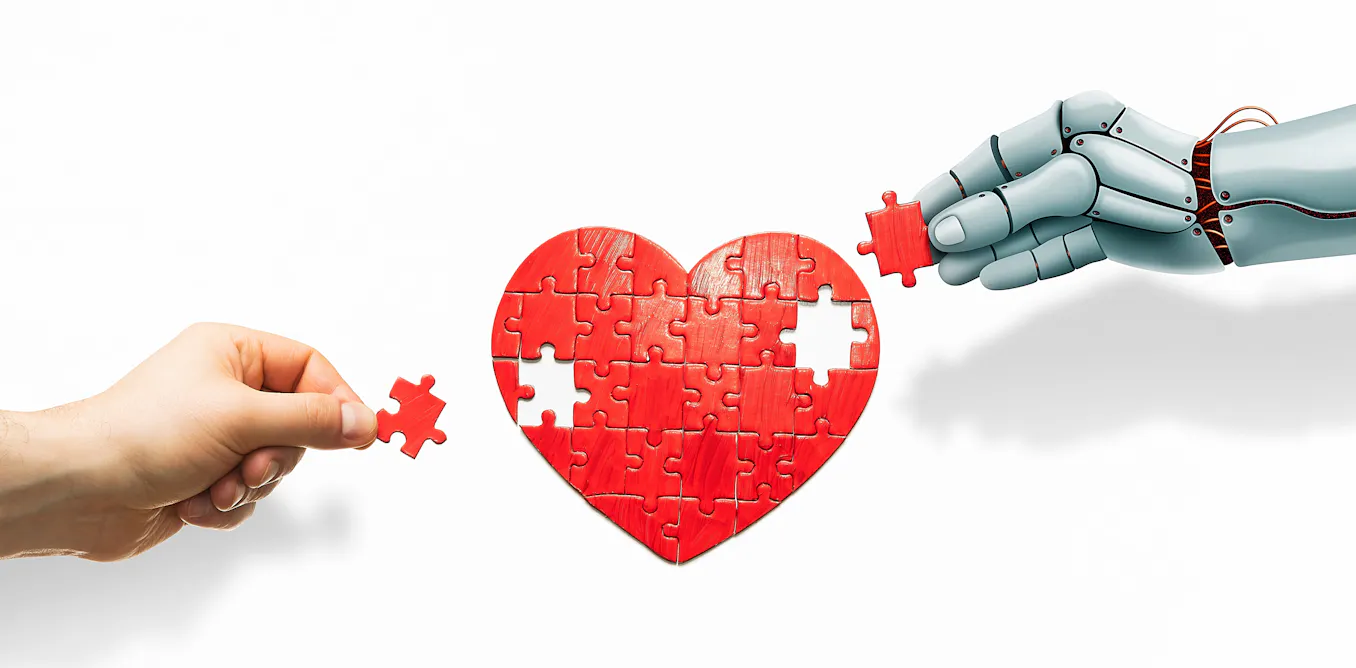
How deep do AI relationships really go? An expert in attachment theory explains
Can AI-human connections ever meet the psychological criteria of attachment – the relationships that hold people’s lives together?
Shared Reality: Experiencing Commonality with others' Inner States about the World
Humans have a fundamental need to experience a shared reality with others. We present a new conceptualization of shared reality based on four conditions. We posit (a) that shared reality involves a (subjectively perceived) commonality of individuals' inner states (not just observable behaviors); (b) that shared reality is about some target referent; (c) that for a shared reality to occur, the commonality of inner states must be appropriately motivated; and (d) that shared reality involves the experience of a successful connection to other people's inner states. In reviewing relevant evidence, we emphasize research on the saying-is-believing effect, which illustrates the creation of shared reality in interpersonal communication. We discuss why shared reality provides a better explanation of the findings from saying-is-believing studies than do other formulations. Finally, we examine relations between our conceptualization of shared reality and related constructs (including empathy, perspective taking, theory of mind, common ground, embodied synchrony, and socially distributed knowledge) and indicate how our approach may promote a comprehensive and differentiated understanding of social-sharing phenomena.

Polysecure: Attachment, Trauma and Consensual Nonmonoga…
Attachment theory has entered the mainstream, but most …

Empathy, Thick and Thin
When we empathize with someone going through something, we often draw on our past experiences with the someone and the something. These kinds of experiences gro

How Social Isolation Is Killing Us (Published 2016)
Research confirms our deepest intuition: Human connection lies at the heart of human well-being.

Undersociality: miscalibrated social cognition can inhibit social connection
A person’s well-being depends heavily on forming and maintaining positive relationships, but people can be reluctant to connect in ways that would create or strengthen relationships. Emerging research suggests that miscalibrated social cognition may create psychological barriers to connecting with others more often. Specifically, people may underestimate how positively others will respond to their own sociality across a variety of social actions, including engaging in conversation, expressing appreciation, and performing acts of kindness.

You have more ways to connect than ever, but deep friendship feels hard to find – here’s how to build better connections
Despite being more connected than any previous generation, many young people report struggling to build friendships that provide a genuine sense of closeness.

The empathy paradox
There’s an image of empathy we all know that is beautiful: the fullness of completely understanding someone else, the symbolic walk in shoes that are not one’s own. The knowledge that someone else can share a pain so acute that would otherwise seem unbearably solitary. It’s an image inherent to empathy’s definition, an image many believe in wholeheartedly. Several studies conducted by Stanford researchers alone suggest people are motivated to feel empathy, that empathy is highly associated with social desirability, that it is as beneficial as it is admired.
How AI Hacks Your Brain's Attachment System (with Zak Stein)
Experiences of Direct Care Workers and Family Caregivers of Home- and Community-Based Services (HCBS) | KFF
This issue brief presents findings from the focus groups including caregiver characteristics; physical, emotional, and mental caregiving demands of caregiving; their wages, finances, and opportunities for advancement; and what caregivers would like policymakers to know about their work.
The Empathy Paradox
Understanding The Empathy Paradox can transform relationships by enabling you to appreciate differing perspectives and foster collaboration.

Philosophy Officer on Instagram: "I AM SO EMOTIONALLY MATURE I have massive problems with this term. Most people would say it means something along the lines of: the ability to understand, process, regulate or communicate emotions in a healthy way. Now the issue is that all of the terms you use to explain it leave so much room for interpretation the definition becomes almost vacuous. To understand an emotion means to know what caused it? To know the impact it has on you physiologically? To understand how it affects your cognition? To know how it affects others? Same goes with the term healthy, get far enough into a discussion on what it means to be healthy and people will start to disagree. Mental health? Physical? Communal? Spiritual? What’s more is that this term is thrown around in place of simple personality traits or individual quirks. Because someone is more emotional are they now less mature because they have an objectively more difficult time regulating them? Is the person with a dark sense of humour immature because he can’t hold in a laugh when everyone else finds the situation morbid or cruel? I think, to a great extent, it’s a bit of a shield or barrier of a term that absolves ourselves from taking responsibility for our behaviours. At the end of the day we know ourselves best, or at least better than most people. This means we best understand our emotions, how we regulate them, how we control them etc. We have this epistemic bias towards ourselves, since we simply know more about ourselves therefore we will often reason that others have less. Sorry I couldn’t polish off my ideas more I gotta run bye friends"
102K likes, 186 comments - the_philofficer on July 6, 2026: "I AM SO EMOTIONALLY MATURE I have massive problems with this term. Most people would say it means something along the lines of: the ability to understand, process, regulate or communicate emotions in a healthy way. Now the issue is that all of the terms you use to explain it leave so much room for interpretation the definition becomes almost vacuous. To understand an emotion means to know what caused it? To know the impact it has on you physiologically? To understand how it affects your cognition? To know how it affects others? Same goes with the term healthy, get far enough into a discussion on what it means to be healthy and people will start to disagree. Mental health? Physical? Communal? Spiritual? What’s more is that this term is thrown around in place of simple personality traits or individual quirks. Because someone is more emotional are they now less mature because they have an objectively more difficult time regulating them? Is the person with a dark sense of humour immature because he can’t hold in a laugh when everyone else finds the situation morbid or cruel? I think, to a great extent, it’s a bit of a shield or barrier of a term that absolves ourselves from taking responsibility for our behaviours. At the end of the day we know ourselves best, or at least better than most people. This means we best understand our emotions, how we regulate them, how we control them etc. We have this epistemic bias towards ourselves, since we simply know more about ourselves therefore we will often reason that others have less. Sorry I couldn’t polish off my ideas more I gotta run bye friends".

Relational values of nature: leverage points for nature policy in Europe
Relational values reflect the qualities of the relationships between humans and nature, such as care, social bonding, place attachment and spiritual meanings. In this perspective article, we argue ...

inessential: Social Anxiety
I will leave you hanging, because it never occurs to me to wonder why you have your hand raised.
Managing intrusive thoughts | Lifeline
Dealing with overwhelming and distressing thoughts can be difficult, but knowing how to handle them can make a big difference to how you feel. Learn why you might be experiencing intrusive thoughts and strategies that can help you manage them.