
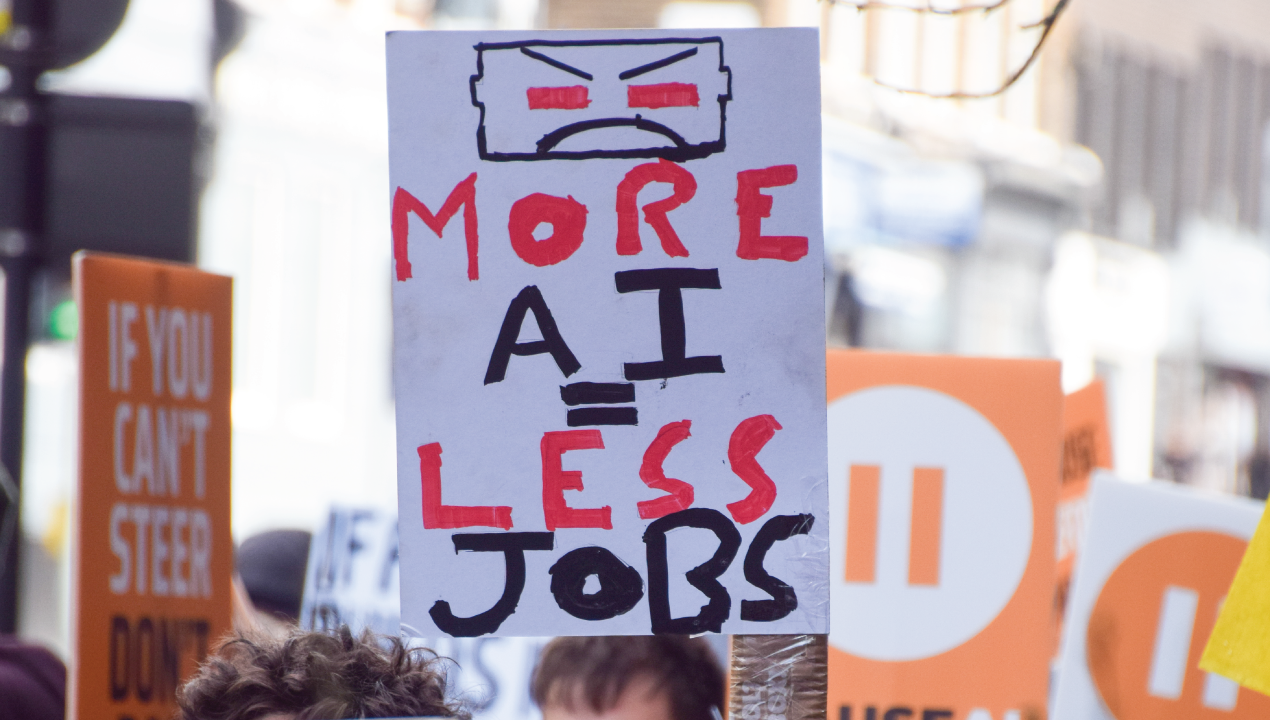
Britain is losing more jobs than it creates owing to artificial intelligence, Morgan Stanley research suggests
Globally, More People Expect AI to Cause Job Loss Than Growth
Amid a mix of concern and excitement about AI, a 37-country survey finds pessimism about its potential impact on jobs and economic inequality.
AI Completely Failing to Boost Productivity, Says Top Analyst
AI may or may not excel at a lot of things, but from an economic standpoint, it's definitely not making us more productive.

Most Americans say AI development is moving too fast and twice as many are AI pessimists as AI optimists
Young adults are more likely than older Americans to believe that AI will create economic gains that benefit everyone, but they are also more likely to worry that AI will replace jobs they depend upon

Companies Are Being Torn Apart by AI "Workslop," Stanford Research Finds
Not only is AI hampering productivity, but it's also blowing up collaboration and souring employee dynamics.

The ‘productivity paradox’ of AI adoption in manufacturing firms | MIT Sloan
Companies that adopt industrial artificial intelligence see productivity losses before longer-term gains, according to new research.

Companies Are Blaming AI for Layoffs. The Real Reason Will Piss You Off.
180,000 tech workers lost their jobs in 2025. Companies say it’s because of AI. Oxford researchers call BS.

Tech companies are cutting jobs and betting on AI. The payoff is far from guaranteed
AI experts say we’re living in an experiment that may fundamentally change the model of work

PhD students who write dissertation with AI less likely to stay in academia
US PhD graduates who used artificial intelligence were more likely to work in industry.

Differences in AI adoption in Europe and the US: Explanations and implications for productivity growth
The economic impact of generative AI will depend on the speed and breadth of adoption by workers and firms. Drawing on a survey of workers in the US and six European countries and a firm survey covering 32 European countries, this column explores the speed of AI adoption across countries and whether an ‘AI gap’ will exacerbate existing productivity differences between the US and Europe. There are large differences in AI adoption across countries, much of which are accounted for by management practices. Higher AI adoption rates are associated with faster productivity growth but not with changes in employment.

Is AI the next Dumbwaiter?
The demand for AI's unbridled growth is reactionary — a way of doubling down on the same old colonizing way of doing things. It doesn't have to be.

Recent Grads Say AI Is Making It Impossible to Find a Job
Recent college graduates are entering a job market fraught with austerity, and gatekept by the very technology degrading their prospects.

Technological Disruption in the US Labor Market • The Aspen Institute Economic Strategy Group
DAVID DEMING, CHRISTOPHER ONG, LAWRENCE H. SUMMERS This paper explores past episodes of technological disruption in the US labor market, with the goal of learning lessons about the likely future impact of artificial intelligence (AI). The authors measure changes in the structure of the US labor market going back over a century in two ways. ...

The UK tech energy grab: how AI data centres are delaying the building of homes
Artificial intelligence infrastructure is being handed priority access to Britain's overwhelmed electricity grid, pushing housing down the list. But as the US shows, there's an alternative: make Big Tech pay for the power it needs. Report by Nicole Kobie

Mind the Gap: AI Adoption in Europe and the U.S.
This paper combines international evidence from worker and firm surveys conducted in 2025 and 2026 to document large gaps in AI adoption, both between the US and Europe and across European countries. Cross-country differences in worker demographics and firm composition account for an important share of these gaps. AI adoption, within and across countries, is also closely linked to firm personnel management practices and whether firms actively encourage AI use by workers. Micro-level evidence suggests that AI generates meaningful time savings for many workers. At the macro level, in recent years industries with higher AI adoption rates have experienced faster productivity growth. While we do not establish causality, this relationship is statistically significant and similar in magnitude in Europe and the US. We do not find clear evidence that industry-level AI adoption is associated with employment changes. We discuss limitations of existing data and outline priorities for future data collection to better assess the productivity and labor market effects of AI.

Will AI Destroy the Economy? (According to Economists: No.) | AI Reality Check | Cal Newport
AI Has Ruined the Job Market
Maybe flawed people were better than brute algorithms.