


Trump administration undermining rule of law at home and worldwide, according to intergovernmental report
Democracy Tracker | The Global State of Democracy
Each report describes an event that affects the state of democracy in a given country, with assessments made relative to that country's context, not as comparisons or rankings between countries.
The Global State of Democracy 2026: Democracy in an Age of Conflict
In the face of increasing political and societal fragmentation, the Global State of Democracy 2026 explains the patterns that define the direction of democratization around the world. Drawing on the latest data from the Global State of Democracy Indices, the report documents both democratic stagnation and key declines in indicators that measure the credibility of elections, the effectiveness of legislatures, respect for freedoms of expression and the press, and access to justice. These phenomena affect countries across thespectrum of democratic performance.
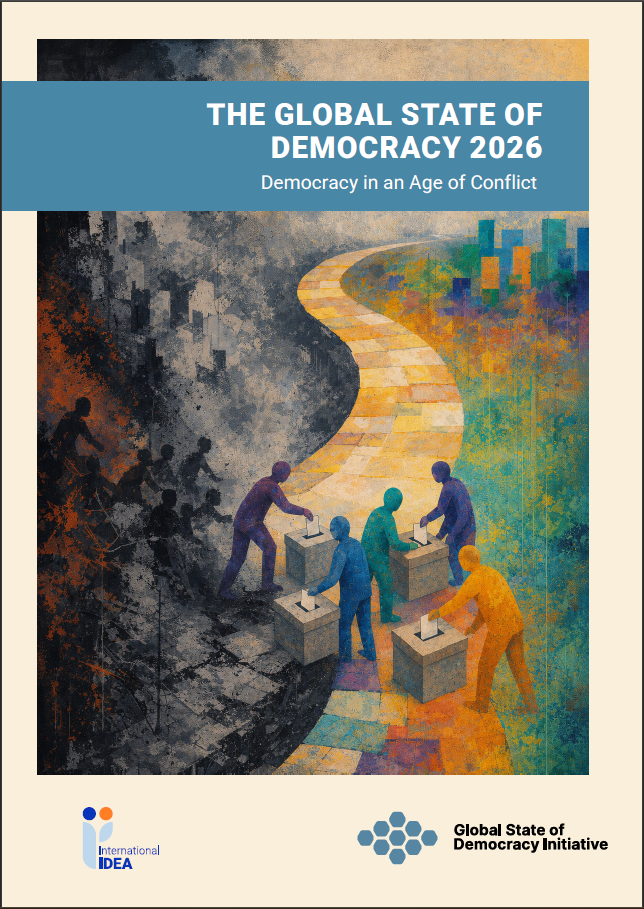
The Global State of Democracy 2026: Democracy in an Age of Conflict
In the face of increasing political and societal fragmentation, the Global State of Democracy 2026 explains the patterns that define the direction of democratization around the world. Drawing on the latest data from the Global State of Democracy Indices, the report documents both democratic stagnation and key declines in indicators that measure the credibility of elections, the effectiveness of legislatures, respect for freedoms of expression and the press, and access to justice. These phenomena affect countries across thespectrum of democratic performance.
The V-Dem Dataset – V-Dem
Includes the world's most comprehensive and detailed democracy ratings. The latest version of the dataset and associated reference documents can be downloaded free of charge below.
Nira Data – DPI Report
The Democracy Perception Index (DPI) is a cornerstone of the Copenhagen Democracy Summit, providing the most comprehensive global snapshot of public opinion on democracy.
Democracy x AI Cohort | Mozilla Foundation
The Democracy x AI cohort is founded on the hypothesis that, if built differently, AI could strengthen democracy rather than erode it.
America’s new oligarchy
Under Trump an ultra-wealthy clique has infiltrated government, raising concerns about democratic integrity

POLYBIUS ACI
Authoritarian Consolidation Index - Real-time democratic health monitoring powered by political science research and AI
Five dimensions of scaling democratic deliberation: With and beyond AI
DemocracyNext's new paper on Five dimensions of scaling democratic deliberation: With and beyond AI
The Crisis of Democracy: Report on the Governability of Democracies to the Trilateral Commission
The Crisis of Democracy: On the Governability of Democracies was initially a 1975 report written by Michel Crozier, Samuel P. Huntington, and Joji Watanuki for the Trilateral Commission and later published as a book. The report observed the political state of the United States, Europe and Japan and says that in the United States the problems of governance "stem from an excess of democracy" and thus advocates "to restore the prestige and authority of central government institutions."
What does it mean for AI to be democratic?
Some pushback on a specific fuzzy idea with some ominous implications

From Democracies to Autocracies: How AI Systems Enable Authoritarianism by Design
AI-enabled authoritarianism is not confined to autocracies. In this paper, we provide greater transparency by investigating and mapping the lifecycles of six AI systems deployed in different political regimes, ranging from the US to China. By drawing on an extensive range of sources (academic publications, investigative research reports, third-party evaluations, media interviews, government procurement notices), we conduct a systematic, qualitative comparison across systems to identify the critical technical and operational features that enable authoritarianism within their respective political contexts. We find that enabling features include the centralization and co-optation of administrative data for law enforcement and political punishment, regulatory gaps that fail to deter misuse, weak user compliance that nullifies human oversight mechanisms, and the encoding of protected group traits that identify members of vulnerable populations. We find that these features are present across systems deployed in autocratic and democratic regimes, albeit in varying configurations. We also find that both centralized and fragmented AI systems can contribute to authoritarianism by exploiting governance gaps: centralized systems directed by executive authorities, particularly within security and military institutions, are often not subjected to formal oversight mechanisms, while fragmented systems diffuse accountability between stakeholders, paving the way for entrenchment. These findings reveal that AI-enabled authoritarianism is distributed, resulting from design and operational choices made by developers, administrators, and users alike. We conclude with recommendations for developers and policymakers to mitigate these risks.

From Democracies to Autocracies: How AI Systems Enable Authoritarianism by Design
AI-enabled authoritarianism is not confined to autocracies. In this paper, we provide greater transparency by investigating and mapping the lifecycles of six AI systems deployed in different political regimes, ranging from the US to China. By drawing on an extensive range of sources (academic publications, investigative research reports, third-party evaluations, media interviews, government procurement notices), we conduct a systematic, qualitative comparison across systems to identify the critical technical and operational features that enable authoritarianism within their respective political contexts. We find that enabling features include the centralization and co-optation of administrative data for law enforcement and political punishment, regulatory gaps that fail to deter misuse, weak user compliance that nullifies human oversight mechanisms, and the encoding of protected group traits that identify members of vulnerable populations. We find that these features are present across systems deployed in autocratic and democratic regimes, albeit in varying configurations. We also find that both centralized and fragmented AI systems can contribute to authoritarianism by exploiting governance gaps: centralized systems directed by executive authorities, particularly within security and military institutions, are often not subjected to formal oversight mechanisms, while fragmented systems diffuse accountability between stakeholders, paving the way for entrenchment. These findings reveal that AI-enabled authoritarianism is distributed, resulting from design and operational choices made by developers, administrators, and users alike. We conclude with recommendations for developers and policymakers to mitigate these risks.
Scoping report: Future challenges to democracy | CoP CC on Participatory and Deliberative Democracy
The report from the European Commission identifies 10 key challenges and emerging trends impacting European democratic systems and suggests future policy options. These challenges are structured across three interconnected levels: citizens and societal dynamics, the information and knowledge environment, and institutions and the democratic system. This framework aims to provide a comprehensive and integrated view of democracy as a connected ecosystem, emphasising how challenges in one area can affect the entire system.
Democracy is an epistemic discipline, it only works if truth can constrain power. Without a faster, more transparent architecture for shared reality, the arc of democracy bends away from substance, through simulation, and toward authoritarianism. Without major action, it's the inevitable end state.
🧵 Democracy feels like it's in a rough state at the moment across the globe, and we hear various explanations, like polarisation, extremism, disinformation, and loss of trust. But what if those explanations are mainly symptoms and we've been trying to treat them rather than the underlying causes?
