

“Wallfacing” to solve Navier-Stokes
On the Navier–Stokes Millennium Prize Problem
We’re sharing an AI-generated solution to the Navier–Stokes Millennium Prize Problem, including a writeup and a formal proof in Lean.
What's good?
I want to start by talking about some things that seem like potential ways out of the dark forest tangle—even if they’re imperfect, which they all are.
NIK on Twitter / X
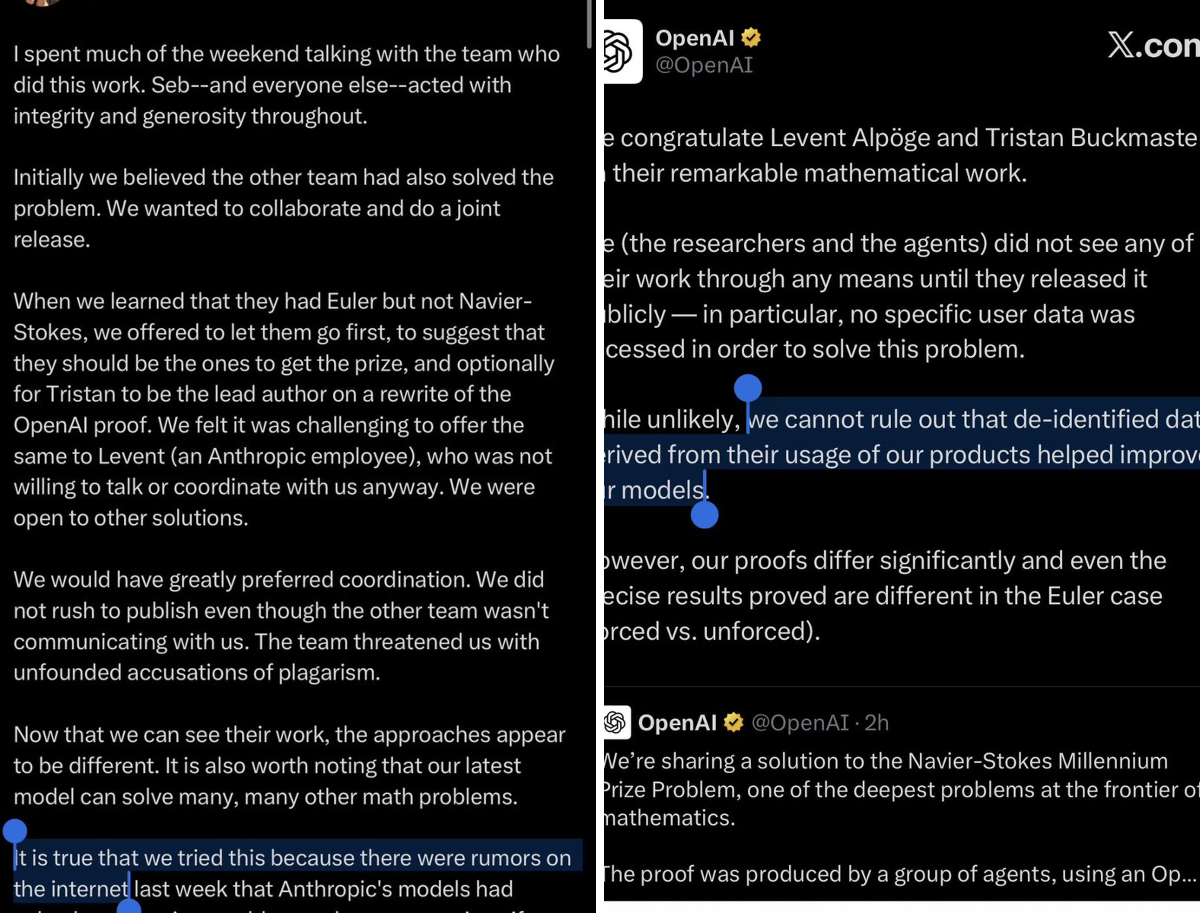
>sam altman: "we tried this because there were rumor on the internet">rumor: math professor close to solving navier-stokes>the professor: using codex for a year>openai: has all his logs>checked every codex session tagged to N-S>found the most promising one>spun up 10,000… pic.twitter.com/RInlP88gmA— NIK (@ns123abc) September 8, 2026
What Is Bluesky?—A Landscape Revealed by the Diffusion Experiment - Nightflight
Navier-Stokes Equation - Clay Mathematics Institute
This is the equation which governs the flow of fluids such as water and air. However, there is no proof for the most basic questions one can ask: do solutions exist, and are they unique? Why ask for a proof? Because a proof gives not only certitude, but also understanding.
Caduceus City
The appearance of a thoroughly protocolized environment is, almost, the perfect cover for dark practices.
Building in the dark forest
We write from our new home in the Dark Forest. This week we fully committed to our new universe: we abandoned Slack and moved all operations into DFOS, our new tool, available more widely in the coming weeks. It feels good in here. Calm. Cozy. Just enough activity for things
Against the dark forest
The complex of ideas I’m going to call the Dark Internet Forest emerges from mostly insidery tech thinking, but from multiple directions.
GitHub - openai/NavierStokesAndEuler at 8937a8f4cbc7abaab5e9e97d1cc7f5d2319d9538
Lean certificates accompanying Navier-Stokes and Euler results - openai/NavierStokesAndEuler

From global trends to local realities: A multi-scale scenario-building methodology for community infrastructure planning
This paper details a multi-scale scenario-building methodology designed to explore transport infrastructure futures in rapidly changing Circumpolar North communities, bridging global trends and national contexts with local realities. Focusing on Churchill, Canada, and Kirkenes, Norway, we employed a hybrid approach that combined top-down adaptation of existing global and regional socioeconomic scenarios with bottom-up, participatory ethnographic research to ensure local relevance and incorporate stakeholder knowledge. We developed coherent scenarios across global, regional (national), and local scales, allowing higher-level archetypes to manifest differently depending on locally specific features identified through fieldwork. This consecutive, nested process utilized morphological analysis and the Factor-Actor-Sector framework to maintain consistency while accommodating local specificities. The methodology centered not just on scenario creation but also on the function of scenarios as a tool for community dialogue, utilizing artistic visualizations in workshops to engage diverse stakeholders. This approach demonstrates a way to navigate the tension between global and national drivers versus local community needs, yielding distinct yet comparable local futures grounded in broader development pathways. It offers practical insights for deliberations and planning in uncertain environments, both built and unbuilt.
Pace Layers 02025 Annual Journal
Long Now’s annual print journal explores the ancient past and distant future of the present moment through essays, interviews, fiction, poetry, and visual art. The journal takes its name and shape from Long Now cofounder Stewart Brand’s pace layers framework — a tool for thinking about how civilizations work. [Learn more about Pace Layers](https://longnow.org/pacelayers/)


A varied ecosystem and terminology. - Nel Ramblings
On Thickets, Enclosure, and Leaving
Every platform I left, I left for the same pattern: enclosure by othering — systems that define what is shameful, create targets, and point an aggressive majority at them. Substack's AI-detection turn is the latest, and it is Dark Forestry in action. The escape is spatial: go where the platforms ar…

The Viscous Frontier
open.substack.com