


What’s the best way to handle difficult conversations? Here are seven ways to improve your communication skills and make these conversations easier.
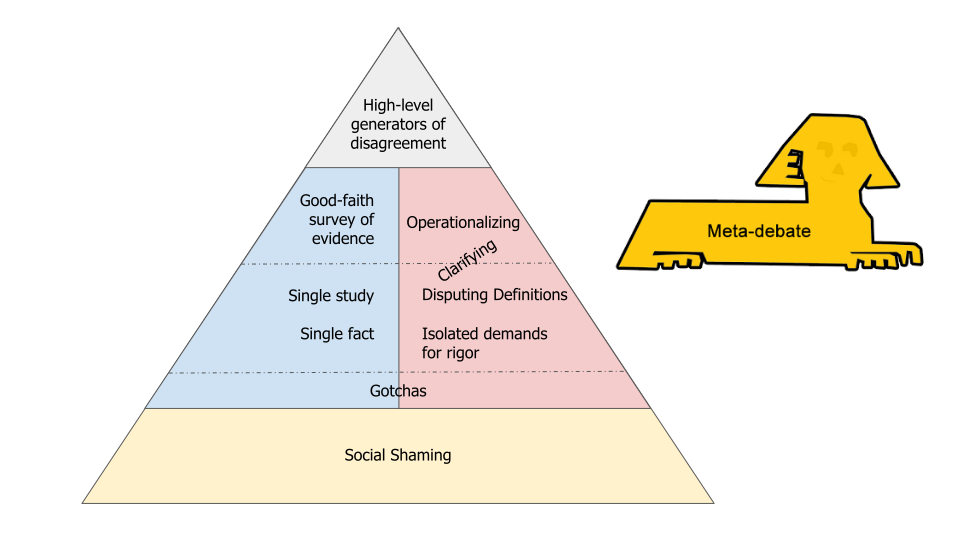
How to disagree well: 7 of the best and worst ways to argue
A classic essay defines different ways to disagree, from the worst to the best, with lessons that ring true in our divisive times.

8 Communication Hacks I Use To Be More Assertive As a Young Employee
Become more influential by learning the language of these subtle cues

Talking with strangers is surprisingly informative
A meaningful amount of people’s knowledge comes from their conversations with others. The amount people expect to learn predicts their interest in having a conversation (pretests 1 and 2), suggesting that the presumed information value of conversations guides decisions of whom to talk with. The results of seven experiments, however, suggest that people may systematically underestimate the informational benefit of conversation, creating a barrier to talking with—and hence learning from—others in daily life. Participants who were asked to talk with another person expected to learn significantly less from the conversation than they actually reported learning afterward, regardless of whether they had conversation prompts and whether they had the goal to learn (experiments 1 and 2). Undervaluing conversation does not stem from having systematically poor opinions of how much others know (experiment 3) but is instead related to the inherent uncertainty involved in conversation itself. Consequently, people underestimate learning to a lesser extent when uncertainty is reduced, as in a nonsocial context (surfing the web, experiment 4); when talking to an acquainted conversation partner (experiment 5); and after knowing the content of the conversation (experiment 6). Underestimating learning in conversation is distinct from underestimating other positive qualities in conversation, such as enjoyment (experiment 7). Misunderstanding how much can be learned in conversation could keep people from learning from others in daily life.

Throughline: Three Media Interview Tips
Everyday conversations are one thing, media interviews are quite another. Learn three ways to keep your message front and center in any media interview.

Best practices: conversation design
An introduction to IBM Research’s Natural Conversation Framework

Good conversations have lots of doorknobs
Or "Spiderman Is My Boyfriend"

Exploring Conversation Design: Applications and Benefits
Discover the what, why and how of Conversation Design, including its definition, applications, and benefits.
Beginner's Guide to Arguing Constructively
How to turn arguments from vicious battles into productive dialogues.
Conversation Skills Essentials
A teacher friend of mine told me that this year students were different. If she asked to see a hall pass from a freshman, they'd give her the finger. They swore at her and were gen...
Harnessing Artificial Intelligence to Facilitate Difficult Conversations
Having difficult conversations is a cornerstone of healthy relationships, yet people are often reluctant to initiate them. We propose that chatbots, with their remarkable ability to emulate human communication, can be harnessed to help people prepare for difficult conversations. In a pre-registered study ( N = 1,371), participants who briefly prepared for a difficult conversation with a chatbot were significantly more likely to initiate that conversation in real life over the following week, compared to those in a control condition. This effect was partly driven by participants anticipating that the conversation would go better after discussing it with a chatbot. Our findings indicate that when deployed thoughtfully, chatbots can influence consequential real-world behaviour within existing social relationships.

Stop being awkward: 6 tips for better video meetings
Video conferencing etiquette is simpler than you think. Learn these tips and best practices to host (and participate in) better video meetings.
How not to sound like a jerk (and communicate effectively) over Slack and email, according to a linguistics expert
If you're telecommuting amid the COVID-19 pandemic, here's what a linguist wants you to know about instant messaging kindly and effectively. For starters: It's normal to feel awkward without face-to-face interactions.

7 Habits That Make People Seem Less Intelligent
It's surprisingly easy to do things that make you look unintelligent in public. Here's a list of the most common mistakes...and how to avoid them.
How to Give a Great Research Talk
How to Deliver Constructive Feedback in Difficult Situations
Thoughtful, empathetic language can make or break your business relationships
Misplaced Divides? Discussing Political Disagreement With Strangers Can Be Unexpectedly Positive
Differences of opinion between people are common in everyday life, but discussing those differences openly in conversation may be unnecessarily rare. We report three experiments ( N = 1,264 U.S.-based adults) demonstrating that people’s interest in discussing important but potentially divisive topics is guided by their expectations about how positively the conversation will unfold, leaving them more interested in having a conversation with someone who agrees versus disagrees with them. People’s expectations about their conversations, however, were systematically miscalibrated such that people underestimated how positive these conversations would be—especially in cases of disagreement. Miscalibrated expectations stemmed from underestimating the degree of common ground that would emerge in conversation and from failing to appreciate the power of social forces in conversation that create social connection. Misunderstanding the outcomes of conversation could lead people to avoid discussing disagreements more often, creating a misplaced barrier to learning, social connection, free inquiry, and free expression.