


The United States is currently evolving into a Network State, says a military analyst who writes regularly on the subject.
The Network State
Technology has enabled us to start new companies, new communities, and new currencies. But can we use it to start new cities, or even new countries? This book explains how to build the successor to the nation state, a concept we call the network state.
The Network State: How To Start a New Country
Technology has enabled us to start new companies, new c…
AI, Geopolitics, and National Security (Chapter 8)
Artificial intelligence is reshaping geopolitics by transforming how states generate, interpret, and project power. Rather than producing a single new weapon, AI operates as a general-purpose technology that scales perception, prediction, and decision-making across military, civilian, and informational domains. This chapter argues that AI rivalry increasingly depends on control over material and organizational foundations, including semiconductors, compute infrastructure, data centers, industrial coordination, and institutional adoption. It examines battlefield integration, U.S.–China competition, semiconductor statecraft, cyber operations, information power, and governance. The chapter shows that AI capabilities diffuse rapidly through commercial platforms, open-source ecosystems, and wartime experimentation, while frontier development remains constrained by infrastructure and supply-chain chokepoints. Because AI capability is difficult to measure or verify, governance is shifting away from traditional arms-control models toward export controls, standards, voluntary commitments, and multistakeholder coordination.
How a billionaire-backed network of AI advisers took over Washington
A sprawling network spread across Congress, federal agencies and think tanks is pushing policymakers to put AI apocalypse at the top of the agenda — potentially boxing out other worries and benefiting top AI companies with ties to the network.
The AI influence network's power players
Millions of dollars are pouring into state and federal races specifically around AI.

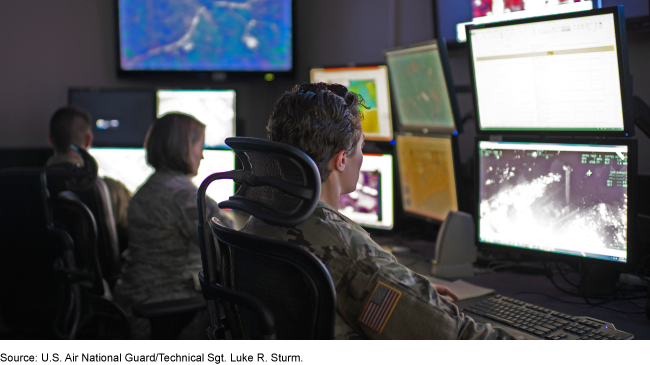
Military Intelligence | New Technology Solutions
It may come as no surprise to you that some of the most challenging work available in computer science is to be found in the USA military.
Exclusive: Highly classified US national security communications network goes down, sources say | CNN Politics
The highly classified network that the National Security Agency uses for its internal communications is down, according to six people familiar with the matter.

The closed world: Systems discourse, military strategy and post WWII American historical consciousness
This essay proposes a cultural and historical explanation for the American Military's fascination with computing. Three key elements of post-WWII US political culture — apocalyptic struggle with the USSR, subsuming all other conflicts: a long history of antimilitarist sentiment in American politics; and the rise of science-based military power — contributed to a sense of the world as a closed system accessible to American technological control. A developing scientific systems discourse, centrally including computer science and AI, was adopted for strategic thinking and military technology. The Strategic Computing and Strategic Defense Initiatives are discussed as contemporary examples of this conjunction.
CBI dismantles transnational cybercrime networks across multiple States
CBI dismantles transnational cybercrime networks, arresting two operatives in collaboration with international law enforcement agencies.

Defense Intelligence: Comprehensive Plan Needed to Improve Stakeholder Engagement in the Development of New Military Intelligence System
Intelligence collected on foreign militaries is critical for the U.S. military. The Defense Intelligence Agency's database for this intelligence doesn...
How Elon Musk and the Tech Billionaires Hijacked the State and Our Minds
Historian Quinn Slobodian tells Byline Times that Elon Musk's rise tells a deeper story—of fortunes built on state power, and a new politics where humans are treated less as citizens than as systems to be optimised

The Digital Maginot Line
There is a war happening. We are immersed in an evolving, ongoing conflict: an Information World War in which state actors, terrorists, and ideological…

We need network societies, not network states — The Collective Intelligence Project
Balaji Srinivasan's The Network State posits a choice between reaction and stasis. A brighter future does not await through network states, but through network societies.

The Hacking of Culture and the Creation of Socio-Technical Debt - Schneier on Security
Culture is increasingly mediated through algorithms. These algorithms have splintered the organization of culture, a result of states and tech companies vying for influence over mass audiences. One byproduct of this splintering is a shift from imperfect but broad cultural narratives to a proliferation of niche groups, who are defined by ideology or aesthetics instead of nationality or geography. This change reflects a material shift in the relationship between collective identity and power, and illustrates how states no longer have exclusive domain over either. Today, both power and culture are increasingly corporate...
Books — Sharon Weinberger
Drawing on deep, exclusive reporting, a veteran national security correspondent reveals how a new military-industrial complex is arising from the cradle of Silicon Valley, with vast implications for American democracy and the global balance of power.Elon Musk, Peter Thiel, and Alexander Karp. These tech titans are fast becoming some of the most powerful figures in the realm of national security, with enormous implications for us all. As Sharon Weinberger reveals in this gripping account, the American military and spy agencies helped to create Silicon Valley as we now know it, and some of its biggest and most valuable companies today owe much of their success to the Pentagon and CIA. Beginning with the War on Terror and accelerating under Donald Trump, however, the old alliance between elected leaders in Washington and the unelected CEOs of Silicon Valley has grown increasingly uneasy as power has shifted to the private sector and Big Tech exerts greater and greater influence over its old patrons. Companies such as SpaceX and Palantir, along with newer entrants to the field such as Anduril, are proudly supporting—and quietly shaping—US national defense, whether by providing spies and soldiers with AI and cloud-computing tools or actual military hardware such as microwave weapons, hypersonic missiles, and advanced drones. The implications of this historic shift are poorly understood and fraught with peril. What happens when mercurial billionaires like Elon Musk control weapons and technologies that were once the preserve of the US government? How will this new military-industrial complex affect the way wars are fought, or even which wars are fought? That is the urgent question before us today, at the dawn of this new era—and as Weinberger reveals, it is one on which our collective future might well hinge.
The US State Department has designated A/I, a small Italian provider of open source infrastructure for political activists, as a global terrorist group. They will reach into our very homes to grab us — if we let them. state.gov/releases/office-of-the-spokes…

Designation of Autistici/Inventati as a Specially Designated Global Terrorist - United States Department of State
www.state.gov