Wargames, mutually assured destruction, and the coming battle to control your digital life
Digital Degrowth: Radically Rethinking our Digital Futures
We are fast approaching the point of “peak digital”, with the continued mass production and excessive consumption of digital technologies set to become a key driver of climate crisis, ecological breakdown and ongoing societal instability.<br /> <br /><i>Digital Degrowth</i> is a call to completely rethink our digital futures in these fast-changing times. It explores how degrowth thinking and alternate forms of “radically sustainable computing” might support ambitions of sustainable, scaled-down and equitable ways of living with digital technologies. Neil Selwyn proposes a rebalancing of digital technology use: digital degrowth is not a call for simply making reduced use of the digital technologies that we already have – rather it is an argument to reimagine digital practices that maximise societal benefits with minimal environmental and social impact. Drawing on illustrative examples from across computer science, hacker and environmental activist communities, this book examines how core degrowth principles of conviviality, autonomy and care are already being used to reimagine alternate forms of digital technology.<br /> <br />Original and stimulating, this is essential reading for students and scholars of media and communication, sustainability studies, political ecology, computer/data sciences, and across the social sciences.

The Digital Sublime: Myth, Power, and Cyberspace
Interpreting the myths of the digital age: why we believed in the power of cyberspace to open up a new world.The digital era promises, as did many other te
Bolt - Investing at the intersection of the digital and physical world
Bolt: Investing at the intersection of the digital and physical worlds

Appropriate Measures — Real Life
Changing the tech we use is not enough to mitigate the environmental and social harm of mass technology

Adventures in Mapping Digital Empires
For years, Tactical Tech has worked to understand and visualise Big Tech's impact on society. In this piece, you will be taken on a journey through the different formats, narratives and visual representations Tactical Tech has used to tell the story behind the acquisitions, mergers and investments of the Big Tech Google, Amazon, Facebook, Apple and Microsoft. Read to learn about our provocation design approach to promote digital thinking.

The Next Great (Digital) Extinction
How today's internet is rapidly and indifferently killing off many systems while allowing new types of organizations to emerge.

Why we must reclaim digital sovereignty
A new white paper envisions a radically different technological future
The Whale and the Reactor: A Search for Limits in an Age of High Technology, Second Edition
“In an age in which the inexhaustible power of scientific technology makes all things possible, it remains to be seen where we will draw the line, where we will be able to say, here are possibilities that wisdom suggest we avoid.” First published to great acclaim in 1988, Langdon Winner’s groundbreaking exploration of the political, social, and philosophical implications of technology is timelier than ever. He demonstrates that choices about the kinds of technical systems we build and use are actually choices about who we want to be and what kind of world we want to create—technical decisions are political decisions, and they involve profound choices about power, liberty, order, and justice. A seminal text in the history and philosophy of science, this new edition includes a new chapter, preface, and postscript by the author.

Digital dystopia: how algorithms punish the poor
In an exclusive global series, the Guardian lays bare the tech revolution transforming the welfare system worldwide – while penalising the most vulnerable

2023 Landscape: Confronting Tech Power - AI Now Institute
Our latest annual report diagnoses concentration of power in the tech industry as a pressing challenge and points the path forward to seize this moment of change.

An ecological perspective to master the complexities of the digital economy
Economic and social interactions are shifting to digital platforms which grow into vast ecosystems where user engagement creates value for members while ecosystem orchestrators harvest massive revenue. The digital ecosystem business model succeeds by adeptly navigating fast-changing environments, including new technologies and volatile demands, through dynamic innovation in a decentralized decision-making setting. This renders digital platform ecosystems complex adaptive systems. Recognizing that natural ecosystems are a prime example of complex adaptive systems, we propose a systematic hierarchical framework for describing and understanding digital ecosystems, rooted in ecology and evolution. Our framework compares digital ecosystems hosted by societies to natural ecosystems embedded in biomes, products to species, and technologies and elements of business strategy to the genetic makeup of a species. As digital platforms face heightened scrutiny about their socio-economic power and societal value, our approach contributes to the development of deeper understanding and sustainable governance of the digital economy.
LIMITS 2026 -- Workshop on Computing within Limits
LIMITS concerns the role of computing in human societies situated in a world of planetary boundaries and limits, such as limits of extractive logics, limits to a biosphere’s ability to recover, limits to our knowledge, or limits of technological solutions to societal issues. As an interdisciplinary group of researchers, practitioners, and scholars, we seek to reshape and orient the broader computing research agenda, grounded by an awareness that contemporary computing research is embedded in finite socio-ecological conditions and must reckon with with ecological limits in general, and climate- and climate justice-related limits in particular. LIMITS 2026 solicits submissions that move us closer towards computing that supports ecological and just futures for diverse human and non-human lifeforms and thriving biospheres.
Technology is Not Values Neutral: Ending the Reign of Nihilistic Design
We fail to take tech seriously when we do not grasp its full impact on humans

Role of digitalization in environment, social and governance, and sustainability: Review-based study for implications
Digitalization gives people access to a vast network of untapped data, which has the potential to help society and the environment. Smart systems connected to the internet can systematically provide a unique opportunity to solve difficulties related to long-term sustainability. The goals are to create an egalitarian, ecologically sustainable, and healthy society. Technological resources are envisioned as game-changing instruments. Three key concerns integration benefits are highlighted here: (i) sustainable development goals, (ii) socio-economic development, and (iii) the role of digital technology in environmental sustainability. This viewpoint describes the potential that digitization can create a future sustainable society. The technological network would unite the urban and rural worlds under a shared banner of sustainable development, keeping all social elements in the loop. Nations that take a comprehensive strategy will be able to provide equitable growth and an efficient, sustainable, and digital existence for their citizens. As a result, digitization provides better living conditions, active public involvement, clean governance, and transparency in public welfare programs and processes. People who are well-informed, self-aware, and digitally equipped will be better learners, thinkers, reformers, participators, and change and growth agents, marching forward on sustainable progress. The advantages of digitization in hastening the transition to sustainable industrial processes and improving people's health and happiness are explored. Finally, the perspective encapsulates the advantages of digitization by offering a holistic vision of how technology could aid in addressing major challenges such as endangered world biodiversity and climate change.

Startups’ Trillion-Dollar Numbers Game | Backchannel
Techies love making outrageous promises—but they’re pushing the limits of plausibility.

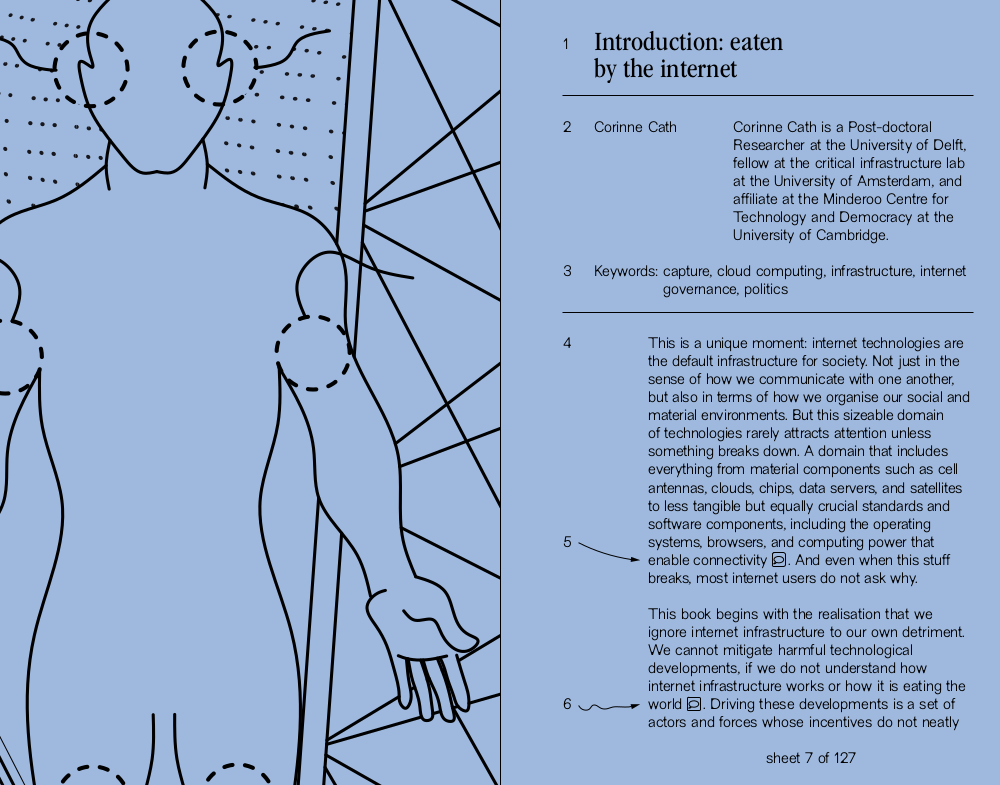
Eaten by the Internet
This book makes internet infrastructure visible as a force of political power, which is transforming the social world, from the bottom up—through fifteen chapters contributed by a global set of researchers, activists, and techies. We are living a unique moment: internet technologies are the default infrastructure for society, not just how we communicate but also how we organise our social life, politics, and economy, all the way down to our material environments, like cities. Our world is eaten by the internet. This means that those who control the internet control the bounds of public speech, economic production, social cohesion, and politics, making its infrastructure a core political terrain in the networked age. The book’s chapters cover a wide set of topics, spanning from the global politics of content moderation by internet infrastructure to the colonialism inherent in the race to plug the moon, from the harms wrought by blockchain companies in rural America to the particularities of online censorship across Asia. The chapters take on thorny topics, discussing power consolidation in the advertisement and cloud industry, the role of internet infrastructure in the war in Ukraine, and tech’s environmental impact—amongst others. In doing so, this book roots contemporary technology debates in the politics of internet infrastructure and urges us to ask how can we ensure our infrastructures sustain us, rather than consume us?