


Imagine a world without platform lock-in, where no ban or billionaire could take down your social network. That’s what ActivityPub has planned.
The Efforts to Extend ActivityPub
ActivityPub has fostered a social web for millions of people. To grow, some developers believe it needs improvement. These are their efforts.
Why ActivityPub is the future
We often tout things like “Mastodon is based on open web protocols” as one of its advantages. I want to elaborate why exactly that’s a good thing.
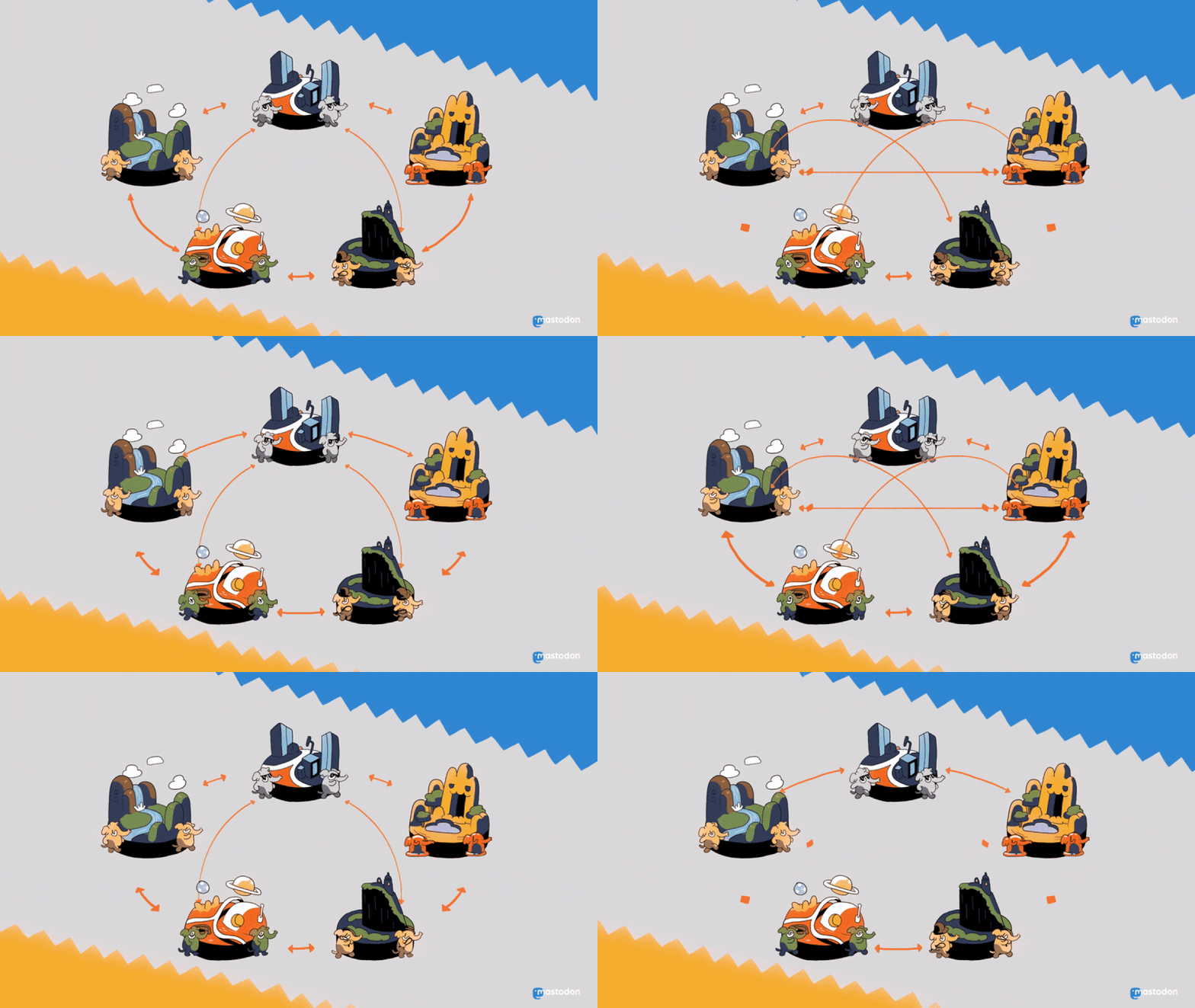
ActivityPub
Connect your site to the Open Social Web and let millions of users follow, share, and interact with your content from Mastodon, Pixelfed, and more.

Social Networking Utopia — Matt
In discussing the network topology of social networks — whether centralized like Facebook or federated like ActivityPub — I think the ult...

EFFecting Change: How to Build a Decentralized Web That Truly Works for All
Freedom of movement in digital Europe
Leaving a platform should not mean losing your network. Builders' joint position paper on opening the social internet up to competition. Read it and sign on.

Freedom of movement in digital Europe
Leaving a platform should not mean losing your network. Builders' joint position paper on opening the social internet up to competition. Read it and sign on.
ActivityPub
ActivityPub is a protocol and open standard for decentralized social networking. It provides a client-to-server (C2S) API for creating and modifying content, as well as a federated server-to-server (S2S) protocol for delivering notifications and content to other servers. ActivityPub is the defining standard of the Fediverse, a decentralised social network of various social interaction models, and content types, which consists of independently managed instances of software such as Mastodon, Pixelfed, Lemmy, and PeerTube, among others.

ActivityPub
The ActivityPub protocol is a decentralized social networking protocol based upon the [ActivityStreams] 2.0 data format. It provides a client to server API for creating, updating and deleting content, as well as a federated server to server API for delivering notifications and content.
ActivityPub
The ActivityPub protocol is a decentralized social networking protocol based upon the [ActivityStreams] 2.0 data format. It provides a client to server API for creating, updating and deleting content, as well as a federated server to server API for delivering notifications and content.
FediForum Talk: How To Bullshit Your Way Through a Conversation about ActivityPub
By Evan Prodromou, Social Web Foundation and editor of the ActivityPub standard. One of the best bluffers in the field of distributed social networks gives you just enough knowledge about ActivityP...

Recently I’ve been thinking about a couple of... - Adam Wood
Recently I’ve been thinking about a couple of different tech-related things that sort of overlap. One is the (emerging) shape of the new social web; the other is a pull I’m feeling to try and lessen reliance on American companies. I’ve been interested in / concerned by what became of social media for some time.1 Since the sundering of Twitter in 2022, I’ve kept an eye on the various alternatives, with particular interest in Mastodon and Bluesky. Actually, to be more accurate, my interest has been in the protocols behind those platforms: ActivityPub and AT Protocol respectively. Both have their...

Will the End of Lockdowns Change Our Relationship with the Internet? - Slashdot
Last year author Sonia Shah predicted that after pandemic-induced lockdowns finally ended, "The hype around online education will be abandoned, as a generation of young people forced into seclusion will reshape the culture around a contrarian appreciation for communal life." This week the Atlantic...

Power and the Internet - Schneier on Security
All disruptive technologies upset traditional power balances, and the Internet is no exception. The standard story is that it empowers the powerless, but that’s only half the story. The Internet empowers everyone. Powerful institutions might be slow to make use of that new power, but since they are powerful, they can use it more effectively. Governments and corporations have woken up to the fact that not only can they use the Internet, they can control it for their interests. Unless we start deliberately debating the future we want to live in, and the role of information technology in enabling that world, we will end up with an Internet that benefits existing power structures and not society in general...
Do we need publicly-owned social networks to escape Silicon Valley?
A state-run social media network could become an alternative to Twitter or Facebook, but it could also pose a risk to our privacy and freedom

Bluesky & Open Social Media Tech