One attorney called it a ‘super search engine.’

The MyPillow guy’s lawyers got fined for using false AI-generated citations.
The attorneys defending MyPillow founder Mike Lindell in a defamation case (which he lost) were ordered to pay $3,000 each for putting AI-generated misquotes and “citations of cases that do not exist” in a brief submitted in February, as reported by ArsTechnica. More and more lawyers are getting caught — and punished — for including AI hallucinations in their work, and this trend will likely only continue to grow. [Link: Why do lawyers keep using ChatGPT? | https://www.theverge.com/policy/677373/lawyers-chatgpt-hallucinations-ai | The Verge]

DOGE used ChatGPT in a way that was both dumb and illegal, judge rules
DOGE staffers used ChatGPT to scan grants for terms related to DEI.

The ChatGPT effect: In 3 years the AI chatbot has changed the way people look things up
ChatGPT has dramatically altered how people retrieve information, muscling aside Google search as the first stop on the hunt for answers.

The ChatGPT effect: In 3 years the AI chatbot has changed the way people look things up
ChatGPT has dramatically altered how people retrieve information, muscling aside Google search as the first stop on the hunt for answers.
Your Search Results Are Getting Sloptimized
How companies are gaming the chatbot internet
How to get ChatGPT to recommend your product | Ethan Smith
🎙️ Graphite's CEO on why ChatGPT is driving more qualified leads than Google, how to optimize for Reddit without spamming, and why early-stage startups can win at AEO when they couldn't at SEO

Companies Are Using Reddit to Manipulate ChatGPT and Google AI Search
Peptide companies have been doing AI-engine optimization by spamming the biohackers subreddit to manipulate ChatGPT and Google.

ChatGPT isn’t the only chatbot pulling answers from Elon Musk’s Grokipedia
Google’s Gemini, AI Mode, and AI Overviews, Perplexity, and Microsoft are starting to cite Musk’s Wikipedia knockoff.

AI ruling prompts warnings from US lawyers: Your chats could be used against you
As people increasingly turn to artificial intelligence for advice, some U.S. lawyers are telling their clients not to treat AI chatbots like trusted confidants when their freedom or legal liability is on the line.

Hallucination-Free? Assessing the Reliability of Leading AI Legal Research Tools
Legal practice has witnessed a sharp rise in products incorporating artificial intelligence (AI). Such tools are designed to assist with a wide range of core legal tasks, from search and summarization of caselaw to document drafting. But the large language models used in these tools are prone to "hallucinate," or make up false information, making their use risky in high-stakes domains. Recently, certain legal research providers have touted methods such as retrieval-augmented generation (RAG) as "eliminating" (Casetext, 2023) or "avoid[ing]" hallucinations (Thomson Reuters, 2023), or guaranteeing "hallucination-free" legal citations (LexisNexis, 2023). Because of the closed nature of these systems, systematically assessing these claims is challenging. In this article, we design and report on the first preregistered empirical evaluation of AI-driven legal research tools. We demonstrate that the providers' claims are overstated. While hallucinations are reduced relative to general-purpose chatbots (GPT-4), we find that the AI research tools made by LexisNexis (Lexis+ AI) and Thomson Reuters (Westlaw AI-Assisted Research and Ask Practical Law AI) each hallucinate between 17% and 33% of the time. We also document substantial differences between systems in responsiveness and accuracy. Our article makes four key contributions. It is the first to assess and report the performance of RAG-based proprietary legal AI tools. Second, it introduces a comprehensive, preregistered dataset for identifying and understanding vulnerabilities in these systems. Third, it proposes a clear typology for differentiating between hallucinations and accurate legal responses. Last, it provides evidence to inform the responsibilities of legal professionals in supervising and verifying AI outputs, which remains a central open question for the responsible integration of AI into law.

How AI bots quietly dismantle paywalls via web search
ChatGPT and other AI chatbots have figured out how to get around paywalls through "live" web search—and they're doing it systematically and quietly across major publications, new Digital Digging research reveals.

Do Self-Promotional “Best” Lists Boost ChatGPT Visibility? Study of 26,283 Source URLs
Just last month, OpenAI CEO Sam Altman revealed that more than 800 million people use the platform each week. But what does it take to get mentioned and
Work smarter with your company knowledge in ChatGPT
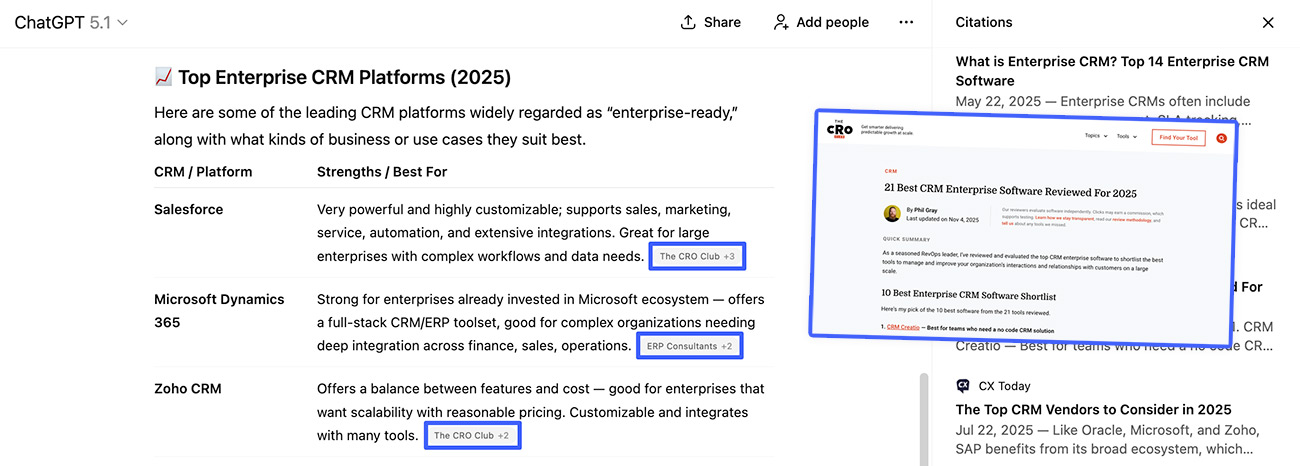
Company knowledge brings context from your apps into ChatGPT for answers specific to your business, with clear citations, security, privacy, and admin controls. Available now for Business, Enterprise, and Edu users.