


You don’t bring a persuasive argument to a gunfight.
Decapitation and the End of Politics
How Targeted Killings Are Reshaping Modern Warfare

Guns, games and violence: The real questions you should be asking
Don’t get thrown by causality

Argumentation theory | Communication and Mass Media | Research Starters | EBSCO Research
<p>Argumentation theory explores the processes and methods of reasoning and debate used by individuals in both formal and informal contexts. The theory has roots in ancient philosophical discourse, particularly from figures like Aristotle, and has evolved through the contributions of modern philosophers such as Chaïm Perelman and Stephen Toulmin. It highlights how arguments are structured, identifying key components such as claims, grounds (or data), and warrants, which collectively help participants make their case. </p> <p>Additionally, arguments can be categorized into three main types: factual claims, which are verifiable; judgment or value claims, which are subjective; and policy claims, which pertain to proposed courses of action. This framework acknowledges the influence of personal biases, often shaping the reasoning process, and emphasizes the importance of logical support, backing, qualifiers, and rebuttals in strengthening arguments. In academic contexts, the theory suggests that creating valid topics should focus on policy arguments, while also addressing counterarguments to foster a comprehensive debate. Overall, argumentation theory serves as a critical tool for understanding how reasoning and persuasive communication function in various scenarios.</p>

Beginner's Guide to Arguing Constructively
How to turn arguments from vicious battles into productive dialogues.
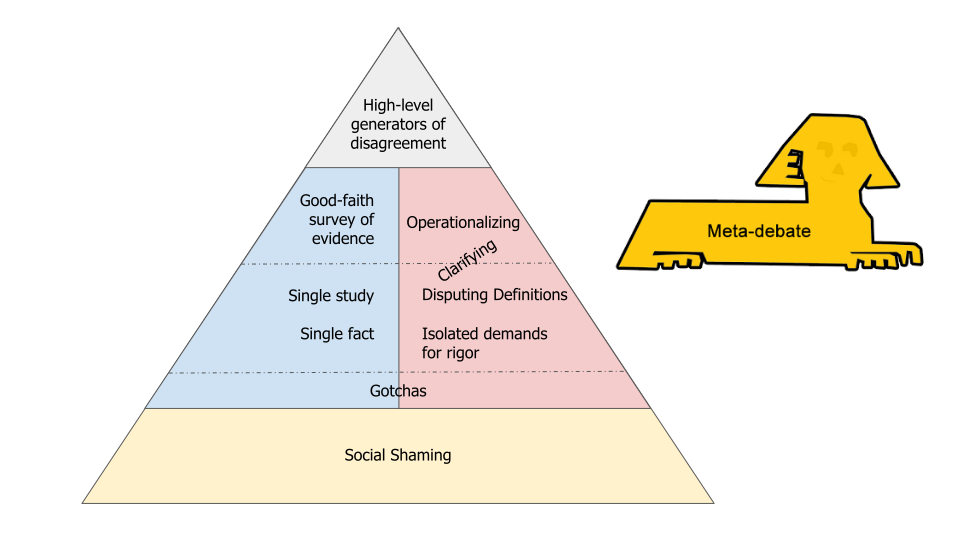
When is Political Violence Justified
What the Liberal Tradition Says on the Subject

A Better Conversation on Guns
For the U.S. to make lasting progress against firearm violence, it must change the way it talks about — and talks to — people who carry.

Biddeford shooting renews questions about ICE tactics, training
A review of previous Maine cases show how investigations into use of force often lean heavily on officers’ perception of potential harm.

Here Are a Few of the Ways AI Could In Fact Kill Everyone
It has become fashionable to ask “doomers” to “get specific” about their dooming. Well, aiight then.

The Universal Pursuit of Safety and the Demand for (Lethal, Non-Lethal or No) Guns - Social Economics Lab
Personal lethal firearm ownership has for several decades been a hot button political issue in the United States. This article aims to explore the motivations and beliefs underlying sharply different views on the subject through an original large-scale survey of lethal firearm owners (LFAO) and non-owners and experimental information interventions. We start by documenting several facts: First, LFAO and non-owners appear to be driven by a common objective---to be safe. Both groups list protection of family or self as the top rationale for owning or potentially acquiring a lethal firearm (LFA). Second, among non-owners, there are those who are interested in purchasing a lethal firearm (NO-I) and those who are not (NO-UI). NO-I feel the least safe in their daily lives. Third, there are differences in emotional responses to possession of a LFA. LFAO report feeling unsafe and less confident if they did not own the product whereas NO-U report similar feelings if they did own it. Fourth, LFAO are much less concerned about the possibility of personal and social costs associated with lethal firearm possession, a finding heightened across partisan lines. Taken together, these facts motivate three experimental treatments that randomly provide respondents with information on either (1) the personal legal and medical risks of ownership or (2) a non-lethal firearm (NLFA), provided with or without a conservative pundit's endorsement. The first treatment increases concerns about harms associated with lethal firearm ownership among all respondents, but these results are generally short-lived and do not affect policy views. The second treatment, however, increases respondents' willingness to pay for a NLFA and their self-reported preference for firearms that incapacitate but do not kill. Moreover, these treatment effects are more persistent than those of the cost treatment, especially when coupled with an endorsement, and affect the support of policies aimed at encouraging NLFA. Importantly, we do not find that exposure to information on NLFA makes current owners want to give up their (lethal) guns. We interpret these findings through an organizing framework in which every household has a demand for safety but differs in how they use firearms or other tools to produce it, due to different perceptions of the safety possibilities frontier (SPF, views about the least harmful ways to achieve protection benefits) or different preferences and incentives influencing the tradeoff over protective benefits vs. harms. Our results suggest that a substantial share of LFAO perceive the SPF differently than non-owners, and that there is a potential demand for less-lethal tools to be and feel safe.

Political Violence Is Never Acceptable
Nor is the threat or implication of violence.

Persuasion Index: A Theory-Guided Framework for Persuasion Analysis
Identifying persuasive rhetorical cues is critical across domains, from detecting information manipulation and improving AI safety to advancing public health communication. We propose Persuasion...

What Tear Gas and Rubber Bullets Do to the Human Body
So-called “less-lethal” weapons like those that have been used against demonstrators in Los Angeles can cause severe, lasting harm like nerve or brain damage or blindness. They can also kill.

It's Safer in the Front
Faced with intensifying repression and state violence, there is an understandable inclination to seek safety by avoiding confrontation. But this is not always the most effective strategy.

TV: The Shame of Wisconsin
One cannot watch Making a Murderer without thinking of the adage that law is to justice what medicine is to immortality. The path of each is a little crooked and always winds up wide of the mark. Moreover, nothing is as vain and self-regarding as the law.

Actually, Testosterone Doesn't Make You More Violent
Testosterone isn't inherently linked to violence, so what's the logic behind Pete Hegseth's hormonal plan for the U.S. military?

What About the Rapists and Murderers?
Trigger warning: rape, sexual assault, murder, torture, ablelism, trauma.