

We built a posttraining task that runs for 20 hours with the Tinker API. The core bottleneck is research intuition.
MirrorCode: evidence AI can already do some weeks-long coding tasks
Early results from MirrorCode benchmark with METR: AI agents can complete weeks-long coding tasks, including reimplementing a 16,000-line codebase.
AI Tinkerers | Global AI Events & Meetups 2026
AI Tinkerers is a global community of AI builders. Discover city chapters, upcoming meetups, and practical demos.

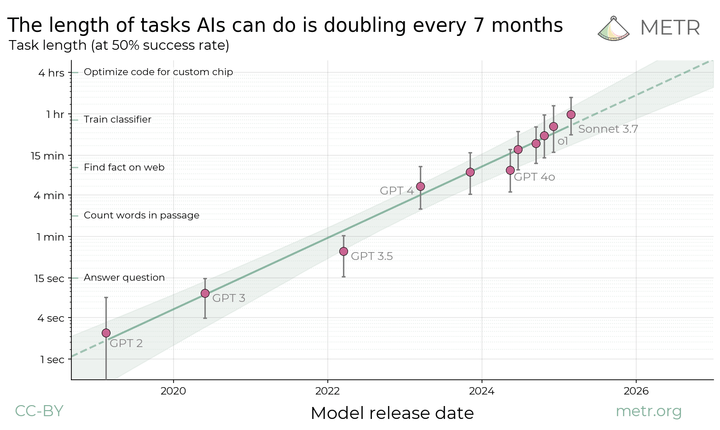
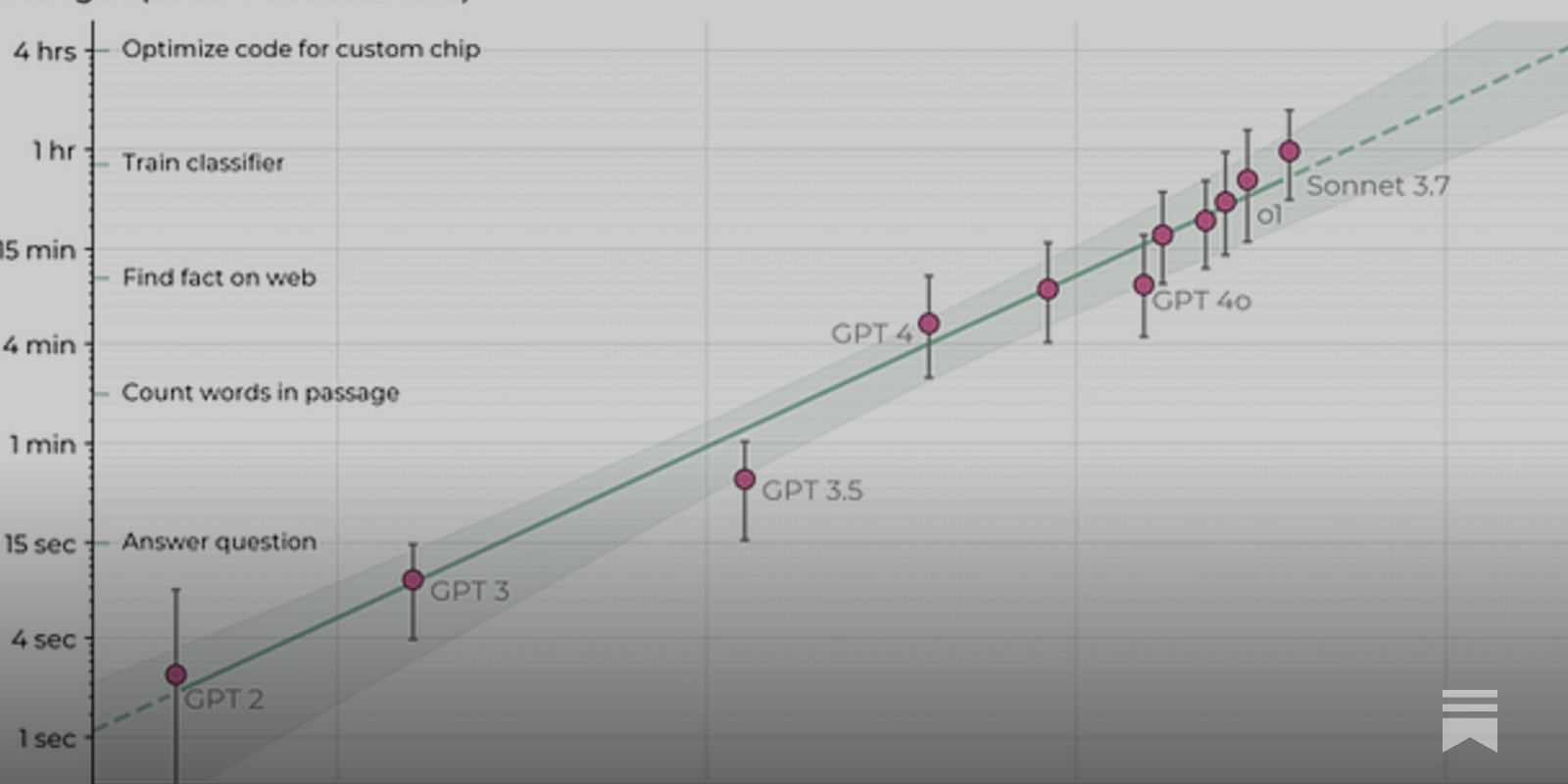
Measuring AI Ability to Complete Long Tasks
We propose measuring AI performance in terms of the *length* of tasks AI agents can complete. We show that this metric has been consistently exponentially increasing over the past 6 years, with a doubling time of around 7 months. Extrapolating this trend predicts that, in under a decade, we will see AI agents that can independently complete a large fraction of software tasks that currently take humans days or weeks.
AI research speeds up. Monitoring gets harder. - Sensemaker
OpenAI says coding agents now run 3.1 days for every human research day, while its chief scientist warns the lab’s main monitoring method is weakening.
Hyperfast AI: Rethinking Design for 1000 tokens/s
I recently spoke at AI Tinkerers Raleigh about hyperfast inference systems and how they’re fundamentally changing AI application design. If you haven’t heard of Cerebras (or however they pronounce it), you’re in for a treat—this is one of the most exciting areas of research in AI right now.
What AI coding costs you | Tom Wojcik
What's the effect of the prolonged AI usage among coders and is it tracked correctly, if it all?
TasteVal: Measuring the Experimental Research Taste of AI Systems Against Human Experts
We introduce TasteVal, a benchmark to evaluate the experimental research taste of frontier models. We define research taste as the ability to pick interesting problems to solve, design experiments, and interpret experimental results. TasteVal measures the experimental component of research taste; given a fixed research problem, we measure how well a model iteratively designs experiments and draws conclusions from their outcomes. We operationalize experimental research taste as compute efficiency; a Researcher who reaches the same score as an expert human using half the serial experimental compute has twice the experimental taste. Experimental taste thus acts as a multiplier on experimental compute, making it a key input to forecasts of AI progress. TasteVal consists of 8 novel, challenging, open-ended tasks representative of frontier AI R&D. To isolate taste from coding ability, the model under evaluation acts as a Researcher that iteratively designs experiments while a fixed Coder agent implements them and reports their results. The Researcher executes until either the 40 H100 hour or 120 wall-clock hour budgets are exhausted. We recruit 24 human experts, at least 2 per task, and take the best expert attempt per task as the expert baseline. We evaluate 20 models released between 2023 and 2026. The best-performing model, Opus 5.5, exceeds our expert baseline, with a compute multiplier of 2.3x (95% CI 1.15-4.37), at roughly 1/30 of our baseliners' average per-run cost. On TasteVal, the compute multiplier of frontier models has doubled approximately every 3.0 months since December 2025 (95% CI 1.7-5.0), up from every 14 months between 2023 and December 2025. Measured by final normalized performance, frontier models show no trend break, doubling every 14.6 months. To keep TasteVal uncontaminated, we do not release the tasks.

Using AI for Just 10 Minutes Might Make You Lazy and Dumb, Study Shows
New research suggests that reliance on AI assistants can have a negative impact on people’s ability to think and problem solve.

Where’s my ten minute AGI?
Why don’t AIs automate more real-world tasks if they can handle 1-hour ones? Here are at least three fundamental reasons.
No Vibes Allowed: Solving Hard Problems in Complex Codebases – Dex Horthy, HumanLayer
scaleapi/SWE-bench_Pro-os
SWE-Bench Pro: Can AI Agents Solve Long-Horizon Software Engineering Tasks?
I don't know if I like working at higher levels of abstraction
AI tools push us to higher abstraction. I'm not sure I like what that costs us.
AI Isn’t Lightening Workloads. It’s Making Them More Intense.
The technology is increasing the speed, density and complexity of work rather than reducing it, a new analysis of 164,000 people’s work activity shows.

Writing Code vs. Shipping Code: Productivity Effects Across Generations of AI Coding Tools
How do the productivity effects of AI evolve across successive generations of tools, and to what extent do task-level gains ultimately translate into final outp

Writing Code vs. Shipping Code: Productivity Effects Across Generations of AI Coding Tools
How do the productivity effects of AI evolve across successive generations of tools, and to what extent do task-level gains ultimately translate into final outp