

This blog discusses why, after supporting OWL, Irene Polikoff, co-founder of TopQuadrant, has completely abandoned it in favor of SHACL.
Why I Use SHACL For Defining Ontology Models | TopQuadrant
This is the second blog on what modeling language we recommend to use when creating ontologies. In this blog I will talk about what I do use.
OWL - Semantic Web Standards
The W3C Web Ontology Language (OWL) is a Semantic Web language designed to represent rich and complex knowledge about things, groups of things, and relations between things. OWL is a computational logic-based language such that knowledge expressed in OWL can be exploited by computer programs, e.g., to verify the consistency of that knowledge or to make implicit knowledge explicit. OWL documents, known as ontologies, can be published in the World Wide Web and may refer to or be referred from other OWL ontologies. OWL is part of the W3C’s Semantic Web technology stack, which includes RDF, RDFS, SPARQL, etc.
Haus of Owl
Haus of Owl is made up of a community of working creators. Meet them in the Creator Directory - or become one of them.

Theo - t3.gg on Twitter / X
I think Codex stopped using Electron 👀The owl was a big hint, the custom architecture used for the ChatGPT Atlas browser was called "OWL" (OpenAI’s Web Layer) https://t.co/L6PFio3EBE pic.twitter.com/ALFTbVCIXq— Theo - t3.gg (@theo) May 29, 2026
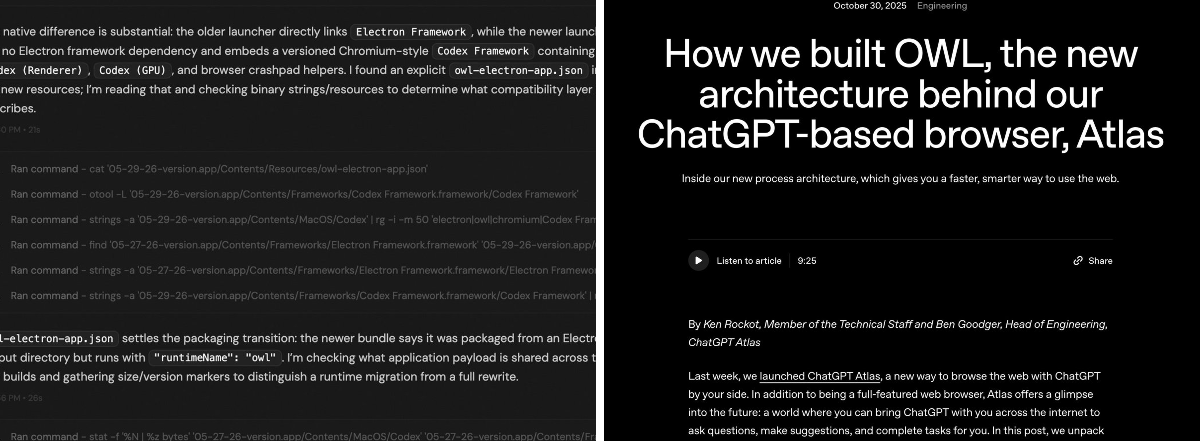
How we built OWL, the new architecture behind our ChatGPT-based browser, Atlas
A deep dive into OWL, the new architecture powering ChatGPT Atlas—decoupling Chromium, enabling fast startup, rich UI, and agentic browsing with ChatGPT.

Tophhie Social (@tophhie.social)
Our corner of the fediverse, powered by ATProtocol. Hosted by @tophhie.cloud, built for community, and fully ready to federate responsibly 🚀 Support our efforts... aka.tophhie.cloud/tsdonate. For help, go to support.tophhie.cloud.

Owlstown: the website builder for academics
Build your academic website and keep it updated easily. Owlstown is designed for all academics, from students to professors to labs.
I expected better from Google
Nico, Minitap’s CEO, shares what the team found in Google’s Artemis repository and why attribution matters for the open-source community.

#opensource | Andre Zayarni | 61 comments
We have a long history with MongoDB. Many years ago, when I was still writing code myself, NoSQL was a novel concept. I was sold on its simplicity and natural compatibility with the Node stack. I used Mongo for all my side projects. For work, we still preferred SQL DBs, though. Fast forward to the early days of Qdrant, MongoDB Ventures reached out, and we had several conversations; they considered investing in our seed round. Their product managers and engineers were reaching out and praising our solution. At some point, they revealed that they are going to add vectors to their Atlas search product just by using Lucene. So what, who cares? At Qdrant, we’re not retrofitting anything. We’re building a dedicated vector search engine - from the ground up. If someone wants to replicate what we do? Go ahead, we are #opensource. But here’s where it gets frustrating. We have put in the hard work building our community and attracting prominent people in the AI landscape to use our product and create content about it. We have built our Qdrant Stars program to engage with the community even closely. qdrant.tech/stars So, what does it have to do with Mongo? Well, they just made a clever shortcut and reached out to our Qdrant Stars program members and influencers from our community, making them an offer they could not decline. I do not blame the content creators, it is their daily work and it is an excellent opportunity for them, guys, I can totally understand you, no worries. But let's call it what it is: A multi-billion-dollar company is now trying to buy its way into a community built by an early-stage startup, not them. We don’t fear competition. But when the incumbents start copying your strategy and poaching your community, it says one thing loud and clear: We’re making the right people nervous. We’ll never outspend Mongo, and we don’t need to. We have something they can’t copy or buy: a fast-growing, mission-driven, technically superior open platform - and a community that sees through the noise. So to the engineers, researchers, and creators who believe in open innovation, performance that doesn’t compromise, and communities that are earned, not acquired: you know where to find us. And to the MongoDB marketing geniuses: take on Elastic, take on Redis, take on Oracle, and others of your calibre, but leave Qdrant and other startups like us alone. | 61 comments on LinkedIn

the quintal is open
Introducing quintal: a collective blogging platform on atproto, no algorithm, no metrics, one axolotl mascot. The small internet I always wanted to live in.

The Astrosky Ecosystem: An independent online platform for science communication and social networking
While almost everything that astronomers study occurs in the vacuum of space, astronomy itself does not `happen in a vacuum'. Interactions between scientists, as well as outreach to members of the public, improve extensively from access to good communication tools. Social media has become a key tool for communication in astronomy, being widely used by individuals and organizations alike for networking, outreach, and more. However, traditional social media is reliant on benevolent corporations providing a free service without compromising on quality, and the recent takeover and decline of Twitter has shown how vulnerable these platforms can be. In this proceeding, we present The Astrosky Ecosystem, which is an initiative to develop open-source tools and integrations for social media, principally the Bluesky social network. We explain how our project enables the astronomy community to operate its own social media infrastructure, independent of for-profit corporations. We also discuss some of the project's technical aspects, including its use of the AT Protocol for social networking, before concluding with ideas for the future.


made a map of all standard.site blogs! pub-search.waow.tech/atlas
good heavens, she's BLOGGING now?? i've been playing around with migrating to independent, open-source social networks for a while now. the tech is really maturing! but the space is still awkward to discuss. i talk about this issue here, and how it applies across matrix, activitypub, and ATproto.

communicating open social networks to normies
spacegirl.pckt.blog
