


This is the second blog on what modeling language we recommend to use when creating ontologies. In this blog I will talk about what I do use.
OWL - Semantic Web Standards
The W3C Web Ontology Language (OWL) is a Semantic Web language designed to represent rich and complex knowledge about things, groups of things, and relations between things. OWL is a computational logic-based language such that knowledge expressed in OWL can be exploited by computer programs, e.g., to verify the consistency of that knowledge or to make implicit knowledge explicit. OWL documents, known as ontologies, can be published in the World Wide Web and may refer to or be referred from other OWL ontologies. OWL is part of the W3C’s Semantic Web technology stack, which includes RDF, RDFS, SPARQL, etc.
Why I Don’t Use OWL Anymore | TopQuadrant
This blog discusses why, after supporting OWL, Irene Polikoff, co-founder of TopQuadrant, has completely abandoned it in favor of SHACL.

Ologs: A Categorical Framework for Knowledge Representation
In this paper we introduce the olog, or ontology log, a category-theoretic model for knowledge representation (KR). Grounded in formal mathematics, ologs can be rigorously formulated and cross-compared in ways that other KR models (such as semantic networks) cannot. An olog is similar to a relational database schema; in fact an olog can serve as a data repository if desired. Unlike database schemas, which are generally difficult to create or modify, ologs are designed to be user-friendly enough that authoring or reconfiguring an olog is a matter of course rather than a difficult chore. It is hoped that learning to author ologs is much simpler than learning a database definition language, despite their similarity. We describe ologs carefully and illustrate with many examples. As an application we show that any primitive recursive function can be described by an olog. We also show that ologs can be aligned or connected together into a larger network using functors. The various methods of information flow and institutions can then be used to integrate local and global world-views. We finish by providing several different avenues for future research.
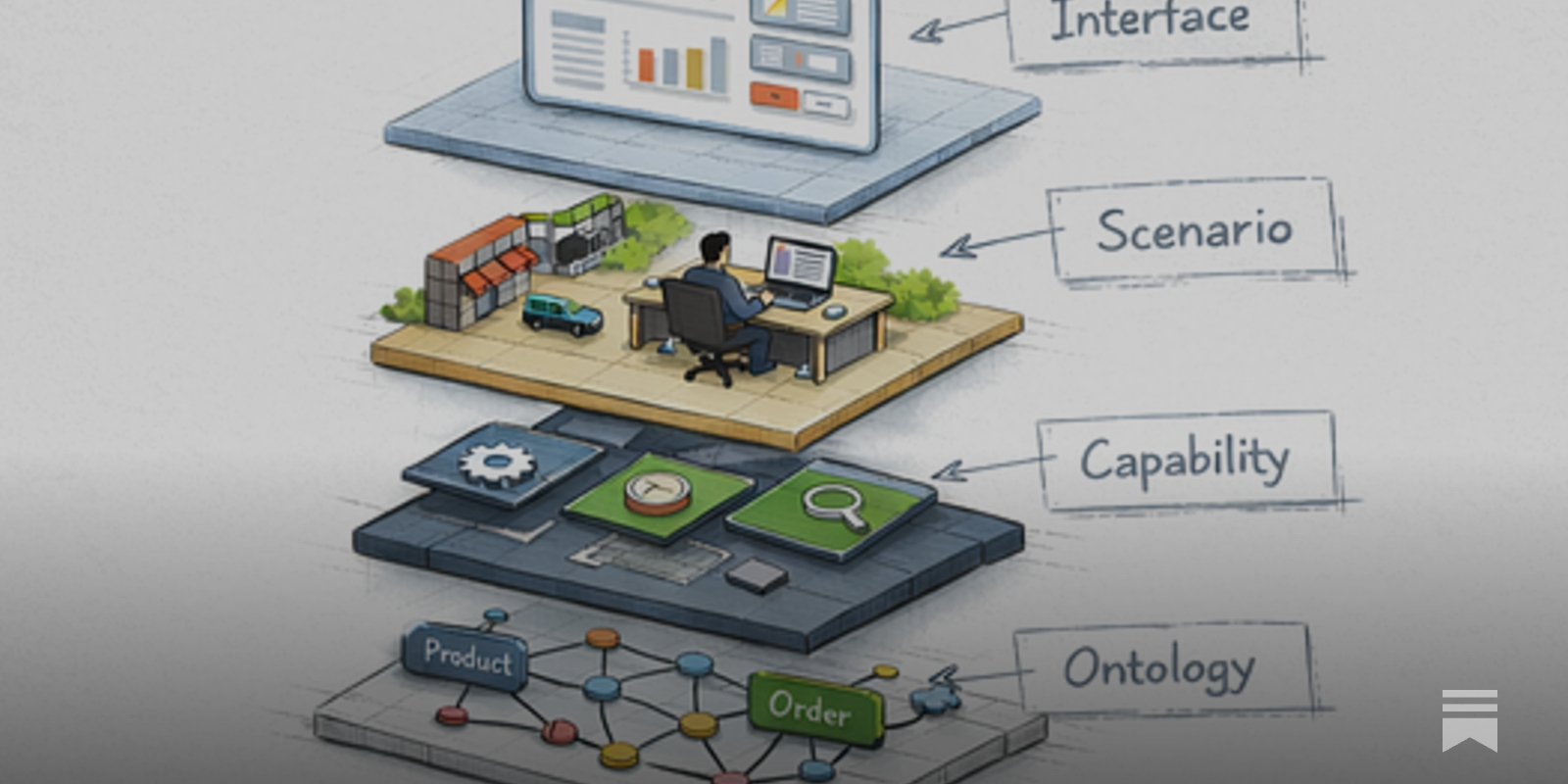
The Ontology Layer of Design
Why words are the most important design tool in the AI era
Introducing Model Council
Today we are launching Model Council, a multi-model research feature that brings several models together for one answer.

Ontologies for AI in practice / part I
Discover how ontologies, knowledge graphs and semantic enrichment improve LLM accuracy, reduce errors and build trust in AI through a real experiment.

Linked Open Vocabularies (LOV)
Your entry point to high quality and reusable Vocabularies to describe Linked Data.

GATlab: Modeling and Programming with Generalized Algebraic Theories
Categories and categorical structures are increasingly recognized as useful abstractions for modeling in science and engineering. To uniformly implement category-theoretic mathematical models in software, we introduce GATlab, a domain-specific language for algebraic specification embedded in a technical programming language. GATlab is based on generalized algebraic theories (GATs), a logical system extending algebraic theories with dependent types so as to encompass category theory. Using GATlab, the programmer can specify generalized algebraic theories and their models, including both free models, based on symbolic expressions, and computational models, defined by arbitrary code in the host language. Moreover, the programmer can define maps between theories and use them to declaratively migrate models of one theory to models of another. In short, GATlab aims to provide a unified environment for both computer algebra and software interface design with generalized algebraic theories. In this paper, we describe the design, implementation, and applications of GATlab.



Conceptual Models: The Hidden Structure Behind Your Next Great Interface
Discover the hidden structure behind every great UI. Master how to use conceptual models to design systems that users instantly understand and grow to trust.
GoodRelations - W3C Wiki
GoodRelations is a lightweight ontology for exchanging e-commerce information, namely data about products, offers, points of sale, prices, terms and conditions, on the Web. It can be used in all RDF syntaxes (like RDF/XML, Turtle, RDFa, JSON-LD, ...), Microdata, and basically any syntax that supports an Entitity-Attribute-Value pattern.
LinkML – Bring structure to your data.
An open framework that simplifies authoring, validating, and sharing data — providing an accessible platform for interdisciplinary collaboration and a reliable way to define and share data semantics.
Alex Russell | Web Components and Model Driven Views | Fronteers 2011
There's a lot of tension between today's markup and the semantics we're trying to express in our apps. HTML5 adds a few new types to help describe common cases, but what about when there's no allegory in markup for what you're building? What we need now is infrastructure, not guilt about being "non-semantic". This talk explores new standards-track work in WebKit that's going to enable say-what-you-mean development in completely new ways.

shaarli/Shaarli
The personal, minimalist, super-fast, database free, bookmarking service - community repo
Metadata Integration: A Systematic Review on Methods, Challenges and Applications Across Multiple Domains
Metadata contributes to ensuring semantic interoperability, data reuse, and efficient information retrieval across heterogeneous systems. However, existing studies present fragmented approaches and lack a consolidated view of the strategies adopted in different domains. This fragmentation creates a gap in understanding the current state of the art and identifying cross-domain trends and challenges. This systematic review aims to address this gap by analyzing metadata integration practices across multiple domains, including Health and Medicine, Smart Cities and IoT, Data Science, Geosciences, Cultural Heritage, Library and Information Science. This review follows the Kitchenham structure, encompassing the planning, execution, and reporting phases. A total of 81 peer-reviewed articles published between 2014 and 2025 were selected from five major databases, based on the defined inclusion and exclusion criteria and a structured quality assessment process. The results reveal a predominance of the use of ontology, followed by metadata-driven language, standards, processes, and common metadata schema with an emerging trend towards automation through the adoption of AI-based approaches. The identified challenges include semantic heterogeneity, lack of standardization, limited automation, and usability issues in the current tools and platforms. We provide a comprehensive synthesis of existing approaches, highlighting domain-specific and cross-domain trends, and identifying research opportunities to advance metadata integration through automation, semantic enrichment, and standardized practices.