

In this article I will discuss a technique to find and extract RSA private keys and certificates which are hidden in large amounts of data, such as memory dumps.
I deleted all my SSH keys
I’ve been using ed25519-sk keys with YubiKeys since practically the moment they were available. But because of some specific use-cases (and because, frankly, YubiKeys are expensive) I’ve had a few traditional on-disk keys hanging around for a while just waiting for me to finally decide to get rid of them.
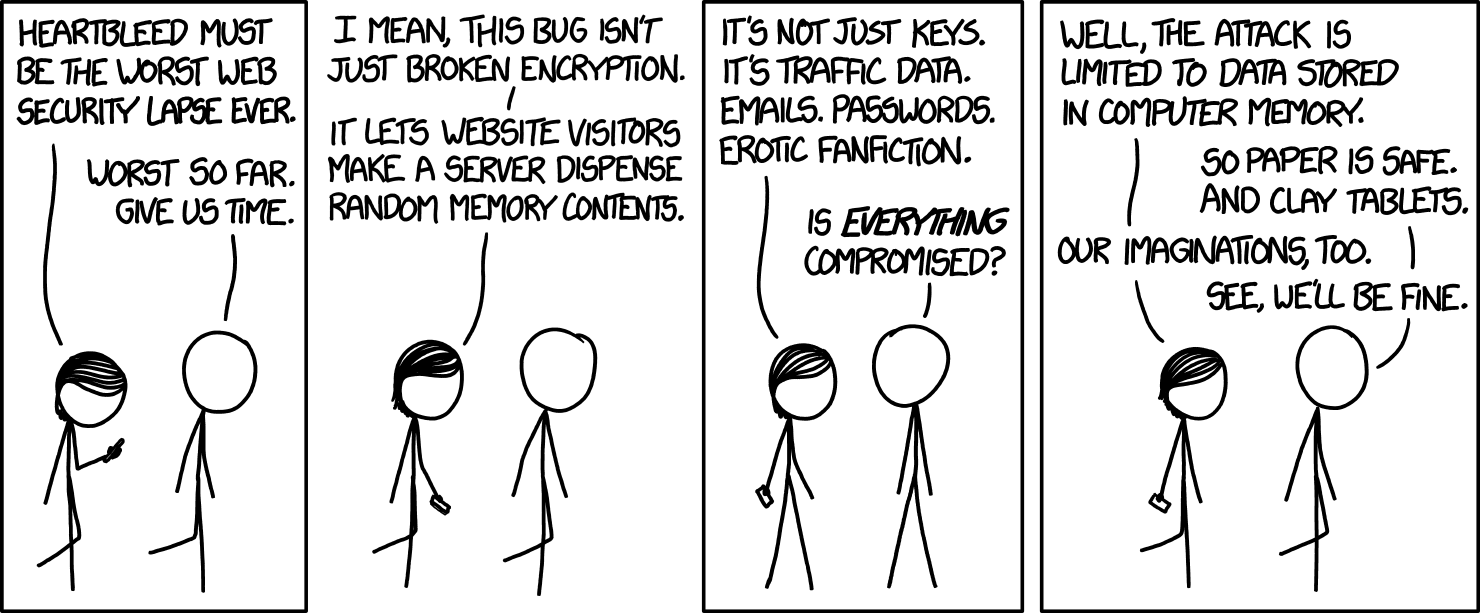
Heartbleed
I looked at some of the data dumps from vulnerable sites, and it was ... bad. I saw emails, passwords, password hints. SSL keys and session cookies. Important servers brimming with visitor IPs. Attack ships on fire off the shoulder of Orion, c-beams glittering in the dark near the Tannhäuser Gate. I should probably patch OpenSSL.
Hacker leaks millions more 23andMe user records on cybercrime forum | TechCrunch
The same hacker who leaked stolen 23andMe user data two weeks ago published new data that appears to have been stolen from the genetic testing service.

Eight Bits of Trust; eMudhra's CA keys cracked in milliseconds
One of eMudhra's certificate authority private keys is the number 4. Not a number that starts with 4, or the number 4 followed by a few hundred random digits, just, 4... Another one is 56, and another is 115. I know, because I recovered all of them from their

Heartbleed - Schneier on Security
Heartbleed is a catastrophic bug in OpenSSL: “The Heartbleed bug allows anyone on the Internet to read the memory of the systems protected by the vulnerable versions of the OpenSSL software. This compromises the secret keys used to identify the service providers and to encrypt the traffic, the names and passwords of the users and the actual content. This allows attackers to eavesdrop communications, steal data directly from the services and users and to impersonate services and users. Basically, an attacker can grab 64K of memory from a server. The attack leaves no trace, and can be done multiple times to grab a different random 64K of memory. This means that anything in memory—SSL private keys, user keys, anything—is vulnerable. And you have to assume that it is all compromised. All of it...
The Duty of a Scholar
There was a joke at the time that although the National Security Agency had opened up in recent years and started taking their defensive role more seriously, the one aspect of cryptography which they would never discuss publicly was side channel attacks — and this itself constituted a side channel, revealing the importance they attributed to the field. Being active in computer security, and recognizing that the NSA knew a few things about the topic, my immediate priority was to determine whether the information leakage I had identified was sufficient to construct a practical cryptographic side channel. By mid-December I had a proof-of-concept exploit which stole enough bits of an RSA private key for the entire key to be reconstructed, and I turned my attention to the hard part of the problem: Quietly notifying security teams and working together to get the issue fixed before disclosing it publicly.
Japan data leaks: Which poses greatest risk, licenses, credit cards or My Number cards?
TOKYO -- Leaks of personal information held by companies and other organizations have surged due to unauthorized access. The compromised data ranges f

@me - explore your atproto identity
visualize your decentralized identity and see what apps have stored data in your Personal Data Server

@me - explore your atproto identity
visualize your decentralized identity and see what apps have stored data in your Personal Data Server
Confidential files on El Salvador human rights stolen after legal action against CIA
US group says computer and hard drive containing survivor testimony about El Salvador civil war was stolen from Washington office

Caesar (@caesar.dev)
Heads up if you have an account on W Social: your private data does not stay inside the W'alled garden.

Reverse-engineering Find My People to stalk ̶m̶y̶ ̶e̶x̶ a friend, cause I can
How I registered a Linux machine with Apple's private services, received an existing Find My People key over IDS, and decrypted the live location without a Mac.
Announcing: keytrace.dev Take your @bsky.app / @atproto.com account and connect it to your other accounts around the internet. Keytrace cryptographically verifies your connected accounts so other social apps can trust the data. Learn more: keytrace.dev/blog/introducing-keytrace

Keytrace - You be you, everywhere.
keytrace.devThis is an absolutely astounding press release from eMudhra. No apology, a suggestion that the researcher who found their private keys must have used AI, and an attempt to shift blame to auditors... wow. emudhra.com/en/press-release/emudhra-stat…

eMudhra Statement on distrust of select Global TLS Intermediate and one Root CA
emudhra.com

