


'Cultural Connectives', a book by Rana Abou Rjeily, bridges the divide between Arabic and Latin-based languages by cleverly comparing their typography.
An interactive introduction to the terrific experience of rendering Arabic typography and its technical debt
This post was discussed in Lobsters and HackerNews

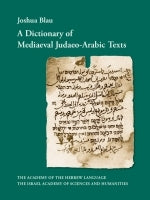
A Dictionary of Mediaeval Judaeo-Arabic Texts
In the Middle Ages, Jews in Arab lands used both Judaeo-Arabic and Hebrew as their literary languages. Mediaeval Judaeo-Arabic texts are written in Middle Arabic, which contains classical and later elements. The latter do not appear in standard dictionaries of Classical Arabic, and it is to these post-classical, neo-Arabic, and pseudo-correct terms and expressions, which to a great extent are identical with Middle Arabic elements found in other Arabic writings of the period, that Joshua Blau’s Dictionary of Mediaeval Judaeo-Arabic Texts is primarily devoted. The Dictionary is based largely on the works of the leading Jewish scholars of the period, including Saadia Gaon, Judah Halevi, and Maimonides, but it also refers to the Responsa literature, legal documents, and personal and commercial letters. This first comprehensive dictionary of Mediaeval Judaeo-Arabic contains about 9,000 entries. The lemmas are presented in both Arabic and Hebrew scripts, and are translated into Hebrew and English. A special section is devoted to lexicographical literature.
Neither Corpus Nor Edition: Building a Pipeline to Make Data Analysis Possible on Medieval Arabic Commentary Traditions
We have built a suite of tools in Python to proficiently analyze text reuse and intertextuality for a specific kind of set of medieval Arabic texts (commentaries) available in print. We take these printed editions, scan them, pre-process the images, give it to an OCR engine, clean the results, and store it in a data structure that mimics the explicit intertextual relation the texts have, and continue to perform data analysis on it. Digital approaches to medieval Arabic texts have either been at the micro-level in what has become known as a ‘digital edition’, i.e. the digital representation of one text, densely annotated, most commonly in TEI-XML, or it has been done at the macro-level in what is called a ‘digital corpus’, consisting of thousands of loosely encoded and sparsely annotated plain text files, accompanied by an entire infrastructure and high-performing software to perform broadly scoped queries. The micro-level generally is at the level of tens of thousands of words while the macro-level can be at the level of over a billion words. The micro-level is explicitly designed to be human readable first, while the macro-level is built to be machine readable first. At the micro-level, every little detail needs to be correct and in order, while at the macro-level a fairly large margin of error is still negligible as a mere rounding error. Amidst these levels we have been seeking a meso-level of digital analysis: neither edition nor corpus, but rather a group of texts at the level of hundreds of thousands to millions of words, with a small but perceptible margin of error, and a light but noticeable level of annotations, principally geared towards machine readability, but with ample opportunity for visual inspection and manual correction. In this paper we explain the rationale for our approach, the technical achievements it has led us to, and the results we so far obtained.

Remote Origins: Translation, Genealogy, and Alterity in Medieval Castile (1252-circa 1390)
This dissertation analyzes selected examples of thirteenth- and fourteenth-century written culture to show their engagement with the religious alterity of Islam as an integral part of the origins of the kingdom of Castile. Following an interdisciplinary methodology, it addresses how medieval ideas about astrology, geography, history, medicine, race, and religion participated in creating discourses about origins that recognized the intellectual and political authority of al-Andalus. It argues that early Castilian vernacular texts conceptualized the translation of Arabic sources as an instrument for creating, transforming, and superseding the alterity of Islam while recognizing the cultural and political authority of Andalusi traditions. The first chapter serves as an introduction explaining the historical and theoretical framework of the dissertation. To do so, it provides an overview of Castilian ideas about genealogy, historiography, authority, and translatio, and translation. Then, through close reading and ample historicization, chapters two, three, and four analyze the impact of Andalusi textual traditions, cultural practices, and human population in three interrelated fields of medieval science, literature, and history. Chapter 2 explores the political implications of King Alfonso X’s (r. 1252-1284) dedication to the translation of Arabic sciences by focusing on the translation of a treatise of astrology titled Libro de las cruzes (1259). The chapter traces the cultural and political context that accompanied the transmission of the book in al-Andalus alongside the content of its Arabic and Castilian prologues. In light of ideas about the transference of knowledge (translatio studii) shared by Christian and Muslim scholars, I conclude that deployment of a twofold origin in the Libro de las cruzes illustrates the strategies and motivations of Alfonso X’s broader engagement with Arabic sources. The third chapter turns to the early fourteenth-century romance Libro del caballero Zifar with a double focus on its forged origin as a translation from caldeo (Chaldean) and the prominence of cursed lineages. Regarding lineage, the chapter explores the representation of exemplary virtues by the protagonists of the romance as enacting ideas about the transformable character of lineage and the capabilities of the individual to unmake inherited negative traits. Likewise, the textual strategy of the forged translation enables the inclusion of Arabic and Asian referents at the origin of a profoundly Christian text. In chapter 4, literature meets historiography in the analysis of the Crónica de Flores y Blancaflor. Being the result of intertwining a Castilian chronicle—Alfonso X’s Estoria de Espanna—and a French romance, this text narrates the love story between an Andalusi Muslim prince and the daughter of a captive Christian noble. The chapter focuses on Berta, the captive woman, to show the implications of her decision to nurture Flores and Blancaflor with her milk. Considering Christian and Muslim ideas about milk and wet nursing along with the tenets of Castilian historiography, the chapter shows the limits of dominant ideas about dynastic origins among the Christian elites of Castile while evidencing the existence of an alternative discourse that—coming from within Castilian historiography—incorporates maternal and non-Christian kinship as an essential part of the origins and possibilities of the kingdom. A short final chapter serves as a conclusion, suggesting paths for expanding the results of this dissertation within and the thirteenth and fourteenth centuries covered by its contents.
A new Arabic grammar of the written language
687 pages 19 cm; "Replaces the sixth edition of Thatcher's Arabic grammar."


Publications | Michael Sells
Lockert Library of Poetry in Translation: Princeton University Press, 2021. A complete bilingual, Arabic-English facing page translation and edition of Ibn `Arabi's Tarjumān al-Ashwāq; with introduction, notes, appendixes on the manuscripts and printed editions consulted in creating the Arabic edited text, full translations of Ibn ʿArabi’s romantic prefaces and apologia, translator’s commentary on each poem, and glossaries on the personal names, place names, core vocabulary, ritual terms, and the history of translations of the Tarjumān.
AI Suggestions Homogenize Writing Toward Western Styles and Diminish Cultural Nuances
As part of the Digital Library's transition to Open Access, new features for researchers are available in the Premium Edition. Click here to learn more.

Road to a book lexicon (Part 1) - Nick The Sick
The article where I don't define a lexicon, and instead, complain about ISBNs
What can intralingual translation do?
Published in Asia Pacific Translation and Intercultural Studies (Vol. 6, No. 1, 2019)
Language: Japanese

Typography
Including fonts, lettering, calligraphy, handwriting, etc.
Language: English
Fonts (by あ) — Semble

Typographers. I really want this to stop. Type scale generators that hand back 3.815rem headings, 1.563rem subheads and a 0.64rem caption…

Why does Chicago use Comic Sans on some elevator inspection certificates?
Fonts In Use
The Typography of whitehouse.gov, 2000–2026

Primarium

ミート・プロキシ

【アフレコ】一気見&おまけ! 沖縄方言 すぎる 白雪姫【総集編 まとめ】 ※子ども向けコンテンツではありません

日本はなぜ「北朝鮮」と呼ぶのか【特派員コラム】
増田はなぜ「はてブ」になったか - Nightflight

京都市左京区の下鴨夜光町。「やこう」の由来を調べたら、室町後期の字名にたどりついた。宝徳3年(1451)の中村郷地からみ帳に「夜ヒカリ」とあり、当時は「よひかり」と読んでいた。賀茂別雷神社(上賀茂)の社領で、社人の往来田が置かれていた。 もとは上賀茂村上賀茂字夜光。昭和6年に町に…

出身地鑑定!! 方言チャート

Zach Weinersmith (@zachweinersmith.bsky.social)

AP Stylebook (@apstylebook.com)
dialect.redlog.net

How Y’all, Youse and You Guys Talk (Published 2024)
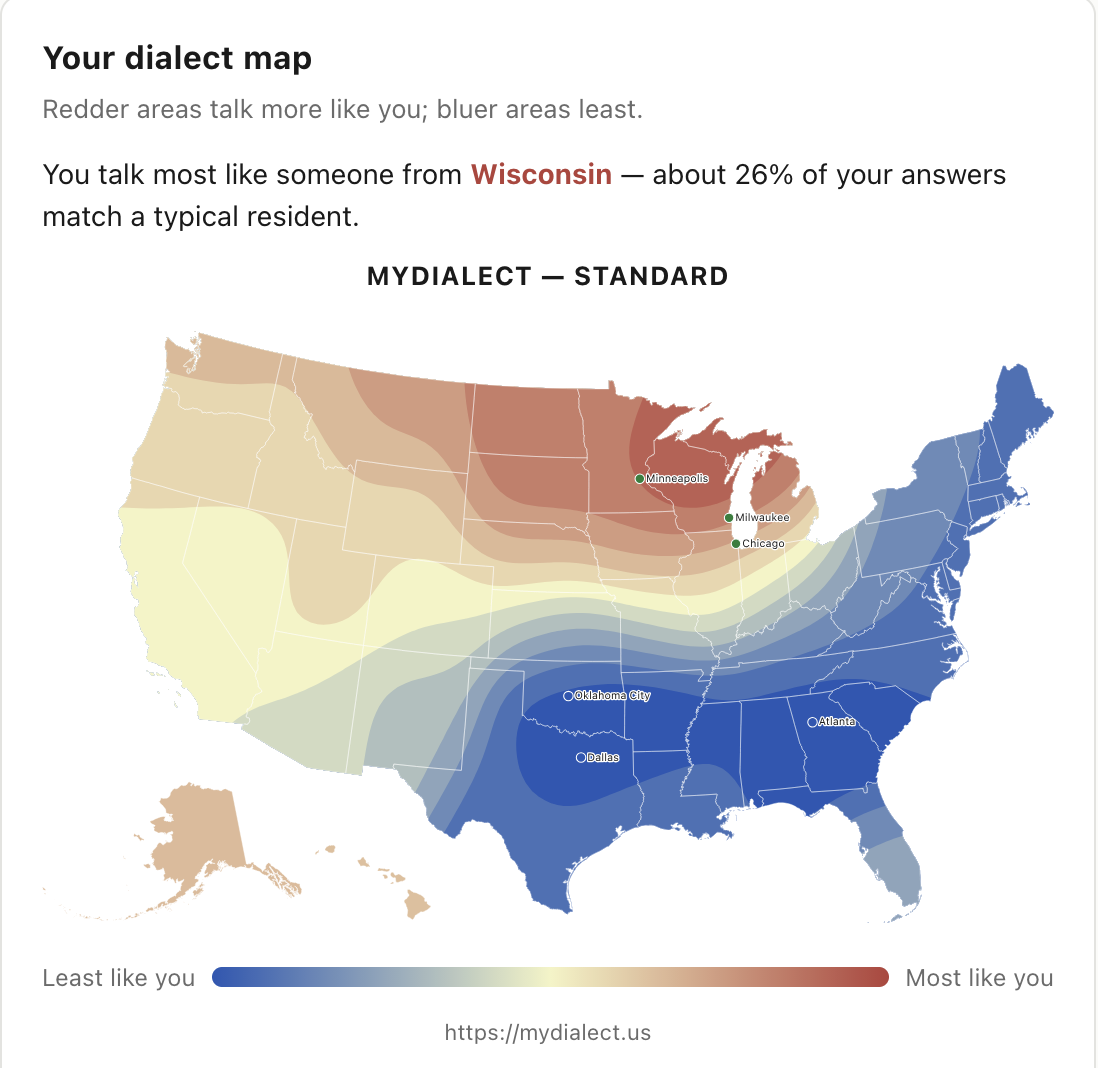
How Do You Talk? — American Accent Quiz & US Dialect Map
Welcome | Yale Grammatical Diversity Project: English in North America