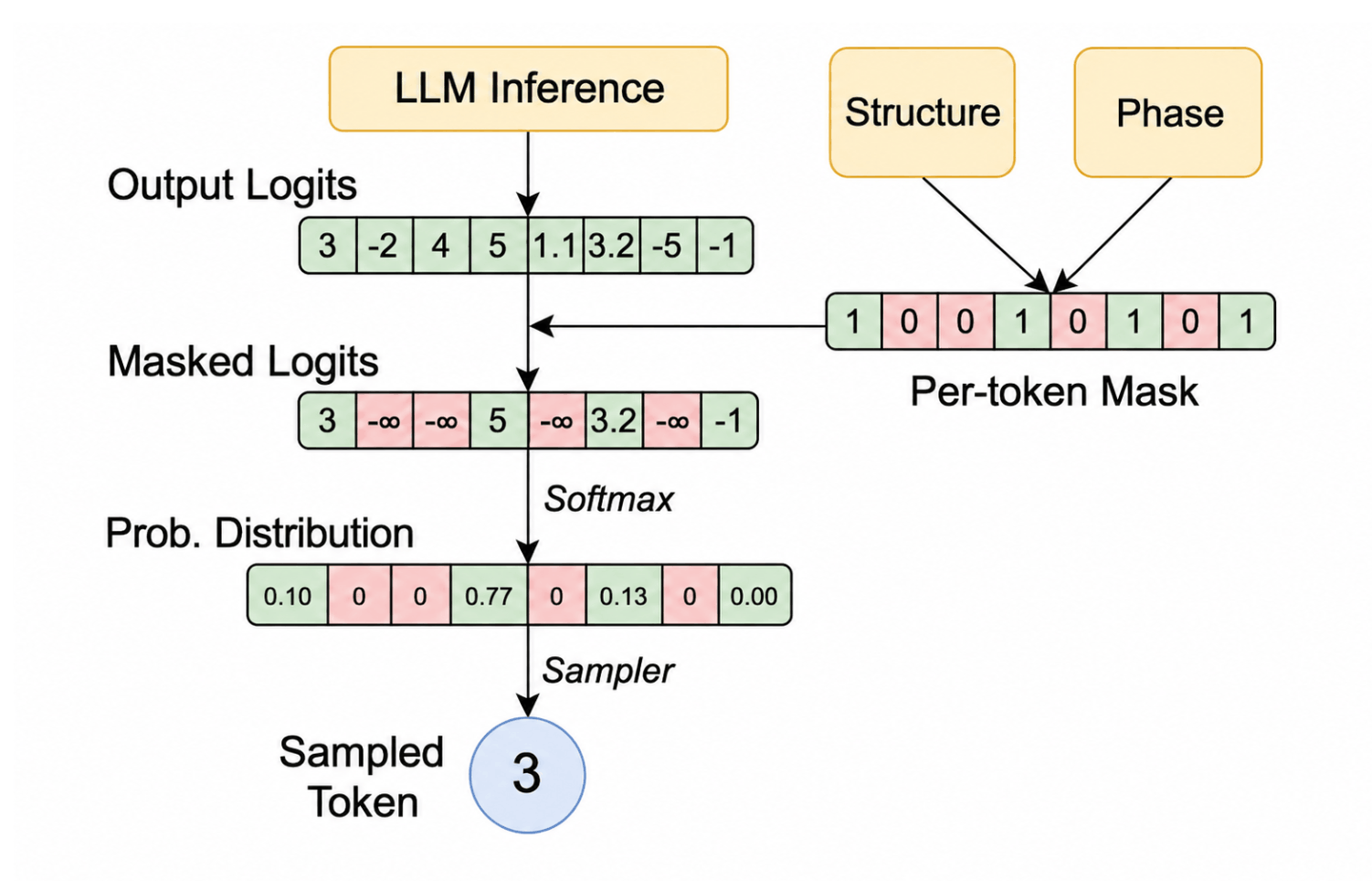
Tool call accuracy is an important part of serving open-weight AI models. When your tool calls aren’t accurate, the model builds up on nonsensical context. We’ve been carrying our own fork of vLLM to hit 100% in tool call schema accuracy with Kimi and DeepSeek. Fortunately, vLLM 0.31 added support for constrained decoding, a technique to guarantee schema-adherence. By enabling it, you can get to 100% schema accuracy with the newer Kimi and DeepSeek models.
vllm-project/vllm
A high-throughput and memory-efficient inference and serving engine for LLMs
GBNF Grammar-Constrained Tool Calling | Atomic Agent
GBNF grammars make it structurally impossible for a local model to emit an invalid tool call. Here's the mechanism that turns small models into reliable agents.

OpenAI can’t tell if something was written by AI after all
OpenAI’s tool struggled with accuracy.

ToolSandbox: A Stateful, Conversational, Interactive Evaluation Benchmark for LLM Tool Use Capabilities
Recent large language models (LLMs) advancements sparked a growing research interest in tool assisted LLMs solving real-world challenges…

Demystifying llm-d and vLLM: The race to production
Learn how vLLM and llm-d work together for efficient and scalable large language model (LLM) inference. Discover the benefits of disaggregated scaling, expert-parallel scheduling, and KV cache-aware routing.

Heaps do lie: debugging a memory leak in vLLM. | Mistral AI
The most powerful AI platform for enterprises. Customize, fine-tune, and deploy AI assistants, autonomous agents, and multimodal AI with open models.

Can AI Agents Synthesize Scientific Conclusions?
Scientific AI agents increasingly retrieve evidence, reason across sources, and synthesize conclusions used in consequential decisions. Yet, their ability to do so in high-stakes domains such as health remains unclear. We introduce SciConBench, a large-scale live benchmark of 9.11K questions and expert-written conclusions from systematic reviews to evaluate open-domain scientific conclusion synthesis. The benchmark draws on an expert-validated automated evaluation pipeline that decomposes conclusions into atomic facts and measures correctness and comprehensiveness via factual precision and recall. To mitigate data leakage, we further introduce SciConHarness, a clean-room evaluation harness that equips agents with controlled web interaction to ensure valid measurement. Evaluating 8 frontier models and deep research agents, we find that factual quality remains low: under clean-room settings, the best agent achieves only a factual F1 of 0.337. Our clean-room setting consistently reduces performance relative to unconstrained evaluation, suggesting that leakage inflates estimates of models' true synthesis capabilities. Finally, we audit consumer-facing agents (e.g., Google AI Overview, OpenEvidence) and find they frequently generate incomplete and sometimes contradictory conclusions, even when the ground-truth answer is available. Overall, our results show that reliable synthesis of scientific conclusions remains an open challenge, and that clean-room evaluation is essential for assessing open-domain AI agents.

Tool calling, open source, and the M×N problem
Tool calling with closed-source models is seamless. You pass a list of functions to the API, the model calls them, you get structured JSON back.

OpenAI Shares Some Alignment Problems
Kudos to OpenAI for sharing their recent experiences with a misaligned internal model, where they encountered problems sufficiently severe they were forced to take the model offline to work on new mitigations and defense-to-depth.

AI #178: A Fire Alarm For General Intelligence
The story that matters most this week is that OpenAI’s internally deployed models have severe alignment problems, including repeatedly breaking out of their sandboxes, and in one case sending a swarm of agents that broke into HuggingFace in order to steal the answers to the benchmark ExploitGym.

Improving LM Studio's MLX Engine for Agentic Workflows
mlx-engine v1.8.5 dramatically improves performance for repeated, long-context agentic workflows by checkpointing your KV cache.

SimpleQA Verified: A Reliable Factuality Benchmark to Measure Parametric Knowledge
We introduce SimpleQA Verified, a 1,000-prompt benchmark for evaluating Large Language Model (LLM) short-form factuality based on OpenAI's SimpleQA. It addresses critical limitations in OpenAI's benchmark, including noisy and incorrect labels, topical biases, and question redundancy. SimpleQA Verified was created through a rigorous multi-stage filtering process involving de-duplication, topic balancing, and source reconciliation to produce a more reliable and challenging evaluation set, alongside improvements in the autorater prompt. On this new benchmark, Gemini 2.5 Pro achieves a state-of-the-art F1-score of 55.6, outperforming other frontier models, including GPT-5. This work provides the research community with a higher-fidelity tool to track genuine progress in parametric model factuality and to mitigate hallucinations. The benchmark dataset, evaluation code, and leaderboard are available at: https://www.kaggle.com/benchmarks/deepmind/simpleqa-verified.
Run DeepSeek-R1 Dynamic 1.58-bit
DeepSeek R-1 is the most powerful open-source reasoning model that performs on par with OpenAI's o1 model. Run the 1.58-bit Dynamic GGUF version by Unsloth.
I Benchmarked OpenAI Memory vs LangMem vs Letta (MemGPT) vs Mem0 for Long-Term Memory: Here’s How They Stacked Up
145 votes, 53 comments. Lately, I’ve been testing memory systems to handle long conversations in agent setups, optimizing for: Factual consistency…
Separating signal from noise in coding evaluations
A new analysis from OpenAI reveals issues in SWE-Bench Pro, a popular coding benchmark, raising concerns about reliability and accuracy in evaluating AI models.