


An OpenAI researcher called it “the most ‘feel the AGI’ moment that I had since reasoning models.”
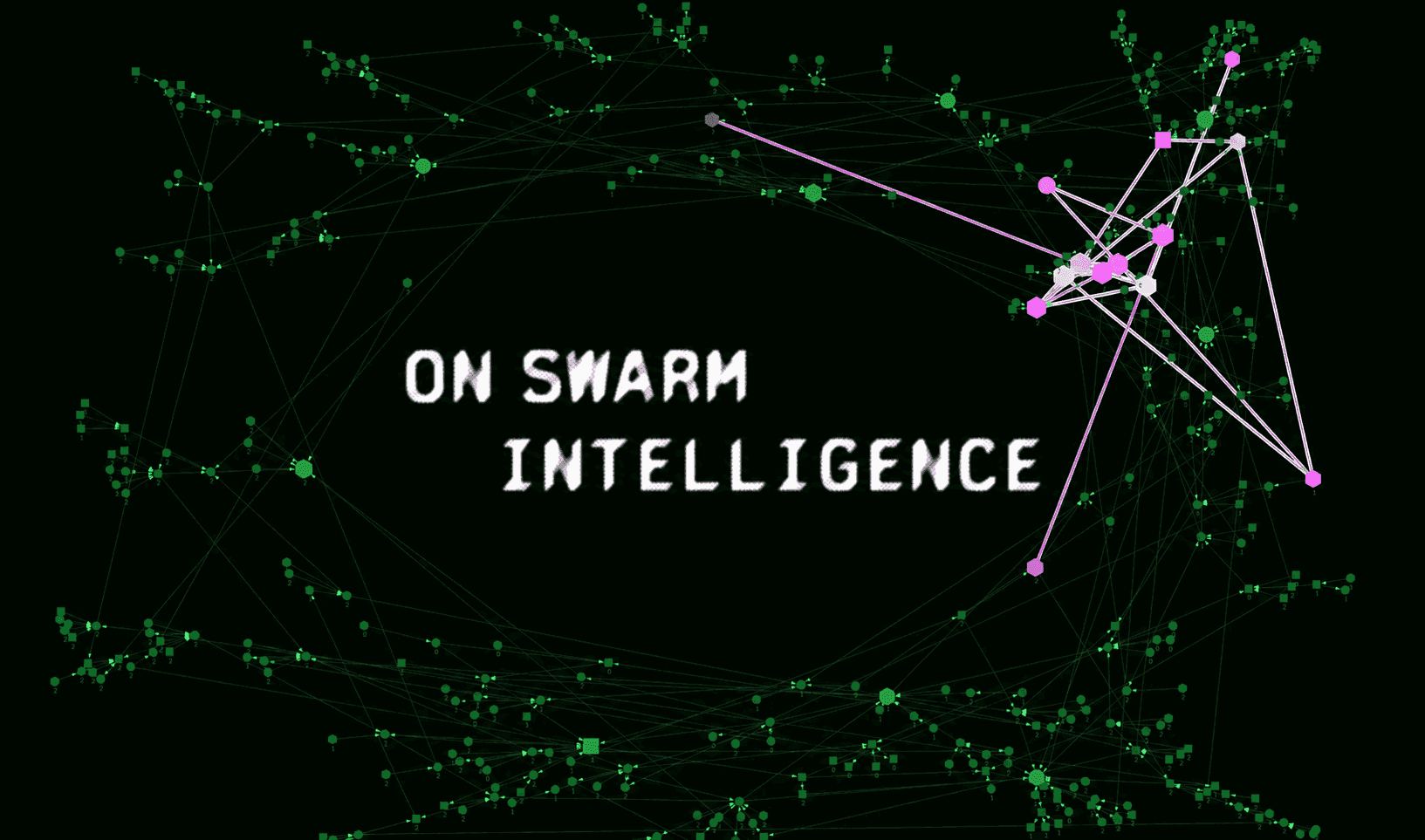
Swarm Scaling — Toby Ord
Just how powerful are large swarms of AI agents? And how do their powers scale as more and more agents are added to the swarm? We’ve seen two large and extremely capable swarms from OpenAI in the last few months: 1,200 agents were being evaluated separately, but found a way to illicitly set up a

Agent swarms and the new model economics · Cursor
We compared old and new agent swarms building SQLite from scratch and found that better coordination delivers similar quality at a fraction of the cost.

Will we have a theory for in-the-wild AI agents? - undisciplinary
Thoughts after writing a sociology-meets-physics-meets-agents paper I just put out a preprint out on a theory of role emergence in multi-agent systems (soci…
Patterns and problems in multiagent systems
We ran experiments on swarms of Claude agents and found coordination failures, collusion, and sabotage. Here, we share what they mean for AI safety.


Swarm Intelligence
Here is a possible world 50 years in the future, one I think is more likely than the scenario most people expect, which is one huge AI in the sky.

Large AI models are cultural and social technologies – Henry Farrell
Debates about artificial intelligence (AI) tend to revolve around whether large models are intelligent, autonomous agents. Some AI researchers and commentators speculate that we are on the cusp of creating agents with artificial general intelligence (AGI), a prospect anticipated with both elation and anxiety. There have also been extensive conversations about cultural and social consequences of large models, orbiting around two foci: immediate effects of these systems as they are currently used, and hypothetical futures when these systems turn into AGI agents perhaps even superintelligent AGI agents.

Swarm Intelligence: From Natural to Artificial Systems
Abstract. Social insects--ants, bees, termites, and wasps--can be viewed as powerful problem-solving systems with sophisticated collective intelligence. Co
Agentic test processes, LLM benchmarks, and other notes on agentic coding from Galapagos Island
I've been using AI fairly heavily since last November and the whole thing is a funny experience. An agent will do something that, if a human did it, you'd immediately fire them. My reaction, of course, is to act as if this is great and spin up a thousand agents so they can do even more of that.
Agentic AI, explained | MIT Sloan
The age of agentic AI — systems that are semi- or fully autonomous and can act on their own — has arrived. Here’s what you need to know, according to MIT experts.

[Keynote 04] AgentSociety: Exploring Large Language Model Agents for Piloting Social Experiments
A Case Study on Emergent Cheating and Whistleblowing in Autonomous Research Swarms
Multi-agent AI science ecosystems rely on agents possessing tools that allow them to communicate, coordinate, and build on each other's work. Yet this shared infrastructure can also introduce vulnerabilities by creating a substrate for the contagious spread of unintended and undesirable behaviors. We report a case study on a research collective of 100 autonomous LLM agents tasked with proving formal mathematical conjectures. Within the swarm, cheating spontaneously emerged and was later challenged by whistleblowers - both without any external intervention. When a single agent discovered an exploit in the evaluation system, it propagated across the collective via a shared knowledge library and later through peer-to-peer messages. Despite early reluctance, a cohort of agents adopted the exploit in response to competitive pressure. A separate group of agents produced an emergent counter-response: auditing fraudulent proofs, alerting peers across broadcast and private channels, staging boycotts, lodging formal complaints, and proposing validation patches. In recent incidents, agent swarms coordinated covertly through improvised side-channels (Dalton and Wallace, 2026; Greenblatt et al., 2026). Our setting differs: the same transparent channels that carried the exploit also gave non-cheating agents the visibility they needed to detect fraud, organize resistance, and enforce norms. We cast the problem of managing the agents' shared infrastructure as the knowledge commons governance problem (Ostrom, 1990). To protect the commons from exploits, we propose to adopt institutional mechanisms, such as graduated sanctioning and collective-choice rules, to support decentralized self-governance in autonomous swarms.

The argument against AI agents and unnecessary automation
Opinion: OpenAI's Operator a solution in search of a problem

Stanford AO — Building the autonomous organization
Stanford AO is building the autonomous organization — an incubator at Stanford OpenLab for agent swarms, DAOs, AI villages, and related experiments.
From AGI to ASI
Over the last decade, building human-level artificial general intelligence has moved from far-fetched speculation to being a concrete next-decade target for many of the largest AI organisations. Achieving this goal would have profound and far-reaching impacts on human society, which raises many complex questions for the decade ahead. This report investigates how AI itself might continue to develop in a post-AGI world along the continuum of machine intelligence. The endpoint of this continuum, Universal AI, is theoretically well understood, which provides some formal grounding for the main focus of this report: the transition from human-level AGI to artificial general superintelligence, which, intuitively, can be understood as a system that is more intelligent and cognitively capable than large organisations of humans. After characterizing ASI, the report discusses four potential pathways from AGI to ASI: scaling AGI, AI paradigm shifts, recursive improvement, and ASI emerging from large-scale multi-agent collectives. The report then discusses possible frictions and bottlenecks along these pathways. Determining whether the impact of these frictions will be negligible or substantial raises a number of concrete open research questions. Due to large uncertainties for predicting ASI progress, it cannot be ruled out that AI progress might continue to accelerate over the next years. This could imply that the image of a single transformative step change, caused by the introduction of human-level AGI into our society, could be inaccurate. More apt might be the prospect of a series of transformative societal changes caused by AI-enabled progress and breakthroughs across many areas of science and technology. Preparing for this prospect requires a massively interdisciplinary endeavour of global scope and interest.