

Universal Scientific Protocols, Inc. — research publishing, reconsidered. A knowledge management platform for machine learning researchers.
System: Formalizing Science: From Open Corpus to Computable System
Open access made much of the scientific record openly available. An enormous opportunity now exists to make it computable and systemic.

Science Communication as a Collective Intelligence Endeavor: A Manifesto and Examples for Implementation
Effective science communication is challenging when scientific messages are informed by a continually updating evidence base and must often compete against misinformation. We argue that we need a new program of science communication as collective intelligence—a collaborative approach, supported by technology. This would have four key advantages over the typical model where scientists communicate as individuals: scientific messages would be informed by (a) a wider base of aggregated knowledge, (b) contributions from a diverse scientific community, (c) participatory input from stakeholders, and (d) better responsiveness to ongoing changes in the state of knowledge.

Introducing the Protocol Institute
Building a field and community to steward the planetary-scale process of protocolization

A privacy-first, open-source knowledge base
A privacy-first, open-source platform for knowledge management and collaboration.

Long Now Lab 001: Protocols for the Long Now
Lab 001.1 is part of the [Protocols for the Long Now](https://longnow.org/labs/001) lab series. Civilizations run on protocols — shared norms for how we keep time, store knowledge, and make decisions together.

Empowering science communities with open, democratic, researcher-owned infrastructure.
We’re building communities and tech for publishing, curating, sharing, and discussing research online using ATProto and other decentralized protocols.
Empowering science communities with open, democratic, researcher-owned infrastructure.
We’re building communities and tech for publishing, curating, sharing, and discussing research online using ATProto and other decentralized protocols.
A Data Utopia for Science-of-Science
Here I want to briefly sketch out a vision for how to solve a key set of problems facing science-of-science researchers, using the relatively new idea of a ‘data trust.’ In my ideal wor…

Managing scientific knowledge for policy on the ATmosphere - Mathew's newsletter
Two types of Atmosphere toolkit are needed if ATScience is to help scientists do science and better communicate it to other audiences: one serving the researchers and their teams, the other focused on aggregation and synthesis.
Four Ps for Building Massive Collective Knowledge Systems
Design principles for collective knowledge systems—permanence, provenance, permission, and placement—that enable robust networks for evidence-based decision making.
Four Ps for Building Massive Collective Knowledge Systems
Design principles for collective knowledge systems—permanence, provenance, permission, and placement—that enable robust networks for evidence-based decision making.
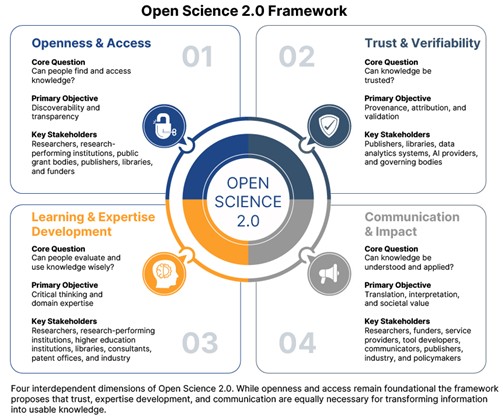
Open Science 2.0: Building Understanding in an AI-Mediated World - The Scholarly Kitchen
Open Science 2.0 must focus not only on access, but also on trust, interpretation, learning, and effective communication. The challenge facing the scholarly publishing ecosystem is ensuring that what is open is also trustworthy, understandable, and genuinely useful.
Coordination Tech in Science: Letters, Journals, and Whatever Comes Next | shishyko!
To modernize our scientific infrastructure, we need new contextualization and coordination technologies that decouple trust from legacy branding — shifting from gatekeeping on write to algorithmic contextualization on read.
Pluralis Research
Protocol Learning — decentralized, communication-efficient model-parallel training for foundation models.
Web publishing is facing its next challenge: a new iteration of centralizing platforms. BUT there is also a new wave of open protocols+standards to gain independence. Next month in NYC let's discuss how we can sail into this next platform shift as captains. #ProtocolsForPublishers pfp.unternet.co
Protocols for Publishers
pfp.unternet.coRDM for ATProto Open Science

Connecting the dots on how to implement FAIR compliant Research Data Management features to the emerging Open Science infrastructure on AT Protocol.
| Eden-Fidelis
About RO-Crate | Research Object Crate (RO-Crate)

Lea: A Social App for Researchers - ATmosphereConf 2026
Chive | Decentralized Eprint Service
What It Means for Universities to Run Their Own PDS: The Potential of DID as Academic Infrastructure - Nightflight
Standard.site - One schema. Every platform.
